






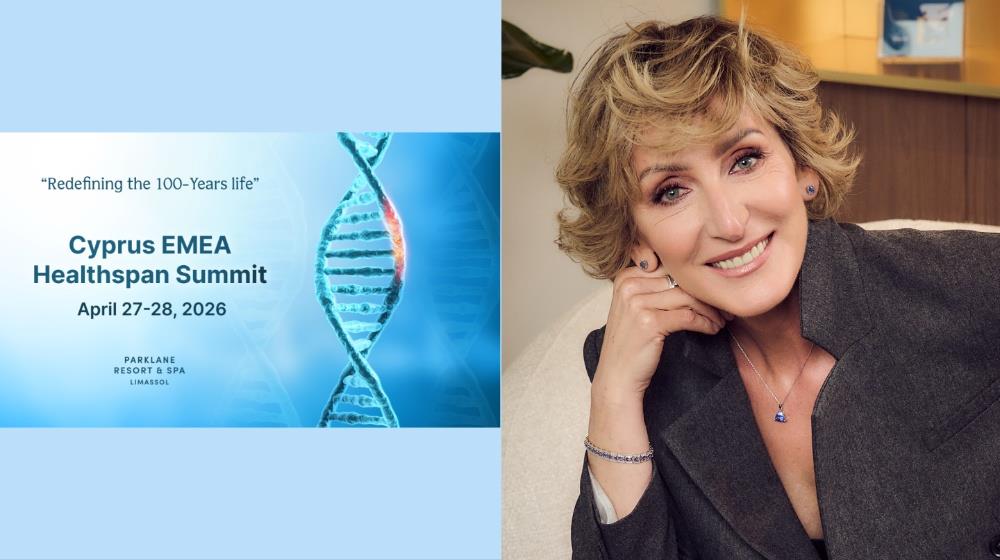
As the global healthcare narrative shifts from reactive treatment to proactive "healthspan" optimisation, Joanna Bensz has emerged as a pivotal architect of the sector. As Founder and CEO of the Longevity Center and Co-Founder of the International Institute of Longevity, Bensz is moving beyond wellness trends to establish a data-driven, scientific ecosystem tailored for the "100-year life."
With the upcoming Cyprus EMEA Healthspan Summit set to position Limassol as a regional hub for biotechnology and preventative medicine this April, the business case for biological age reversal is gaining significant traction among the Mediterranean’s professional elite.
Bensz—who also chairs the Global Roundtable of Longevity Clinics at the Buck Institute (USA)—is instrumental in developing "Golden Best Practices" for the industry. Her work ensures that the future of aging is anchored in standardised medical diagnostics and quantifiable data rather than mere lifestyle marketing.
In this exclusive for CBN, we discuss with Joanna Bensz her leadership in the longevity landscape, the economic potential of high-end health tourism in Cyprus, and why health optimisation is becoming the ultimate performance asset for the modern CEO.
Ms. Bensz, you left a high-level corporate career for the longevity sector. How has that field changed since you started?
The shift has been profound in the last 2-3 years. When I entered this space, longevity was still perceived as a niche, almost experimental area among medical professionals. Today, we have many clinics and centers around the world offering various longevity products and services. The problem today is the lack of standardisation and clear guidelines for medical professionals.
One of the biggest differences was also the huge progress in the use of AI. We now have measurable biomarkers, AI-supported diagnostics, and technology proving that biological aging is not fixed, it is modifiable.
At the same time, demographic and economic pressures, aging populations, rising healthcare costs have made it clear that focusing on healthspan is not optional, but it is essential for our sustainable future.
As the founder and co-chair of the International Institute of Longevity, what is the core mission you are pursuing, and how do you bridge the gap between complex laboratory research and actionable protocols for the public?
Our mission is to create a dialog between some of the leading and experience longevity clinics and to be the voice if this new industry. One of the most important commitments to translate cutting-edge longevity science into standardised, clinically applicable protocols, which can be used by clinics worldwide. The biggest gap in this industry is not innovation; it is implementation and standardisation.
Following our annual summit, we are publishing a white paper summarising our recommendations.
How do you distinguish between the "wellness" market and the data-driven "Longevity Medicine" that your organisation champions?
This is a very good question and you will receive very different answers depending who you ask. In my opinion the difference is fundamental.
- Wellness is largely lifestyle-driven, often subjective, and sometimes based on trends rather the science.
- Longevity Medicine should be data-driven, diagnostic-based, and outcome-oriented.
This shift, from perception to measurement, is what defines the field.
The upcoming Cyprus EMEA Healthspan Summit is a major milestone for the region. Why is Cyprus the right location for this dialogue, and what do you hope is the number one "takeaway" for the business leaders attending?
Cyprus is uniquely positioned as the new longevity destination. It combines:
- Strategic geographic access between Europe, the Middle East, and Africa
- A strong medical and tourism infrastructure
- A lifestyle environment naturally aligned with longevity, living close to nature, stress resilience and healthy lifestyle.
It has the opportunity to define itself early as a regulated hub for longevity medicine and longevity startup accelerator, not just wellness tourism. We do have blue zones and longevity cities around the world, but we do not yet have a longevity special economic zone for business and R&D to encourage more innovation and investment into this area.
From AI in healthcare to financial longevity, the summit covers vast ground. Which of these areas do you believe currently offers the most untapped potential for the EMEA market?
From my perspective, without hesitation: LLMs and agentic AI in healthcare.
We are already seeing a shift where patients arrive not just informed, but algorithmically empowered. They have analysed their blood work in tools like ChatGPT, compared protocols, and are asking highly specific, data-driven questions. This is changing the doctor–patient dynamic completely. The real opportunity is to move from passive care to AI-augmented, continuously learning health systems, where:
- patients are educated and engaged
- clinicians are supported by intelligent agents
- decisions are based on real-time, personalised data
In this model, medicine becomes collaborative, predictive, and far more precise. Those who embrace this shift will lead the next generation of healthcare.
You are instrumental in establishing the "Golden Standards" for longevity clinics. What are the essential criteria, technological, ethical, or diagnostic, that a clinic must meet to be considered world-class?
It is not just about “golden standards”, but about best practices and responsible medicine. This field doesn’t need more “top clinics.” It needs trusted, medically rigorous environments where patient safety and scientific integrity come first. At the core, every serious longevity clinic must deliver:
- Diagnostic depth, understanding the patient at a biological level, not just treating symptoms
- Clinical validation, using protocols grounded in real evidence, not trends
- Ethical responsibility, no overpromising, full transparency, and absolute focus on patient safety
Longevity medicine must be honest, measurable, and accountable. Otherwise, it stops being medicine, and becomes marketing.
How do your Longevity Centers implement these standards to ensure that "biological age reversal" is based on science rather than marketing hype?
At our Longevity Centers, every intervention begins with quantifiable diagnostics and ends with measurable outcomes. We track among others: Biological age markers, Inflammatory and metabolic indicators, Cognitive and physical performance metrics
Medical staff follow protocols which were created in line with our Longevity Center Method. Standardisation and training are one of the key areas of our effectiveness. This removes subjectivity and ensures that “age reversal” is part of our clinical process, not a narrative. This is the reason we have created the Longevity Academy to train our team and not also extend it outside of our company. We are now offering a training for medical professionals on Longevity Clinic Certification based on our experience.
In an era of "one-size-fits-all" health advice, how critical is deep-dive diagnostics (biomarkers, genetics, etc.) to the success of a longevity protocol?
It is absolutely critical. There is no such thing as a universal longevity protocol. Two individuals of the same chronological age can have completely different biological profiles. With deep diagnostics, genetics, blood biomarkers, metabolic profiling, you are operating blindly. Longevity medicine is, by definition, precision medicine based on prevention.
We are seeing a shift from traditional "medical tourism" to "longevity tourism." How do you see the global market evolving for travelers who are looking to invest in their healthspan rather than just a holiday?
I would actually challenge both terms, “medical tourism” and “longevity tourism.” Traditionally, medical tourism was about traveling for treatment, often for better access or lower-cost care. What we are seeing now is fundamentally different. This is not about treatment, and it is not about “biohacking holidays” either. It is about proactive, medically guided health investment. People are traveling with a very clear intention:
- to undergo advanced diagnostics, often not available in their home countries
- to receive integrated medical interpretation, not fragmented opinions
- and to leave with a structured, personalised protocol that combines clinical interventions with lifestyle and wellness strategies
What matters is not the location, it is the quality, depth, and credibility of the medical approach.The most advanced centers are no longer offering isolated tests or experiences.
They are delivering end-to-end health intelligence: pre-arrival data analysis, on-site clinical evaluation, and long-term, data-driven follow-up. This is the evolution, from episodic care to continuous health management across borders. And that is why this market will grow, not as tourism, but as a new category of global healthcare delivery.
Do you believe Cyprus has the infrastructure and natural advantages to become a premier global destination for longevity and preventative health?
Yes, with the right framework. Cyprus already has key advantages:
- Climate and lifestyle conducive to health
- Established tourism sector
- Accessibility for international clients
What is needed now is regulation, standardisation, and positioning as a medically credible destination, not just a wellness retreat. If done correctly, Cyprus could become one of the leading longevity hubs globally.
For the CBN audience: What is the "Return on Investment" for a society or a corporation that prioritises longevity, and how will it change the way we think about the "100-year career"?
The return on investment is not just substantial, it is transformational. For corporations, longevity should be a performance strategy:
- Sustained productivity, high-performing individuals can operate at their peak for longer
- Reduced long-term costs, prevention is significantly more efficient than late-stage treatment
- Leadership continuity, experienced executives remain cognitively and physically capable for decades, not just years
- Talent retention, healthier employees stay engaged, motivated, and valuable for longer
For society, the impact is even broader:
- Lower systemic healthcare burden, shifting from reactive care to prevention reduces pressure on national systems
- Extended economic contribution, people remain active participants in the economy well beyond traditional retirement age
- Reframing aging, from decline to capability and contribution
But the biggest shift is conceptual. We are moving from a linear career model: education, career peak, retirement, to a multi-phase, 100-year career. This means: multiple careers over a lifetime, continuous reinvention, and long-term cognitive and physical performance as core assets. In this model, health is no longer a personal matter. It becomes economic infrastructure. Because without health, there is no performance, and without performance, there is no long-term growth.
If we look five years into the future, what is one longevity breakthrough that is currently "exclusive" that you hope will become a standard part of every person's annual health check-up?
One of the areas I am watching closely is epigenetic reprogramming. Dr David Sinclair started his first human trial this year.
I also hope that biomarkers of aging, like the epigenetic clocks will become a standard practice for preventive health and can be covered by insurance.
As a busy CEO and leader, what is your own non-negotiable daily habit for maintaining your healthspan and high performance?
Consistency. No advanced protocol replaces the fundamentals. My non-negotiables are:
- Sleep optimisation
- Daily movement and strength training
- Daily walks with my dogs.
- Metabolic discipline
- Limiting contact with toxic people in my life
But most importantly: I treat my health as a strategic priority, not a secondary concern. Because in the end, longevity is not about living longer, it is about maintaining the capacity to perform, feel at your best and thrive at any age.
Joanna Bensz will be delivering her keynote address at the Cyprus EMEA Healthspan Summit this April at Parklane, a Luxury Collection Resort & Spa, Limassol. The summit, organised by the St. Moritz Longevity Forum in partnership with the MHV Group, represents a landmark gathering of the region’s scientific and financial elite.
For registration and further information on the summit, visit stmoritzlongevityforum.ch