








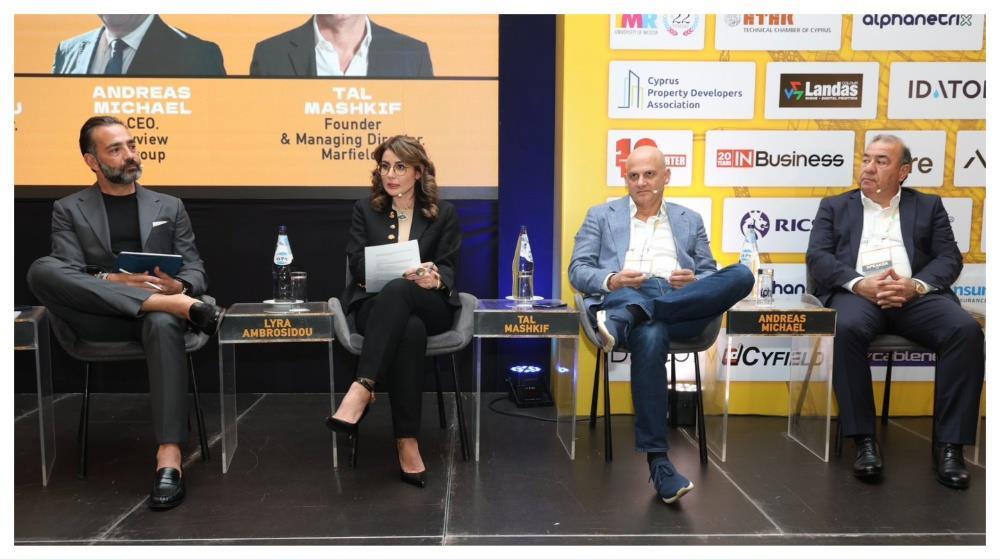
The potential impact that Cyprus' entry into the Schengen Area could have on the real estate and construction sector was examined during a panel discussion entitled 'From Borders to Buildings - How Cyprus's Entry into Schengen will Shape the Real Estate and Construction Landscape,' as part of the recent 20th Real Estate, Property Development & Construction Conference & Exhibition, organised by Altia.
During the discussion, issues were raised regarding the potential increase in international demand for real estate, investment prospects, business and labor mobility, as well as the implications for the design and development of new projects.
The discussion included the participation of the CEO & Co-Founder, Property Gallery, Lyra Ambrosidou, the Founder & Managing Director, Marfields Group, Tal Mashkif, as well as the CEO, Cyview Group, Andreas Michael. The discussion was moderated by the Chairman, Cyprus Property Developers Association & Chairman, Imperio Group, Yiannis Misirlis.
Lyra Ambrosidou described Schengen as a new chapter for Cyprus, which can create significant opportunities for the real estate market if properly managed. As she stated, integration can boost demand, especially from new markets, while at the same time enabling the country to offer more mature and competitive programs to attract investors and residents.
She also stressed that Cyprus has until now been in competition with other European countries, such as Greece, Spain and Portugal, which has affected the dynamics of demand. At the same time, Ambrosidou underlined that permanent residence is a national program and is not affected by Schengen, highlighting the need for a rational approach and avoiding misunderstandings on the issue.
On his part, Tal Mashkif noted that Schengen membership mainly strengthens the image and international positioning of Cyprus, acting as a tool for promoting and enhancing the country's awareness. As he mentioned, it is not enough in itself to radically change the market, but it can contribute to the creation of new demand channels, especially from markets such as India, China and South Africa.
He pointed out, however, that there are also potential risks, as Cyprus is a small market with limited resources. A potential sharp increase in demand could create pressure on land availability and construction capacity, affecting the industry as a whole.
In his intervention, Andreas Michael emphasised that Schengen accession can act as an important tool for strengthening the economy and attracting new population, investments and business activity. At the same time, he stressed that this requires a substantial acceleration of licensing procedures and strengthening of infrastructure.
As Michael explained, the market has a certain capacity to absorb new units annually, which makes proper planning necessary. He pointed out that investors are looking for rapid implementation of projects and that delays in issuing permits and construction can lead to negative impacts, even in the event of Schengen accession.
The discussion demonstrated that, although Cyprus's accession to the Schengen Area creates significant prospects for the real estate market and the construction sector, their exploitation depends largely on the management of infrastructure, the functioning of institutions and the country's ability to respond to new demand.
(Source: InBusinessNews)
