





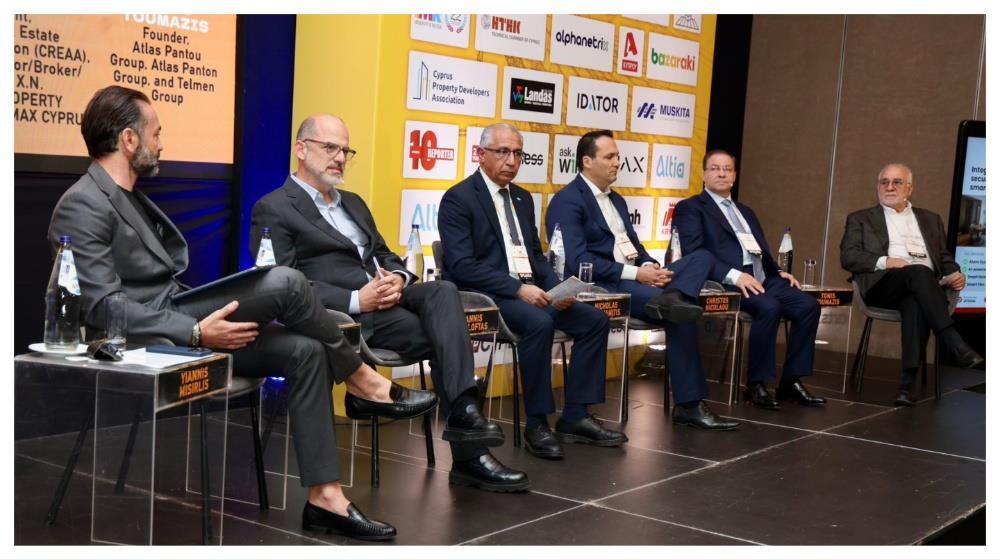
The developments that are expected to shape the real estate market in Limassol in the coming years were highlighted by a panel discussion entitled 'Limassol Real Estate – The Next 10 Years,' as part of the recent 20th Real Estate, Property Development & Construction Conference & Exhibition, organised by Altia.
The discussion included the participation of the Mayor of Limassol, Yiannis Armeftis, the Chairman, Limassol District Local Government Organisation, Yiannis Tsouloftas, the President, Cyprus Real Estate Agents Association (CREAA), Regional Director/Broker/Owner of X.N. UNITED PROPERTY BROKERS – RE/MAX CYPRUS, Christos Nikolaou, the Founder, Atlas Pantou Group, Atlas Panton Group, and Telmen Group, Tonis Toumazis, as well as Nicholas Ayiomamitis, CEO, Imperio.
The discussion was moderated by Yiannis Misirlis, Chairman, Cyprus Property Developers Association & Chairman, Imperio Group.
Mayor of Limassol: A green and sustainable city
Yiannis Armeftis stressed that Limassol must become “a green, clean city, with fewer traffic problems, that can promote innovation and sustainable urban mobility.” According to the Mayor, development should be measured not only by sales numbers or criteria, but by how it is translated into the daily lives of citizens.
He also mentioned that the transition towards a sustainable city translates into a reduction in pollutants of up to 70% in the next five years and underlined the need for "collaboration with common goals between the public and private sectors, to be able to solve issues such as traffic, parking and the use of public transport."
The Mayor further pointed out that Limassol must preserve its cultural identity, address the impacts of climate change and ensure that citizens can live in a friendly and modern city.
Limassol District Local Government Organisation: Development and infrastructure
Yiannis Tsouloftas noted that the city is growing at a rate of twice the number of building permits issued compared to a few years ago. As he stated, this increase is still not sufficient to meet the needs of the economy, while traffic and housing demand remain critical issues.
He underlined the need to accelerate licensing and simplify the legal framework, emphasising that bureaucracy and slow justice remain significant challenges for the market and for the city's development at an international level.
Christos Nikolaou: Prospects and investment interest
Christos Nikolaou noted that Limassol enjoyed significant investment interest, but needs better coordination of infrastructure and licensing. He stressed that attracting foreign investors depends on the city's ability to combine real estate development with sustainable urban development and quality of life.
He also mentioned that the market faces cost and process problems, and that it is important to create flexible and modern processes so that investments can proceed quickly and safely.
Tonis Toumazis: Cost and quality of construction
Tonis Toumazis stressed that the most important factors affecting costs are land prices, insecurity in the area and the increase in the cost of construction materials. He also referred to the improvement of property specifications, such as energy efficiency and underfloor heating systems, which increase costs but improve the quality and sustainability of projects.
Nicholas Ayiomamitis: Market and extroversion
The CEO of Imperio noted that the real estate market in Limassol is affected by inflation, geopolitical developments and demand from foreign investors. He stressed that the right balance between supply and demand is crucial, while Limassol has the potential to emerge as an international business centre, provided that infrastructure and support processes are modernised.
The future of Limassol
The participants agreed that Limassol has the potential to develop into a sustainable, competitive and innovative urban centre. Development should focus on affordable housing, quality of life, technology, protection of cultural heritage and the extroversion of companies.
As the Mayor and the other participants emphasised, development must be measured based on "the daily lives of citizens, the quality of infrastructure and the utilsation of investments for the upgrading of the city," so that Limassol remains a sustainable and attractive city for residents and investors for the next ten years.
(Source: InBusinessNews)