






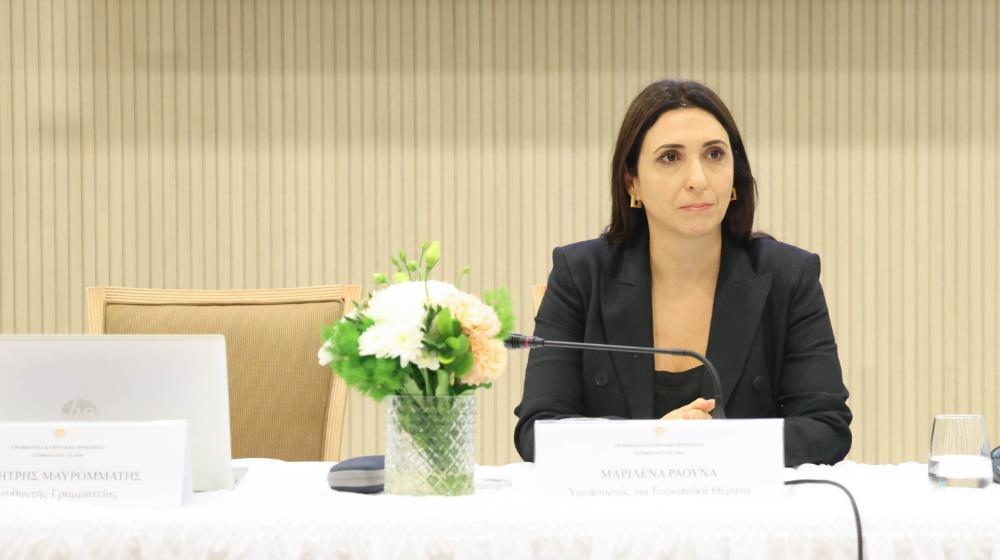
If we want an ambitious budget, then we need to find the means to finance it, Deputy Minister for European Affairs Marilena Raouna told the General Affairs Council.
Raouna chaired the Council on 17 March, which prepared the conclusions, while the main focus of Council of EU Ministers was the EU’s next Multiannual Financial Framework (MFF), with the Cyprus Presidency aiming to accelerate negotiations.
Regarding preparations for the European Council, Raouna noted that leaders will discuss competitiveness, deepening the single market and the next MFF, with particular emphasis also on international developments. “Given the current geopolitical context, leaders will discuss the situation in Ukraine and the Middle East, as well as their implications for the EU,” the Deputy Minister underlined.
“At the same time, given the current geopolitical context, leaders will examine the situation in Ukraine and the Middle East and discuss the way forward. It is important to reaffirm the European Union’s full support to Ukraine, which remains a top priority,” she added
Support for Kyiv and Chisinau
On enlargement, Raouna reiterated support for Kyiv and Chisinau. “The message is clear: Ukraine and Moldova are progressing decisively on their European path, and their future lies within the European Union, despite very challenging circumstances.”
At the core of the discussions was the architecture of the next MFF, with talks now shifting to the political level. Raouna stressed the Presidency’s intention to move forward swiftly, describing “a timely and substantive discussion on the next long-term budget, particularly on its governance. "Our ambition remains to deliver a mature negotiating framework with figures and to move forward with partial general approaches for the main financing instruments,” Raouna said.
On the state of play, she added that the Ministers “have now shifted the discussion to the political level. Today’s exchange of views was open, transparent and very productive, and we will incorporate member states’ positions into the next stage of our work.”
Facilitating dialogue between the Council and Parliament
The presence of the MFF co-rapporteurs and Members of the European Parliament in the Council discussion was also highlighted, underlining the strong interinstitutional dimension of the negotiations. Raouna described the exchange with MEPs as important, while European Commissioner for Budget, Piotr Serafin stressed that his role is to facilitate dialogue between the Council and Parliament, as both institutions are co-legislators in the EU budget process. It was also made clear that proposed changes to the governance of the MFF will not alter the institutional balance, with the European Parliament maintaining its full role in setting priorities and in the annual budget procedure.
On his side, Serafin stressed the need to adapt the EU budget to new realities. “We all know the ambition, that we would like to conclude these negotiations by the end of the year. And this is precisely the moment to discuss governance — who should decide how European Union money is spent," while he clarified that “we are not going to change, through the MFF, the rules of the Treaties or the institutional balance between the Council and the European Parliament. This was the most important message to convey.”
Explaining the need for a shift in approach, he noted that as the current procedure stands, “today, we decide on the budget for seven years, with more than 90% of spending predetermined. In the world we live in, this should no longer be the case. We need more flexibility to decide where and how EU money is spent, depending on priorities and changing circumstances.” Serafin also added that “with more flexibility, we create more space for political decisions on an annual basis. Instead of a budget of constraints, we create a budget of choices.”
EU revenues
On EU revenues, he acknowledged the complexity. “The EU budget is about both expenditure and revenues. The debate on expenditure is often easier, but we need a balanced approach. We have put forward a package of own resources, there is no perfect candidate, each has its weaknesses. That is why we need to look at the whole package.” However, Serafin still expressed cautious optimism. “We cannot afford a non-ambitious EU budget, especially in light of the challenges on competitiveness, security and defence.”
Raouna stressed that “if we want an ambitious budget, then we need to find the means to finance it. Changes to the own resources system are difficult and politically sensitive, but we are living in extraordinary times and this discussion is necessary.”
Despite the challenges, the tone of the discussions was described as positive. Serafin noted that “the debate was not only open, but also very constructive. The atmosphere was actually surprisingly positive, given the complexity of the issue," adding with caution that he has “no doubts that the Cyprus Presidency will do everything it can to advance the negotiations, but reaching an agreement requires effort from all sides.”
Talks on the MFF will continue in upcoming General Affairs Councils, as well as at the informal meeting in Cyprus in May, with leaders expected to provide further guidance at the European Council.
As Raouna concluded, “our goal is to present, by the end of the presidency, a mature negotiating framework with figures,” stressing that in a period of multiple crises, “the challenges require a more autonomous but also open Europe.”
(Source: CNA)
