







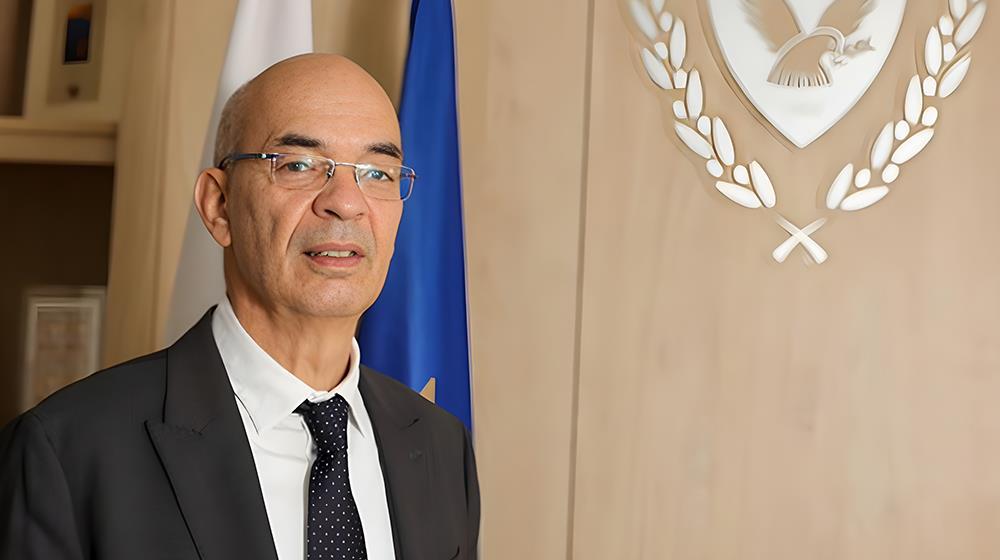
The Cyprus EU Presidency has set sustainability, protection of biodiversity, resilience and competitiveness as its key priorities, Minister of Transport, Communications and Works, Alexis Vafeades said, following the Environment Council held in Brussels.
During a press conference following the conclusion of the 17 March meeting, held in Brussels under Cyprus’ EU Presidency, Vafeades said that it was a very productive Environment Council, stressing that the Presidency has set sustainability, protection of biodiversity, resilience and competitiveness as its key priorities.
He emphasised that strengthening the European Union’s response to the impacts of climate change and the growing environmental challenges is more important than ever. He added that Europe is committed to leading the transition towards a cleaner, greener and fairer future.
The Minister noted that the proposal to amend carbon dioxide emission standards for cars and vans constitutes a key pathway for the future of Europe’s automotive sector and for ensuring a stable investment framework. The proposal was submitted at a critical time, he said, as the industry is facing increasing challenges in terms of global competitiveness. The aim, he said, is to strengthen industrial competitiveness, fulfil the EU’s climate ambitions and keep Europe on track towards zero-emission mobility, while supporting innovation and protecting European jobs. Vafeades pointed out that Tuesday’s discussion provided the Presidency with valuable guidance for advancing this work, ensuring that Europe remains a global leader in climate action, with the objective of achieving a fair and inclusive transition. “The aim of this legislative proposal is to make as much progress as possible by the end of the Cyprus Presidency,” he added.
He also noted that the EU’s climate target for 2040 has now been set and attention is focused on defining the policy framework required to achieve it. In this context, the Minister stressed that the first ministerial exchange under the Cyprus Presidency took place, contributing “decisively” to the shaping of a coherent, predictable and effective framework for the next phase of Europe’s decarbonisation, with further sectoral discussions scheduled for June at the Transport and Energy Council.
Vafeades said that there was a strong commitment among ministers to balance environmental ambition with economic and geopolitical realities, leading to a policy framework that is fair, socially responsible and supportive of European competitiveness. He underlined that the EU legislative framework constitutes the foundation for the EU’s leadership in global climate action, demonstrating to international partners that the Union leads by example.
The Minister also stated that, within the framework of the Council, there was an exchange of views on the lessons learned from COP30, on strengthening outreach to third countries and on developing a multi-year strategy for COP31. He explained that the strategy aims to define the EU’s objectives and “red lines”, while also strengthening its negotiating leverage. “There was strong agreement on safeguarding multilateral processes and addressing gaps in global ambition,” he added. He further noted that there was also an exchange of views on global environmental diplomacy, discussing the EU’s position in ongoing international negotiations, such as those on a legally binding international instrument to combat plastic pollution.
Vafeades also said that the ministers approved the Council conclusions on the EU bioeconomy strategy, which aims to promote innovation, green jobs and economic growth, ensuring that the bioeconomy remains competitive, resilient and inclusive.
He emphasised that the Cyprus Presidency is determined to ensure that Europe leads in climate and environmental action, keeping people, communities and industries at the centre of the transition, advancing the green transition, strengthening international climate and environmental diplomacy and delivering tangible benefits for citizens and the planet.
(Source: CNA)
