








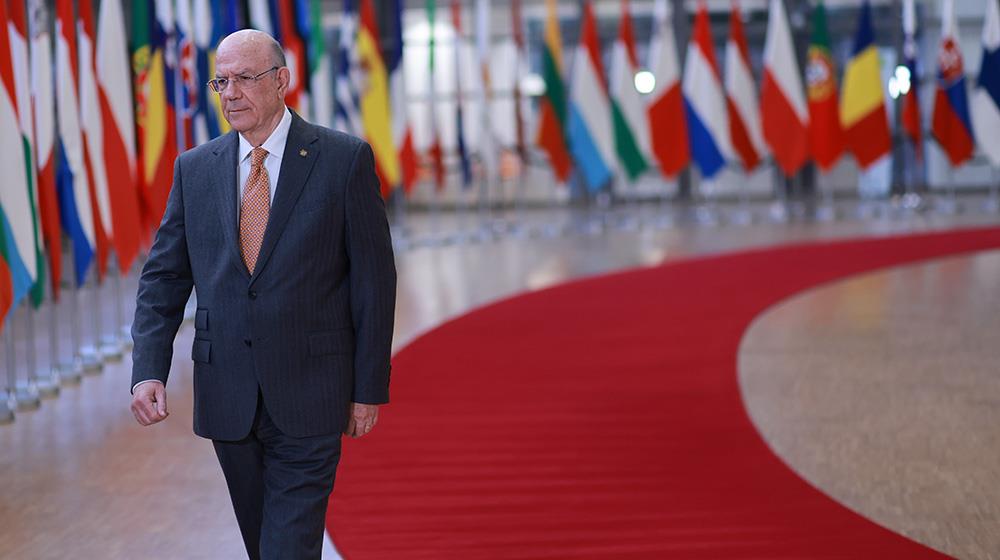
AI should be accompanied by appropriate investment in skills, education and reskilling, Minister of Finance Makis Keravnos has said while who chairing a macroeconomic dialogue meeting with social partners in Brussels.
The Council Presidency, the European Central Bank, the European Commission and the President of the Eurogroup met with European social partners on Monday, 9 March, to discuss recent developments of the economic situation, as well as a thematic topic chosen by the Cyprus Presidency: 'Artificial Intelligence and the Future of the EU labour market: Safeguarding EU Competitiveness and Social Cohesion'.
In a statement, Keravnos said that ongoing geopolitical tensions "continue to test our resilience. Although the economic outlook has been improving, clouds are still looming, forcing us to remain cautious.”
Regarding the discussion on Artificial Intelligence and the future of work in the EU, he said that Artificial intelligence has the potential to strengthen productivity and competitiveness. At the same time, it poses challenges both in the labour market and the cohesion of our societies. To this end, it is well understood that uptake of AI should also be accompanied by appropriate investment in skills, education and reskilling."
The Minister of Finance also added that close cooperation between governments, institutions and social partners will be essential to ensure that the digital transformation supports both economic growth and social cohesion.
Commissioner for Economy and Productivity, Valdis Dombrovskis, said that artificial intelligence can help boost productivity and improve working conditions. “That is why the EU is supporting its uptake in an inclusive and responsible manner through a broad set of initiatives, including the targeted changes recently proposed by the Commission in the Digital Omnibus,” he noted.
Eurogroup President, Kyriakos Pierrakakis, pointed out that artificial intelligence is changing the foundations of society. “This is a reality we must accept and an opportunity we should seize. At a time when Europe is facing structural demographic challenges and slower potential growth, AI can provide a much-needed boost to the productivity of the European economy," he pointed out.
He added that to realise the potential of AI, EU must leverage its comparative advantage: its highly skilled workforce. "It is therefore essential to invest in lifelong learning, upskilling and reskilling," he said, adding that Europe must remain focused on its long-term growth strategy, with Artificial Intelligence able to act as a lever to improve competitiveness.
The General Secretary of the European Trade Union Confederation (ETUC), Esther Lynch, said that “technology does not fire workers – employers do." She added that AI must be integrated into the workplace in a negotiated way, with better wages, strong worker protections and quality jobs so that workers get their fair share, and with the human-in-control principle.
For his part, the Director General of BusinessEurope, Markus Beyrer, said that artificial intelligence has the potential to strengthen productivity as well as support the development of quality jobs only if the EU creates the necessary breathing room for European companies to invest and innovate in a responsible manner.
(Source: CNA)
