







The conversation around artificial intelligence is shifting from capabilities to responsibility. As AI becomes increasingly integrated into critical areas of everyday life, the real question is not just what it can do, but how it is used, by whom, and with what impact on society. In this context, the need for guidelines, specialised applications, and a meaningful understanding of the tools becomes more urgent than ever.
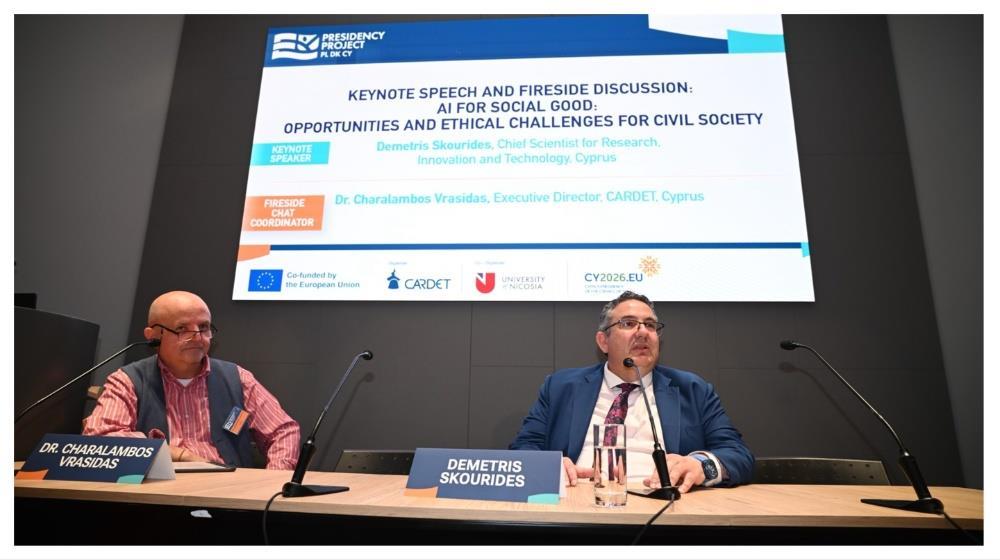
The contribution of artificial intelligence to social good, as well as the limits that should be set on its use, were the focus of a keynote speech and fireside discussion at the Euro-Mediterranean CSO Conference, with the Chief Scientist of the Republic of Cyprus, Demetris Skourides, taking part in an interesting discussion.
For the Chief Scientist, a clear goal is to formulate strategies that can be implemented in practice and create sustainable change, through collaboration with civil society and the stakeholders involved.
At the same time, he states that “everyone has a definition of what innovation is, but there is a common challenge for all citizens,” explaining that working hours remain the same, while the need for greater productivity increases. As he noted, the goal is “to have a strategy that can be implemented and create sustainable change for Cyprus”, through collaboration with the community and stakeholders.
Responding to a question about the use of AI tools in everyday life, he emphasised that “if we really want to use AI tools that will help doctors, the justice system or combat cybercrime, we need more specialised models that are trained in these practices.” At the same time, he warned that “the lack of knowledge in the use of these tools can be worse,” emphasising their proper understanding and utilisation.
Asked about the fact that the development of AI models is concentrated in large organisations, he explained that “training a model requires a lot of energy and has a big impact on the planet,” clarifying that on a global level “as humanity, we cannot build a model in every country.” As he added, the existence of basic models from large players can work positively, while the critical element is “to create the right guidelines so that the models we use have the social impact we want.”
The discussion was moderated by Dr. Charalambos Vrasidas, Executive Director, CARDET, Cyprus.
(Source: InBusinessNews)