






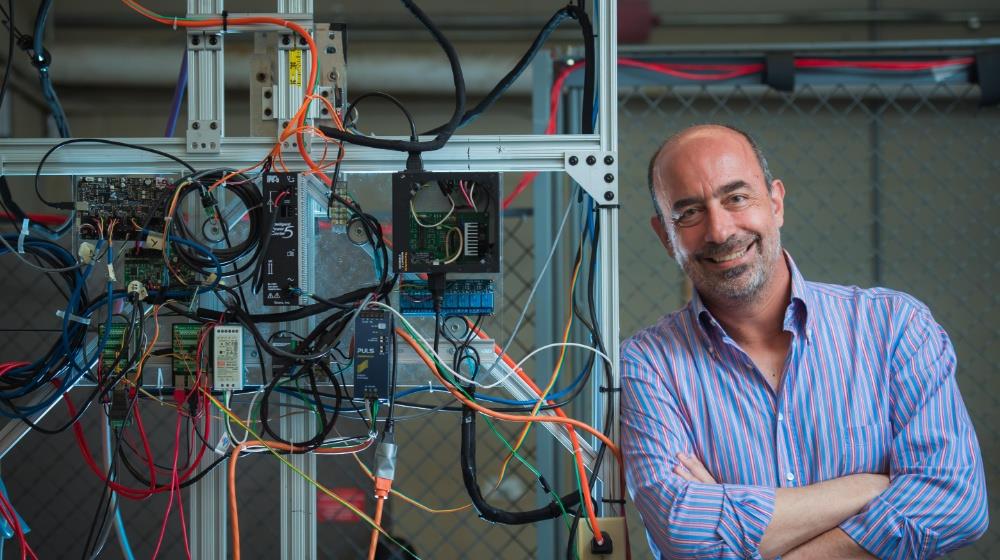
George Lordos, Ph.D, is a Research Scientist and Lecturer at MIT System Design and Management and the Department of Aeronautics and Astronautics.
He teaches space systems engineering and specialises in the design of robust, scalable planetary surface system architectures, including large permanent settlements for Mars. Here, he talks about his vision of humans living on the red planet, orbital mechanics, the economics of space and more.
On July 20, 1969, the world held its breath as the lunar module ‘Eagle’ touched down on the surface of the Moon. When, some six hours later, Neil Armstrong took his “one small step for a man, one giant leap for mankind," the question on everyone’s mind was whether Armstrong, Buzz Aldrin and Michael Collins would make it back to Earth alive. History would later reveal that President Richard Nixon had prepared two speeches – one to celebrate humanity’s triumph; the other to mourn brave men lost in space.
Risk and wonder, ambition and fragility have always defined space exploration and it is within those tense dualities that George Lordos lives and works. He is not the cold, detached scientist of popular imagination – he combines analytical precision with deep empathy; engineering discipline with philosophy, and ambition with an unshakable belief in human happiness. The boy who once gazed at the stars in the Cypriot night sky and, in 1986 waited eagerly for a glimpse of Halley’s comet, would later study Philosophy, Politics and Economics at Oxford, before earning an MBA from the MIT Sloan School of Management. For 16 years, Lordos worked as a strategic management consultant and then as a company director. It was a successful life by any conventional measure – yet something remained unresolved.
In 2014, his universe shifted.
When SpaceX began experimenting with reusable rockets, Lordos recognised the magnitude of what was unfolding. It felt like a modern-day equivalent to the invention of ocean-going ships or continent-crossing railways. “I knew that we would have this incredible expansion of activity in space, which would eventually lead to living on the Moon or Mars,” he says.
“I didn't want to watch from the sidelines; since childhood, I had been dreaming about this.”
Realising that, as an economist, he wouldn’t be able to play an active role in what was happening, he decided to become an aerospace engineer – at the age of 48 – and enrolled on a PhD course in Aerospace Engineering at MIT’s Department of Aeronautics and Astronautics, focusing on technologies that would enable humans to live on Mars. He also founded the MIT Space Resources Workshop, dedicated to the study of using the resources found on the Moon and Mars to make exploration safer and more sustainable.
In Lordos’ Mars architecture concept – Pale Red Dot – machine shops and workshops roughly occupy 1,000 sq.m. With a crew of 36, spread across two villages, inhabitants would have the capacity to repair, design and adapt. “That creates resilience. There is also a layer of psychological resilience – we know that our lives are in our hands, so we have everything we need to address anything that comes our way,” he explains.
When I ask what lessons from Earth might guide this process, particularly in terms of circular economies, his response is immediate. “On the Moon or Mars, waste is not merely an environmental issue – it is an existential one. Every waste stream must become the input for another process.” His latest CERBERUZ project, led by his students and developed for NASA’s LunaRecycle Centennial Challenge, explores how waste packaging materials – traditionally difficult to reuse – can be ground down and combined with lunar regolith to create strong construction materials. Designing space settlements offers a rare opportunity: waste streams can be anticipated, eliminated, reimagined. “We're designing communities from scratch and we are motivated by the economics of space – every kilogram we take to the Moon or Mars is extremely expensive.
To send one kilogram to Mars, roughly ten kilograms must first be launched into Earth orbit – that’s how orbital mechanics work,” he tells me, before elaborating: “Astrobotic quotes approximately $1.2 million per kilo delivered to the Moon while SpaceX estimates around $100 million per ton, so it is wise to design systems that can make use of what we find – the ice that is in permanently shadowed craters and the metals and silicon in the lunar “regolith” (i.e. soil). Then you need machines to convert those resources into useful commodities and a balance must be found between equipment and crew: the machines will look after the people and the people will look after the machines”.
But that’s not enough. For the architecture to be truly self-sustaining, he says, “You need to design for happiness as well. You need to be designing a community. It's not just aerospace engineering. It’s everything.”
Mars is hostile in quiet and absolute ways. The atmosphere is 95% CO2 and, without protection, survival is impossible. “We should be designing our cities so that people don’t have to spend their lives climbing in and out of spacesuits” he says and takes me on a conceptual ride. In his designs, everything is interconnected – habitats linked by tunnels and walkways, vehicles docking directly into homes through airtight systems. On Mars, cars are not simply a means of transport but mobile workspaces equipped with robotic arms and tools. Daily life unfolds in ordinary clothes, despite the extraordinary environment.
Historically, spacecraft have been designed to minimise mass at all costs, leading to small, complex systems – and risks to human life. “That’s why Nixon had another speech prepared,” he reminds me. Lordos’ designs reject that philosophy. In 2019, he and his brother Alexandros won the Mars Colony Design Prize for Star City, a vision that balances aspiration with engineering pragmatism and prioritises technical and psychological resilience. Where NASA traditionally plans missions with four crew members, he proposes 36. During his PhD defence and later at NASA headquarters, he illustrated the problem vividly: four people, each wearing multiple metaphorical hats – medic, engineer, physicist, computer scientist, rover driver, electrician, etc. – are being asked to multitask under extreme stress and that, he argues, is how mistakes happen.
Now that we’re discussing the idea of human communities living on Mars, I can’t help asking about governance, a topic which, Lordos tells me, is a major part of the Star City concept.
“We imagined a model close to Athenian democracy – the original ‘Ecclesia of the Demos’ – which is fitting, because we will start with small city states, just like the Athens of antiquity,” he explains, before revealing, “I have a personal preference for Mars versus the Moon for human settlement. Mars has a better chance of starting an independent branch of humanity, which means that, by definition, Mars will develop its own cultural identity, norms, rules and society.”
George Lordos rejects the notion that Mars represents an escape from Earth and its problems – poverty, injustice, environmental collapse, misgovernance, corruption, war, etc. – and argues that if we want to improve life on earth, there is no better example than that of people from different nations coming together to show the resilience, the creativity, the ingenuity of the human spirit, by living and working on the Moon or on Mars. “One day, millions of children will look at the Moon and know that there are people there, exploring, building and living in harmony. Can anyone calculate the benefit of that? If you can, please let me know!,” Lordos enthuses.
That future may be coming sooner than we think. Thanks to reduced launch costs and commercial innovation, more countries can participate in space exploration. Even Cyprus, now an associate member of the European Space Agency, has taken a step forward but George Lordos believes that the future of space is not governmental but private and commercial.
“Cyprus' entrepreneurial ecosystem has grown recently, producing companies that operate globally. With strong technical education and English language infrastructure, Cyprus is well-positioned to seize opportunities in the space industry."
When I suggest that history offers us little comfort since science has always existed alongside power, sometimes as its tool, he says that scientists must be pragmatic but never morally blind. “Science cannot happen in a vacuum. Will it be abused? Yes, if the scientist hitches their wagon to the wrong people,” he says. “That's why so many scientists left Germany before World War II – Albert Einstein among them. The questions of morality and our impact on humanity and history are among the most difficult to untangle.”
As we end our conversation, he speaks of the current project for his students: designing a space-based AI data centre. Students are asked not only how to build it but to consider why, the risks, the alternatives, the trade-offs. “Engineering,” he says, “begins with the right questions, guided by logic, evidence, and” – here he smiles – “a bit of passion.”
As the celebrated Greek poet Constantine Cavafy famously wrote in “Ithaca,” which uses the mythological journey of Odysseus returning to his home as a metaphor for the journey of life itself, "Keep Ithaca always in your mind. / Arriving there is what you’re destined for. / But don’t hurry the journey at all.”
Lordos merely smiles humbly when I tell him that, while not repeating history’s mistakes is too much to ask, I hope he gets it right. Will he – and, indeed, mankind – succeed? Who knows but in the coming years, the world will doubtless be looking to the skies once again. Let’s hope that we are right to dare to dream of a time when we will be shooting for the stars rather than at one another.
This interview first appeared in the January edition of GOLD magazine. Click here to view it.