






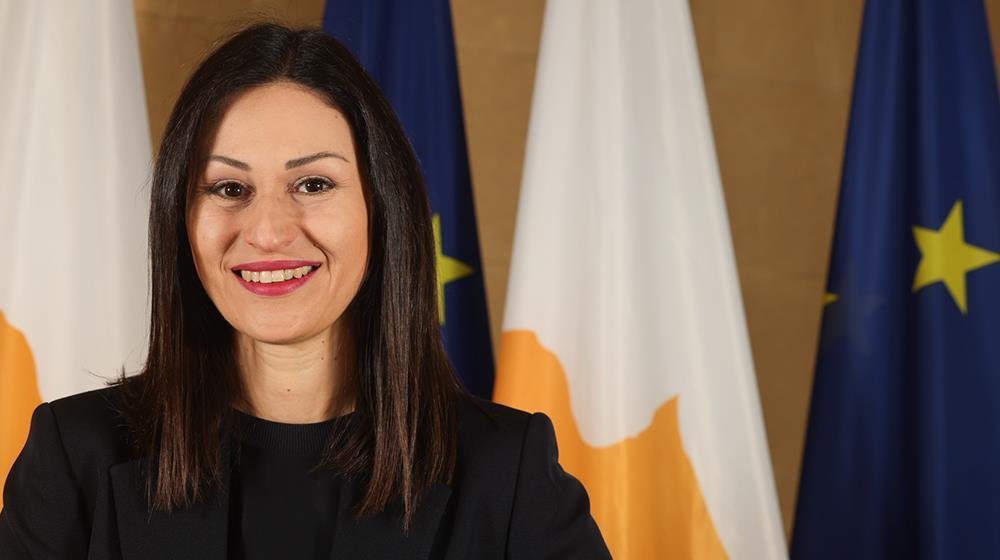
Minister of Agriculture, Rural Development, and Environment Maria Panayiotou outlined five priorities in the fields of environment and climate during a session at the European Parliament’s Committee on the Environment, Public Health, and Food Safety (ENVI), in Brussels.
Opening her speech on 29 January, Minister Panayiotou referred to Cyprus, emphasising that it is located at the southeastern edge of the Mediterranean, on the Union’s external borders. She noted that it is a region where geopolitical tensions exist, but “we desire peace, stability, and prosperity.”
She observed that Cyprus is on the front line of the climate crisis, facing rising temperatures, prolonged droughts, water scarcity, and extreme weather events. She explained that these challenges are not abstract, as they directly threaten the country’s communities, economy, and future. For this reason, Minister Panayiotou stressed, Cyprus approaches environmental and climate issues not as an option, but as a political necessity.
Referring to the Presidency’s guiding motto, “An Autonomous European Union, Open to the World,” she noted that it reflects a European Union that is more resilient, self-sufficient, and better prepared, while remaining outward-looking and actively present on the international stage.
Strengthening Europe’s climate ambitions
The Minister highlighted that regarding environment and climate, “we are determined to strengthen Europe’s climate ambitions, accelerate the green transition, and build resilience through innovation, sustainable energy, water management, and the protection of our unique ecosystems.”
She emphasised that the Cypriot Presidency will promote a strong, united European response, based on solidarity, responsibility, and tangible action, because the future of the region and the entire Union depends on it.
She stressed that there is a clear political vision for a sustainable and resilient Europe, capable of achieving high environmental ambitions through simpler and more effective policies.
Minister Panayiotou also pointed out that the Presidency coincides with a critical moment for the European agenda on environment and climate. She explained that the decisions to be taken in the coming months will shape not only the EU’s ability to respond to climate change, biodiversity loss, and pollution, but also Europe’s economic resilience, strategic autonomy, and citizens’ trust in the European framework.
She noted that at the core of the Presidency’s agenda is the European Green Deal and the shared responsibility to address the triple planetary crisis. “Our goal is not to choose between ambition and competitiveness or between protection and development, but to deliver results in both,” she explained.
Minister Panayiotou emphasised that the work of the Presidency is structured around five interlinked thematic priorities, supported by a set of legislative dossiers, where close cooperation between the Council and the Parliament will be essential.
Water resilience and climate adaptation
The Minister stressed that water resilience will be the first priority of the Cypriot Presidency. “Water is not only an environmental issue. It concerns security, resilience, public health, and economic stability. Across Europe, droughts, floods, and water scarcity are no longer future risks; they are current realities,” she explained.
She observed that if Europe is to remain resilient, competitive, and socially cohesive, it must manage water more effectively and equitably.
Moreover, she noted that achieving this goal requires a cross-sectoral approach connecting water policy with agriculture, energy, tourism, spatial planning, and climate adaptation. “It also requires innovation, investment, and strengthened cooperation, including with neighboring regions,” she added.
During the Cypriot Presidency, the Minister indicated that water resilience will be placed at the center of political discussions, bringing the issue to the Informal Council of Environment Ministers, explicitly linking water resilience with climate resilience.
She added that the objective is clear: better coordination across sectors, alignment of water and climate strategies, common climate scenarios, and well-coordinated, adequate funding.
“We aim to ensure that in the upcoming ‘EU Comprehensive Climate Resilience Framework’ package and the Water Resilience Strategy, full implementation is achieved in a collaborative manner, consistently contributing to the EU’s environmental objectives for 2030 and 2050,” she stated.
Effective climate policy
Regarding the second priority, the Minister stressed that the Cypriot Presidency is fully committed to ambitious climate action—action that delivers real emission reductions while ensuring competitiveness, innovation, and energy security.
Minister Panayiotou highlighted three legislative dossiers. The first concerns the revision of CO₂ standards for cars and vans. She emphasised that this is the most visible element of the automotive package presented by the Commission in December. “It concerns the decarbonisation of transport, the protection of jobs, and maintaining Europe’s leadership position. The Presidency will work toward a balanced and reliable position in the Council. Negotiations will also proceed at the Parliament level to achieve a final agreement for Europe’s benefit,” she explained.
The second dossier concerns the proposal for heavy-duty vehicles, where regulatory certainty is crucial. “We intend to move quickly, and we hope the Parliament will do the same, so that an early agreement can provide clarity for manufacturers and investors,” she noted.
The third dossier is ETS2. “We have heard concerns about price volatility and potential social impacts of the new emissions trading system for buildings and road transport. The Commission’s MSR adjustment proposal is a critical step for a smooth ETS2 launch. The Council has supported this initiative, and the Presidency intends to act swiftly, in close cooperation with Parliament, to achieve an early agreement,” she explained.
Circular economy and zero pollution
The third priority concerns a competitive and resilient Europe, requiring a faster transition to a circular economy.
She observed that circularity is not only an environmental necessity but also an industrial and strategic opportunity, reducing dependence on raw materials, enhancing resilience, and supporting innovation.
The Minister welcomed the Commission’s intention to present a Circular Economy Act by the end of 2026, noting that the plastics package is an important first step.
“Future measures must combine ambition with realism, ensure coherence and legal certainty, while respecting the realities of Member States,” she said.
She also emphasised that discussions will continue at the ministerial level, addressing issues such as plastic imports, trade protection, and added value through cross-border cooperation, circularity, and regional hubs.
At the same time, the Minister highlighted that protecting human health and ecosystems remains a key political priority.
Under the Cypriot Presidency, she noted, negotiations will begin on the revision of REACH, if submitted by the Commission during the Presidency, aiming to modernise and simplify the framework while maintaining the highest protection standards.
She expressed readiness to collaborate with Parliament on the ECHA regulation, leveraging trust and cooperation developed during previous One Substance, One Assessment negotiations.
Simplification without reducing ambition
On the fourth priority, Minister Panayiotou stressed that simplification does not mean deregulation. “It is about making environmental legislation work better,” she explained.
She noted that the Presidency has already begun discussions in the Council on the Omnibus Package and will actively work to advance it.
“Our key measure is to reduce unnecessary bureaucracy, especially for SMEs, while maintaining strong environmental standards,” she said.
She added that the 10th Omnibus Package on food and feed safety will also be advanced, following the path set by the Trio.
Furthermore, the Minister stated that the Cypriot Presidency will work on the Council conclusions regarding the EU Bioeconomy Strategy.
“These Council conclusions will provide the Commission and Member States with the proper mandate to reduce dependence on fossil fuels, support rural communities, protect biodiversity, and create new economic opportunities. This is a strong example of how sustainability and prosperity can reinforce each other,” she said.
Europe’s role in global environmental governance
The Minister emphasised that the fifth priority concerns Europe’s role in global environmental governance, noting that 2026 will be a decisive year for international environmental action.
She stated that Cyprus will work to ensure the European Union speaks with a strong, credible, and consistent voice in global forums, from water and biodiversity to chemicals, oceans, and migratory species.
“We are fully committed to strong EU engagement at COP15 in Brazil, with emphasis on regional cooperation, habitat protection, and improved monitoring. We also welcome the implementation of the BBNJ Agreement, a historic milestone for ocean governance,” she added.
Vision in agriculture, fisheries, and environment
In statements after the ENVI session, Minister Panayiotou noted that discussions with the Agriculture, Fisheries, and Environment Committees of the European Parliament had concluded, highlighting the vision of the Cypriot Presidency.
Explaining this vision, the Minister emphasised that it aims to contribute to creating a Europe that is more autonomous yet open to the world. “The sectors of fisheries, agriculture, and environment are inextricably linked with the vision and goals set for a more resilient, competitive, and sustainable Europe,” she added.
In all Committees, it was stressed that the Presidency will act as an honest broker—for Europe, for European citizens, and for farmers—working in close cooperation with all institutions.
In the Fisheries Committee, discussions focused on the upcoming review of the Common Fisheries Policy and on advancing discussions toward a positive outcome during the Presidency.
Regarding the Agriculture Committee, Minister Panayiotou noted that the priority is the Common Agricultural Policy and how the Presidency will work in the coming days to develop regulations that improve farmers’ positions in the food production chain and in the market.
Referring to ENVI, the Minister underlined that the Presidency’s priorities were analysed, explaining that one of the main objectives is the Council Conclusions on the bioeconomy, to advance progress in reducing car emissions.
She also stressed that the necessary steps will be pursued to ensure the required funding for both the primary sector and environmental protection.
(Source: CNA)
