





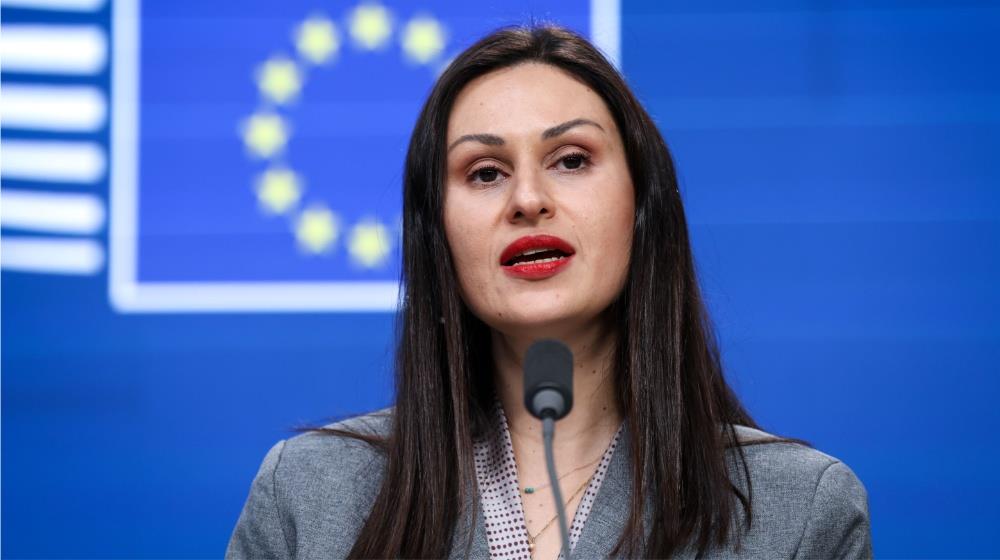
The Minister of Agriculture, Rural Development and Environment, Maria Panayiotou, has welcomed the establishment of the Import Control Working Group, as announced by the European Commission through the Commissioner for Health and Food Safety, Oliver Varhelyi, in Brussels.
The official launch of the Working Group took place on the margins of the Council of Agriculture and Fisheries Ministers on 26 Janaury, and is linked to the Implementation Dialogue on import controls held last December, during which the Commission announced the strengthening of its actions in this area.
The Minister described the discussion as "very productive" and thanked Commissioner Varhelyi and her counterparts for the fruitful discussions. "Now we can say that we have officially launched the Working Group on Import Controls, a very important, very critical, and very timely issue," she added.
"The message from today's discussion was very clear. The EU's requirements for food and feed must be applied uniformly to all food and feed, whether produced in the European Union or imported into the Union," the Minister emphasized. "What we want is very clear. We want better coordination among Member States, better cooperation between the Commission and national authorities. We want consistency. We want controls that actually work on the ground," Panayiotou stressed.
She once again expressed pride in the fact that EU farmers "produce high-quality food and meet EU requirements, because we are certain, we know that they produce food that is safe for our health and our environment. And we want them to continue doing so," but she emphasized that "we must ensure that they continue to produce on a level playing field." She also noted that today, Cyprus Presidency can say that a specific step has been taken. "We have turned our commitment to fair competition into action."
Emphasis on bioeconomy, organic farming and import controls at AgriFish Council
The first Agriculture and Fisheries Council (AgriFish) held under the Cypriot Presidency of the EU concluded with positive messages for the future of European agriculture and fisheries. Panayiotou described it as “a strong and encouraging start” for the EU Council, highlighting the open and constructive atmosphere of the ministers’ discussions.
The Minister praised the cooperation with the European Commissioner for Agriculture, Christophe Hansen, as well as with the Commissioner for Fisheries, Costas Kadis, the Commissioner for Environment, Water Resilience and a Competitive Circular Economy, Jessika Roswall, and the Commissioner for Health and Animal Welfare, Olivér Várhelyi.
She stressed that better regulation is crucial to provide farmers and fishers with the tools they need to remain competitive and resilient. “We firmly believe that the agricultural soul lies at the heart of Europe’s autonomy and resilience,” she said.
“We will be pragmatic and result-oriented. We will work for a Europe that is more autonomous and more resilient, while remaining open to the world,” Panayiotou said, underlining that “agriculture lies at the heart of Europe’s autonomy and resilience.”
A central topic of the meeting was the bioeconomy, which the Minister described as a “horizontal priority” that “connects sectors using renewable biological resources from land and sea to produce food, materials and energy.”
“The bioeconomy is a driver of a circular and low-carbon economy. It is not only about innovation, but also about modernising our industrial base and creating new value chains, while protecting biodiversity and the environment,” she stressed.
The Cypriot Presidency proposed the adoption of Council Conclusions on the implementation of the EU’s updated bioeconomy strategy. “Our aim is to provide clear political guidance for the implementation of this strategy,” she noted, adding that the views of agriculture ministers will be incorporated into the final text to be approved by the Environment Council in the spring.
Particular emphasis was placed on the proposal to amend the regulation on organic farming. “Organic farming is a cornerstone of the Common Agricultural Policy. It supports environmental protection and biodiversity and strengthens rural communities,” Panayiotou said. She added that “the rules must be simpler, less costly and more efficient,” making clear that this directly concerns strengthening the competitiveness of the organic sector.
Cyprus Presidency set an ambitious timetable on the file: “Our objective is to adopt a negotiating mandate with the European Parliament by the end of June 2026, so that the changes can enter into force as soon as possible.”
As regards import controls, earlier in the day the official launch of a special task force to strengthen border checks was also announced.
In response to a question on residues of banned pesticides in food, Agriculture Commissioner Christophe Hansen was unequivocal: “The internal market is sensitive and unique. We need an absolutely unified European approach. Unilateral initiatives do not help the sector.”
He revealed that the Commission is moving towards a zero-tolerance policy. “We have proposed zero limits for three substances and have launched a study to add more products to the zero-tolerance list. Our decisions will be based on scientific evidence,” he said.
From her side, Panayiotou noted that “all member states confirmed the importance of safeguarding very high EU production standards in order to protect the health of citizens and the environment.”
Commissioner Hansen also announced an upcoming action plan on fertilisers saying that they "will present short-term and long-term measures to reduce the use of chemical fertilisers and diversify imports." "We must reduce our dependencies and become more resilient,” he added.
He also referred to the EU’s trade agreements, pointing out that "almost 60% of our agri-food exports are covered by trade agreements, and exports to these countries are growing twice as fast.”
“The message is clear: many serious challenges, but also significant opportunities. We will work together for a fair, sustainable and competitive agri-food sector in Europe,” Panayiotou stressed. For his part, Commissioner Hansen remarked that “if today’s meeting shows what our year will look like, then we have difficult battles ahead of us – but also real opportunities to succeed.”
Finally, asked about the OPEKEPE scandal and media reports referring to individuals named in the case file transmitted by the European Public Prosecutor’s Office to the Hellenic Parliament – and their possible reappointment to the same or higher positions of responsibility in the new structure under Greece’s Independent Authority for Public Revenue (AADE), Commissioner Hansen pointed out that the Commission “is following the situation very closely and is responsible for verifying that EU funds are spent in accordance with EU rules.”
However, “as regards criminal allegations, that is, of course, the task of other European authorities, and they are doing their job as they should. We are, of course, following the cases very closely, but there are also elements that are ultimately criminal and these must be taken up by the competent authorities,” the Commissioner stressed.
(Source: CNA)