








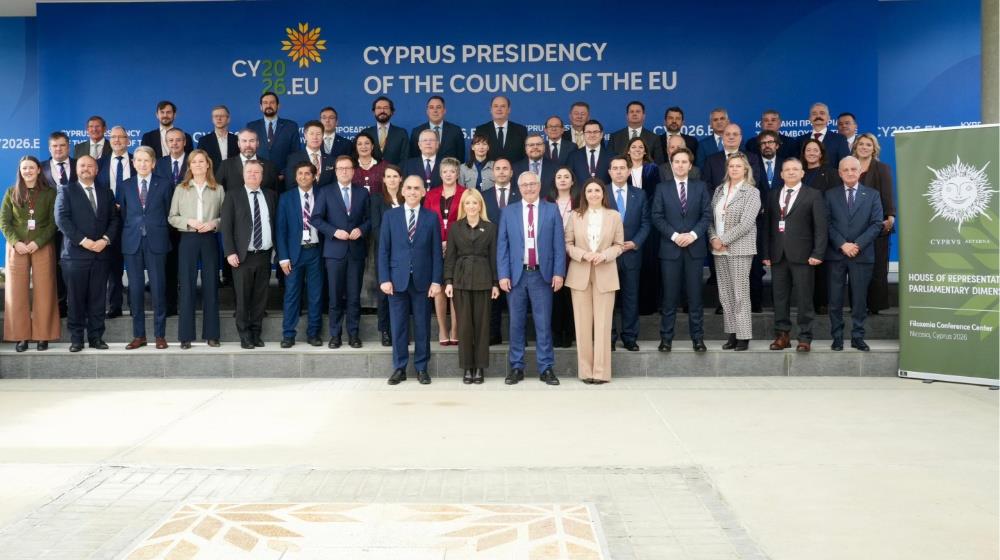
The Cyprus EU Presidency will work with an approach that is realistically ambitious, as true honest brokers, being transparent and inclusive, working closely with the European Parliament to advance our shared European agenda, Deputy Minister for European Affairs, Marilena Raouna, has said.
She was speaking on 12 January at the meeting of the Chairs of Parliamentary Committees on European Affairs (COSAC Chairs), held in Nicosia.
The event marked the commencement of the parliamentary dimension of the Cyprus Presidency of the Council of the European Union.
Parliamentarians have the opportunity, through their countries’ Presidency of the Council of the EU, to help form channels leading the bloc towards a strong Union, capable of acting for the benefit of its citizens and future generations and one that guarantees peace, stability, and security, President of the Cyprus House of Representatives, Annita Demetriou, said in her opening speech.
A new reality
Addressing deputies from the 27 EU member states and states candidate for accession, Demetriou noted that the Presidency “brings the European Union closer to Cyprus and Cyprus closer to the Union, thus bridging the geographical distance between the two.” It also offers an opportunity to the Union to acknowledge its proximity and link to the Eastern Mediterranean and the importance to actively engage with the region, she added.
She referred to “a new reality” in the global arena and “a new security environment,” “where the international rules-based order is under pressure, multilateralism is questioned and marginalised, new hybrid threats arise against security and democracy,” while the impact of energy insecurity, climate change and migration flows is accelerated.
All these challenges and threats, Demetriou said, highlight the need for strategic clarity, consistency of purpose and coordinated collective action to ensure the Union’s capacity to remain relevant and act effectively, towards the shared commitment to peace, security and international cooperation.
Demetriou noted that this “profoundly concerning new reality” emphasises the imperative for the Union’s positions and actions to remain firmly anchored in its founding values and principles, focusing on upholding international law, human rights, fundamental freedoms and the rule of law.
A unique opportunity
For Cyprus and its people, she said, the EU Presidency “represents a unique opportunity to project our European identity and reaffirm our position at the heart of the European construction.”
Solutions, she said, “can only be brought through dialogue and negotiations and can only last in time if based on international law.”
“This is the case for Ukraine. This is the case for Cyprus. This is also the case for Denmark and Greenland, and every country whose sovereignty and territorial integrity is violated, threatened or put into question through force,” she said, adding that this is also the case for the people of Iran, “struggling for a better life in dignity and freedom.”
Cyprus, through its Presidency of the Council of the EU, she said, is prompted to reflect on the European Union “we wish to live in, as European citizens.” “As parliamentarians, it gives us the opportunity to help form channels leading the Union towards that very path for the next decades: towards a Union that is strong and capable of acting for the benefit of its citizens and future generations,” one of values and principles, that guarantees peace, stability, and security and firmly rooted in democracy, but also a Union delivering shared prosperity and equal opportunities, boosting competitiveness and economic growth, allowing business to develop and innovate and societies to thrive, she noted.
She said that COSAC meetings “truly matter” because the group provides a vital forum where representatives of European citizens can engage in dialogue between them and with European institutions, constructively contributing to advancing the European project.
She said that, during the Cyprus EU Presidency, Cyprus’ House of Representatives will host five parliamentary conferences, including the COSAC Chairs and Plenary, the Interparliamentary Conference on Common Foreign and Security Policy and Common Security and Defence Policy and a thematic conference on important aspects of Artificial Intelligence. The House of Representatives and the European Parliament will co-host two conferences: the Meeting of the Joint Parliamentary Scrutiny Group on Europol in Nicosia and the Interparliamentary Conference on Stability, Economic Cooperation and Governance in the EU in Brussels.
Challenging times
Chairman of the Standing Committee on Foreign and European Affairs of the House of Representatives, Harris Georgiades, in his opening address, said that the meeting and the Presidency itself are taking place during challenging times. “World politics are being reshaped, in a struggle, it seems, between liberal democracy, moderation and a rules based international order – however imperfect this may have been – and forces of authoritarianism and revisionism, where brute force is the only currency that matters,” he added.
He referred to the Iranians’ struggle “against the Islamist autocrats who have been ruling this important country,” Ukraine but also Cyprus, noting that “we know first-hand what it means to face aggression from a revisionist, illiberal neighbour.”
Turning a blind eye against such authoritarian powers, he said, “is plainly wrong. It undermines our common values and our common interests.”
What we should be focusing on, he said, is establishing the European Union as a real geopolitical power. For that, he added, “we need a European revival which should start with the economy, because without a robust, competitive economy, we have nothing.”
We should do more to transform our Union into a global player to be reckoned with, able to defend and promote peace and security, liberty throughout our continent and beyond. Georgiades said.
Cyprus Presidency’s priorities
Raouna presented the Cyprus Presidency’s priorities. In her speech, she said that the deputies’ presence there was not merely symbolic but reflected “a fundamental truth” about the EU, that European integration does not advance in Brussels alone but through national parliaments, democratic scrutiny, “and through the trust of our citizens.”
She said that Cyprus was “ready to lead, to coordinate, to negotiate as true honest brokers, to bridge divergences, formulate solutions and compromises, that advance the European agenda.”
Raouna noted that the Cyprus Presidency “has begun at a defining moment.”
“Europe is confronted with a rapidly evolving geopolitical and geoeconomic landscape. War has returned to our continent. Strategic dependencies are being weaponised. Climate change, migration pressures, and technological advances are reshaping our societies,” she added.
The decisions we take today, at European and national level, she said, “will define the Union we pass on to the next generation.” This moment, she said, calls for decisive, credible and united action and for a Union that is more autonomous and open to the world. “This is the central objective of our Presidency,” Raouna said.
She noted that the five pillars of the Cyprus Presidency priorities were autonomy through security, defence and readiness, autonomy through competitiveness, a Union Open to the World, and a Union of Values. Referring to the next Multiannual Financial Framework, she said that Cyprus will work to significantly advance negotiations across all sectoral files, with the aim of presenting a mature negotiating box with indicative figures by June 2026.
Priorities
After Raouna’s presentation, the deputies, in their interventions, referred to the issues they would like to see prioritised, with most of them referring to the bloc’s competitiveness. Migration, defence, support for Ukraine, and the EU enlargement were some of the other issues raised.
The representatives of Albania, Moldova, Serbia, Ukraine and Montenegro said that their countries were ready to move forward as regards their EU accession progress, noting that they expected steps would be taken towards this direction during Cyprus’ EU Presidency.
In response, Raouna said that “it is very clear” from the discussion “that we all know very well what we need to do and what the priorities are” and that this was the guiding principle of the Cyprus Presidency, “to be able to reach ambition and deliver.”
What Cyprus brings to the table, she said, is “broadening a little bit the perspective,” adding elements to the equation, for example, on competitiveness. “We know very well from our geographical position that this region, the Eastern Mediterranean and the Gulf, are an indispensable part of the equation for boosting our competitiveness,” she said.
The overarching challenge, she added, is how, in the midst of increasing shifting and increasing unpredictability on the world stage, and a consistent effort to erode international rules-based order, that the EU remains a beacon of defending international rules-based order, of defending international law, the UN Charter, the international law of the sea, and remaining this stable, reliable and trusted partner.
“And when we stand with Ukraine, when we stand with defending territorial integrity, sovereignty and independence everywhere, that also means our support towards Denmark and Greenland, towards its sovereignty and territorial integrity,” she noted.
Security and enlargement
On security, she said that “now the opportunity to really put a 360-degree approach on security. We must rightly so focus on our eastern borders and our eastern flank, but it would be a missed opportunity if we didn’t also focus on challenges for security on other parts of our borders.”
On the enlargement, and the interventions by the Moldovan, Ukrainian, Serbian, Albanian, and Montenegrin deputies. “The path towards accession is an arduous path, and it’s not always linear. It’s a merit-based process. It's anchored on strict and fair conditionality. And it’s also a message to us as an EU that where our partners deliver, we also need to deliver as a European Union,” she said. That is an integral part of maintaining the credibility of the enlargement process, she added.
She noted that the Cyprus Presidency has worked with the candidate countries. “We know what we have to do. On Montenegro, for example, it’s ambitious, but it’s realistic to be the 28th member state by 2028. And our goal is in January to launch the ad hoc working group on the accession treaty of Montenegro,” she said.
Regarding defence, Raouna said that “now is the time to implement.” She said that, during the Cyprus Presidency, the first project will be decided and launched under the SAFE mechanism while that, on the table there is also a “very important military mobility package.”
“And advancing that will mean that in a few years we will be able to talk in the EU, about a military Schengen,” she noted.
On migration, Raouna said that “it is clear that as we work on the implementation of the Pact on Migration and Asylum, we must continue maintaining the balance between solidarity and responsibility.” As regards returns, she said that Cyprus will also be advancing discussions on the safe third country and also the safe third country of origin, concept.
Raouna also referred to the region and the importance of the Eastern Mediterranean. “If we are to be enablers of security and stability, we need to support those partners that need our support to remain pillars of stability, such as Jordan, such as Lebanon,” she said. It’s also part of addressing the challenge of extremism by supporting these countries, she added.
She also joined those that have expressed solidarity “with the brave people of Iran,” that have taken to the streets for their freedom.
In the second session of the meeting, the programme included discussion on geopolitical challenges and responses, with keynote speeches from Yannis Maniatis, Member of the European Parliament, and Jean-François Rapin, Chairman of the European Affairs Committee of the French Senate.
The second session, also on 12 January, focused on contemporary European geopolitical challenges and the policies needed to address them, having MEP Yiannis Maniatis and the Chairman of the European Affairs Committee of the French Senate, Jean-François Rapin, as keynote speakers.
New geopolitical environment
According to a House statement, in his speech, Maniatis stressed that the new geopolitical environment renders the EU's traditional "soft power" of the EU insufficient, while referring to the war in Ukraine, he stressed the need to strengthen the European defence industry and strategic autonomy, which, he said, extends beyond defence to cover innovation, energy transition, and critical raw materials, without, however, undermining social cohesion.
Finally, he highlighted the strategic importance of the Mediterranean and cooperation with neighboring countries, as well as the need for Europe to move from fragmented crisis management to a coherent and preventive European strategy that will protect democracy, peace, and the European future.
Capitalising on advantages
On his part, Rapin emphasised, among other things, that the Union must capitalise on its advantages, especially the single market, reduce any dependencies, support competitiveness and its industrial and defence base, and ensure respect for the competences of Member States and the principle of subsidiarity. He also stressed the geopolitical importance of enlargement, the need for internal reforms within the Union, and the crucial role of the Mediterranean and relations with the countries of the Southern Mediterranean and Africa, with the active involvement of national parliaments in the shaping of European policies.
It is added that a discussion followed among the participants, during which, among other things, the importance of strengthening the EU's autonomy and ensuring commitment to a merit-based enlargement process was emphasised, with participants reaffirming the decisive role of national parliaments in European governance and COSAC's contribution to strengthening interparliamentary dialogue and democratic accountability in the EU.
(Source: CNA)
