









Do you remember early April last year, when the tariff-war talk was everywhere? Do you remember how tense it felt watching markets drop day after day? Did you catch yourself thinking “Maybe I should just sell for now until things settle”?
If you answered yes, you’re not alone. Many investors reached out to us during that period, feeling anxious. But those who gave in to that feeling ended up learning a costly lesson.
The year 2025 taught us that the greatest risk to our capital is not always the economy, but our own reaction to it.
The Chronicle of Panic: January - April 2025
To understand what happened, let’s look at the events in order:
- Q1 2025: Markets began a steady downward course. Fears of a new trade war escalated, creating a climate of uncertainty.
- Early April: Market psychology reached its nadir, with news coverage being almost exclusively negative.
- As illustrated in Figure 1, this panic materialized in sharp sell-offs. Specifically, the S&P 500 dropped 4.8% on April 3 and plunged a further 6.0% on April 4.
- April 9, 2025 - The Turnaround: The announcement of a "90-day tariff pause" changed everything. In just a single day, the S&P 500 recorded a rise close to 10%.
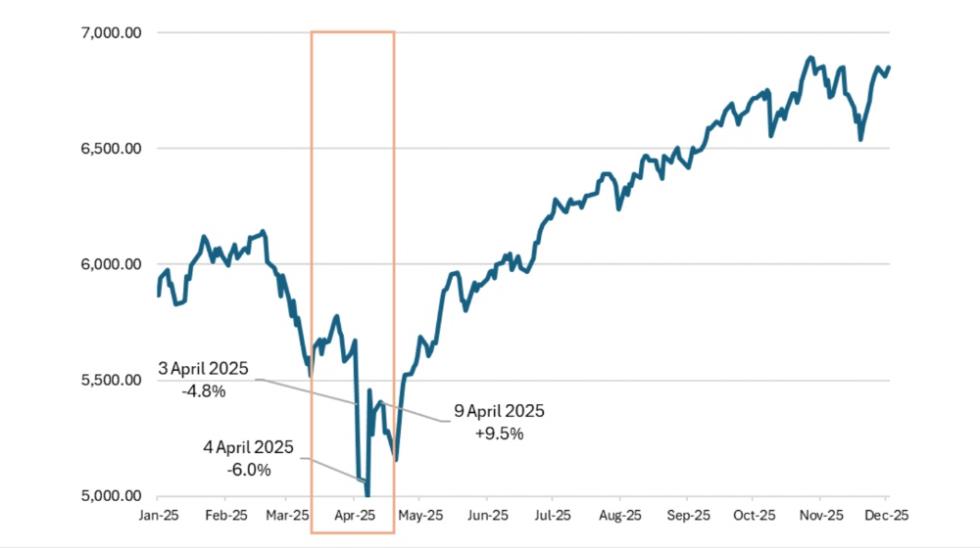
Figure 1: S&P 500 – Daily closing prices and selected returns in 2025
History Repeats Itself
What happened in April was not random. The data proves one of the most paradoxical rules of investing: The best days in the stock market almost always occur during bear markets, when pessimism is at its peak. This is not the first time we have seen such an explosive rise amidst a crisis:
- October 28, 2008 (+10.8%): One of the strongest days in history, right in the middle of the Great Financial Crisis.
- March 13, 2020 (+9.3%) & March 24, 2020 (+9.4%): Two massive upward reactions in the heart of the COVID-19 pandemic panic.
Those who sold just before these dates to "protect themselves" missed out on the best returns of the decade.
The High Cost of Missing Out
It is easy to think that missing just "one good day" like April 9th doesn't matter much. However, historical data from J.P. Morgan Asset Management reveals that missing these few days can destroy long-term wealth.
Their analysis of the S&P 500 over a 20-year period highlights a startling reality:
- Fully Invested: A hypothetical $10,000 investment would have grown to roughly $72,000, with a net annual return of 10%.
- Missing the 10 Best Days: If you missed just the 10 best days (often the days right after a panic sell-off), that same investment would be worth around $33,000, with a net annual return of 6%.
This happens because, as we saw in April 2025, the best days often happen within two weeks of the worst days. When you sell to "avoid the drop", you almost mathematically guarantee you will miss the recovery.
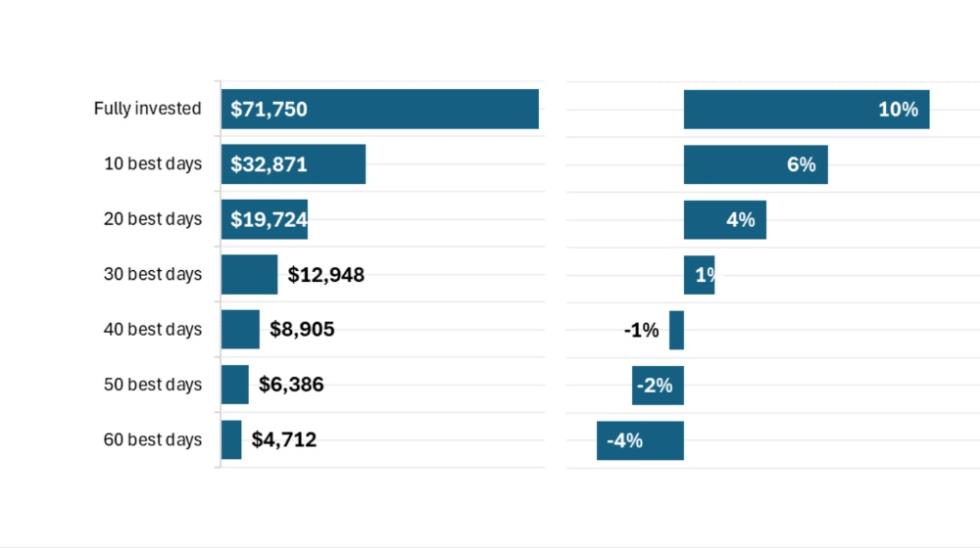
Figure 2: S&P 500 - Performance of a $10,000 Investment and Impact of Missing Best Days (2004–2024)
The Trap of Loss Aversion
Why is it so difficult to stay cool when markets fall? Behavioral Finance provides the answer through "Loss Aversion". The pain we feel when we see our portfolio fall is psychologically twice as intense as the joy we feel when it rises. This instinct drives us to sell at exactly the wrong moment: at the lowest point, just before the recovery.
We Only Invest What We Don't Need Immediately
How can we protect ourselves from our own selves next time? The answer lies in proper allocation before the crisis. If the drop at the beginning of the year caused you to panic, you may have invested money you would need soon. The rules are clear:
- 0-12 Months (Liquidity): Money needed for bills and immediate expenses must be in Cash or Cash Equivalents (like T-bills).
- 1-5 Years (Safety): Capital needed in the medium term belongs to stable, income-generating assets (like bonds).
- 5+ Years (Growth): Only capital that can withstand volatility should be exposed to the stock market.
The stock market is a vehicle for long-term wealth, not a bank account for next month's rent. When you know your short-term needs are secured, a 5% or 10% market drop ceases to be a financial threat and simply becomes a short-term correction and, potentially, an opportunity to buy at lower prices.
The Anchor of Fundamentals
While proper allocation buys you time, understanding what you own gives you conviction. This is where the principles of value investing and fundamental analysis become our strongest allies.
When we view stocks only as ticking prices on a screen, a 10% drop feels like a loss of wealth. But when we view them through the lens of fundamental analysis - as ownership stakes in real businesses with cash flows, assets, and dividends - market volatility looks very different.
Investors who focus on the long-term drivers of a company's value, rather than short-term price fluctuations, are far less likely to panic.
Conclusion
Markets will fall again, and there will be new headlines that stir up fear, maybe in 2026, maybe later. The next time this happens, though, remember April 9th, 2025, as well as 2020 and 2008.
Remember that recovery often comes abruptly and without warning. Over time, markets tend to reward patience and a clear strategy, not sudden reactions to the latest news.
*By Kyriacos Inios, Secretary, CFA Society Cyprus
