




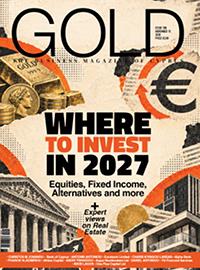



"When thinking about the 2027 outlook, it is important to take a step back and look at the themes and super trends that have been at play for the last few years," Daniel Antoniou, Executive Director, 7Q Financial Services, suggests.
In a recent interview with GOLD magazine, Antoniou notes that "the outlook for 2027 remains constructive but must include an element of caution."
Among other themes, he also weighs in on what kind of returns investors can reasonably expect across the main asset classes in 2027 as well as which equity markets, sectors and regions look most attractive in the coming year.
Antoniou, in addition, shares his choice of the global listed companies he would highlight as ones to watch in 2027.
Among other things, the expert also provides an opinion on the best opportunities in fixed income in 2027 and which alternative investments he believes look particularly interesting.
What is your investment outlook for 2027 and what are the main opportunities and risks?
When thinking about the 2027 outlook, it is important to take a step back and look at the themes and super trends that have been at play for the last few years. The AI trade remains a dominant theme among investors and continues to attract significant attention and capital flows. High profile IPOs, such as Anthropic and OpenAI, will provide further clues on whether the intensity and momentum of the AI trade can remain intact. In the AI shadow, Financials and Energy have been outstanding performers, each highlighting some very important fundamental shifts in modern economies. The ongoing energy transition, coupled with the geopolitical struggles for dominancy and control of important energy hubs and routes, continue to create investment opportunities across the full spectrum of the energy industry, including the once-out-of-favour oil super majors. Financials, another out-of-favour trade, are attracting investor attention as innovation and the normalisation of the interest rate environment allows banks to deliver something almost forgotten – recurring profits.
Going into 2027, one has to carefully measure the extent by which such themes can continue to attract attention and capital. Interest rates are on the rise; so are bond yields. Both reflect modern economy dynamics in which inflation remains above policy targets and consumption – and thus growth – remains resilient. I expect this theme to continue into 2027 and should therefore support Financials’ valuations. Somewhat counterintuitively, such a backdrop could be challenging for the continuation of the AI trade. It feels to me that investors have moved past the future promise of AI. Focus is now shifting to more tangible factors such as profitability and cost of funding for AI infrastructure. Higher interest rates and yields can both act as headwinds for the AI trade.
Concluding, the outlook for 2027 remains constructive but must include an element of caution. Consumption is surprisingly resilient despite inflation and worsening demographics. Valuations are stretched, although this is not a universal characteristic, and pockets of value remain. Such pockets of value are starting to emerge in the last quarter of 2026, in defensive sectors such as Utilities, Healthcare and Consumer Staples. Capital rotation between defensive and cyclical sectors has been an emerging theme within 2026, and this is something that could carry well into 2027.
What kind of returns can investors reasonably expect across the main asset classes in 2027?
Contrary to previous periods, cash is now earning a yield that is just below or at current inflation levels and I expect this to follow through 2027. Fixed income yields are also normalising when compared to previous periods and reach 0.5%-1.5% above current inflation levels, depending on duration and credit quality. I expect sovereign bonds to do better than corporates in 2027.
Equities have impressed with their performance since the Covid years but I do not think they can maintain the same momentum. I expect equities to post high single-digit returns, with double-digit return opportunities to be found in Sectors rather than in Broad Indices. Finally, Alternatives will continue to receive interest and capital flows, and depending on positioning and selection, can reach low double-digit returns.
Which equity markets, sectors and regions look most attractive in 2027?
The US will remain the dominant market simply because it contains the best and most valuable companies in the world, although it must be noted that the US index trade is heavily overweight in Technology. Looking beyond the major US indices, opportunities can be found in Financials, Healthcare, Utilities and Staples.
Which 10 global listed companies would you highlight as ones to watch in 2027, and why?
The following ten, plus two, companies are among the most important publicly listed businesses to watch in 2027:
1. Nvidia Corp
2. Apple Inc
3. Alphabet Inc
4. Microsoft Corp
5. Amazon.com Inc
6. Taiwan Semiconductor Manufacturing Co Ltd (TSMC)
7. Space Exploration Technologies Corp (SpaceX)
8. Meta Platforms Inc
9. Samsung Electronics Co Ltd
10. Tesla Inc
11. Anthropic (subject to successful IPO)
12. OpenAI (subject to successful IPO)
As some of the largest and most influential companies in the world, their innovation and strategic decisions are likely to play a critical role in shaping global markets and the broader economic landscape throughout 2027 and beyond.
Where do you see the best opportunities in fixed income in 2027?
The repricing of debt cost, as a result of inflation and ballooning debt, has pushed yields significantly higher within 2026. In Europe, there are echoes of the sovereign crisis of the early 2010s, particularly with the socio-economic situation in France. Despite this, I consider Sovereigns – especially core – to have the best potential to appreciate in value within 2027, as global risks generally begin to mount.
Beyond equities and fixed income, which alternative investments look particularly interesting in 2027?
Over the last 3 years, we have witnessed the value of Alternatives in that they provide traditional portfolios with stability and risk-adjusted returns. Of particular interest is Private Equity, a segment that is challenged from its limited liquidity profile but can provide recurring and steady market returns, with reduced sensitivity to short-term market volatility.
Consider a hypothetical 60-year-old investor who has recently sold his company and has €10 million available to invest. He has two adult children and wants to grow the family’s wealth over the long term while generating a sustainable level of income. How would you allocate the €10 million across different asset classes and why?
Risk tolerance and risk capacity are fundamental factors to evaluate and consider before making any capital allocations. In general, bonds and equities are important building blocks of a balanced portfolio, and should always be present in portfolios, in weights that reflect each investor’s risk profile. The overall performance of Alternatives over the past years has highlighted their importance as a necessary ingredient. Finally, true diversification and active rebalancing must be applied to reduce risk correlations between the portfolio ingredients.
This interview first appeared in the November edition of GOLD magazine. Click here to view it.