




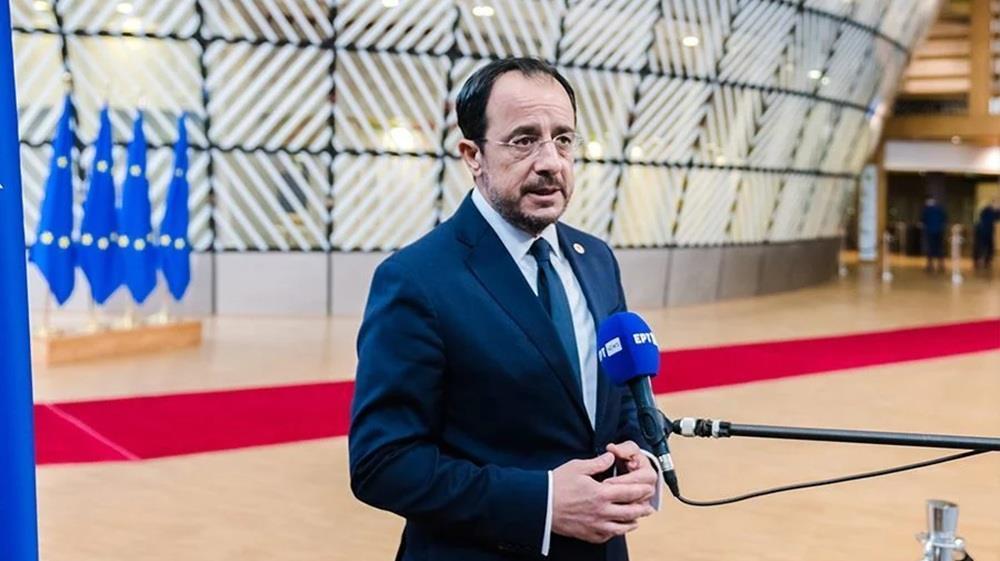
President Nikos Christodoulides today y called for the time horizon of the EU's Multiannual Financial Framework (MFF) to be shortened, saying seven years is too many, and speaking as he arrived at the extraordinary European Council summit in Brussels.
He also said he is optimistic that a political agreement can be reached by the end of December. The President disagreed with linking Ukraine financing to the MFF and announced that he will raise with leaders the issue of Turkey's violations of the Russia sanctions.
The President expressed hope that this extraordinary European Council will produce some results, presenting the agenda, which begins with the Eurozone summit. "It is the last appearance of Ms Lagarde, who by general consensus did an excellent job, and we hope that her successor will continue in the same direction. It is important to see, amid all these geopolitical uncertainties, how we strengthen even further the European Union and the member states," he said.
Speaking of the main discussions of the day, he said that "the big discussions today concern the Multiannual Financial Framework. I want to start with a comment which I will repeat today and which is something that should make us think. I do not consider it appropriate to discuss the European Union's budget for the next seven years. We do not know what the circumstances will be over the next seven years. And although I know that the Treaties contain some provision, if my memory serves me right it concerns five years, the time horizon for the budget discussion should be reduced. We are not in a position today to know the circumstances over the next 5, 6, 7 years."
The President also set out the message he wants to come out of the summit. "I hope the message that comes out of this extraordinary European Council is that we can have a political agreement by the end of December. Beyond that, if we do not reach such an outcome, the message will be very negative, both for the member states and for our citizens, but also the message we will send to the outside world," he stressed.
Turning to the economy, the President welcomed the Commission's autumn forecasts. "I want to welcome the fact that we also saw the Commission's autumn forecasts. Our country, the Republic of Cyprus, is one of only four member states of the European Union with a growth rate exceeding 3%. This gives us the possibility to return growth back to society. And it was within this framework that yesterday we also announced very specific measures, measures that support the family, including our students, our low-income pensioners, the middle class more broadly, and we will continue in this direction."
Returning to the MFF topic, he explained how the discussions will be conducted and where Cyprus stands. "As you know, the President of the Council has possibly decided to group the discussions. In the first discussion we are mainly with the states that support Cohesion policy, an important policy for the European Union. We support the continuation of these policies, which at the end of the day also show our citizens the added value of the European Union." He said "we must continue to invest in such policies and, at the same time, strengthen policies that lead to the strategic autonomy of the European Union," noting that when he speaks of strategic autonomy, he is not referring only to defence and security issues. "I am referring to competitiveness, entrepreneurship, cutting red tape and so on" he added.
Of the final part of the discussion, he noted that it will concern Ukraine. "The discussion will conclude with Ukraine, with the financing of Ukraine. The Republic of Cyprus, as a member state that understands more than any other what is happening with the illegal Russian invasion, will support this effort."
The President announced that he will prioritise the issue of Turkey's non-implementation of sanctions. "I have recently read a report by the European Commission's special envoy, Mr David O'Sullivan, on the implementation of sanctions. Turkey is the champion country when it comes to violating the Russian sanctions, and as the European Union we should not simply make this observation. We must move to the next step in relation to this particular challenge, and it is something I intend to raise with the leaders."
Asked whether he agrees with the link made by German Chancellor Friedrich Merz between support for Ukraine and the MFF, President Christodoulides replied that he does not agree with this link. "I fully understand the German Chancellor's approach, taking into account that he also comes from the countries that wish to see a further reduction of the European Union's budget. But the more issues we link, the harder it will be to reach a political agreement" he added.
Pressed that Chancellor Merz's letter was sent in the knowledge that the link would complicate negotiations, and that there is a Dutch-German alignment, the President said he repeats the position, and "I consider that it is also the position of the majority of member states, that the more issues we put on the table, the harder it will be to reach a political agreement. Beyond that, I understand that there are countries that are closer to our own case. Immediately before the European Council we will have a meeting with the member states that are in favour of continuing and strengthening cohesion policy, precisely in order to coordinate even more and achieve our goals."
On his strategy to prevent further budget cuts, he said that "we are the majority, I would say, of member states. Especially this group that we will be meeting in immediately before the European Council, the states that support cohesion policy, we are the majority. So I believe we have the ability within the framework of the negotiations." He recalled having said earlier, after the reduction made by the Cyprus Presidency with its MFF proposal, which he described as excellent, that he expected a double-digit cut. "A double-digit figure that will be very close to a single-digit one. We are at 10%, which I consider satisfactory," he said. He repeated that "we finally need to have a political discussion on the fact that we cannot today discuss the European Union's budget for seven years without knowing the circumstances in seven years. I understand the need for stability, the need to know, the need to plan, but at the same time I consider seven years to be too many."
Asked by CNA about own resources and the digital tax, he said that "we have seen the proposals. We see there, as you know, very strong and clear opposition from Ireland. For our part, we asked for some more information so that we can assess the data."
Asked whether Cyprus has red lines regarding its burden in financing the budget, he answered "of course we have red lines, and the most important thing is cooperation with other states, because that is where you have the possibility of having allies in the negotiations, so that there are more opportunities and chances of reaching the result you want. At the end of the day, at the same time, we all understand, and I believe all members of the European Council should be aware, that there will be a compromise. No one in the negotiations will get everything they want."
To the question of whether he still hopes for an agreement at the end of December, the President replied that he is optimistic. "The European Union has proven over time, and especially in recent years, that despite difficult discussions and negotiations, at the end of the day, at the same time, we understand the cost of not reaching compromise and agreement" he said.
Also read: President Christodoulides participating in extraordinary European Council meeting on MFF-Ukraine