





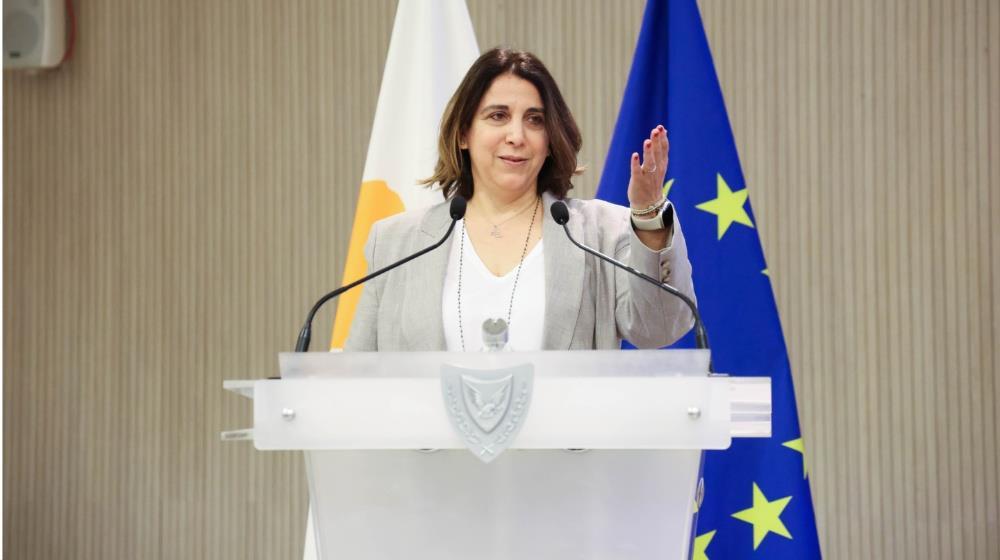
The reduction of energy costs for the public and businesses, the enhancement of energy security, and the acceleration of the green transition in a socially just and economically sustainable manner are the three goals of the government's energy strategy, stated the Deputy Minister to the President, Irene Piki, conveying the greetings of the President of the Republic, Nikos Christodoulides, during a conference taking place in Nicosia.
She highlighted that it is a time of constant geopolitical and economic changes, with energy being at the centre of developments, affecting the competitiveness of economies, the security of states, and the cost of living for our citizens.
"In this environment, Cyprus continues consistently and realistically on its path towards a safer, more sustainable, and more competitive energy model," she noted. She also mentioned as a priority the completion of the liquefied natural gas import terminal in Vasilikos, noting that the new tender process currently underway is a very important step towards completing the project in a way that fully safeguards the interests of the Republic of Cyprus and its citizens.
Reduction of Energy Costs
Regarding the goal of reducing energy costs, she stated that the level of electricity bills continues to be one of the greatest challenges for both households and businesses.
"That is why our interventions are not limited to short-term support measures but are primarily focused on permanent and structural solutions," she said, highlighting the opening of the competitive electricity market as a milestone in this direction.
She described it as "a reform that contributes to modernising our economy, creates new options for consumers, and lays the foundations for a more effective and competitive environment for the benefit of citizens and production."
RES penetration
Regarding the increase in the use of Renewable Energy Sources, she indicated that by July 2026, more than 105,000 consumers, households, and businesses had installed photovoltaic systems for self-consumption, while applications for net billing are also steadily increasing.
Piki noted that this data represents a development that confirms that the green transition is no longer a future goal but a reality that is already shaping the energy landscape of our country.
She pointed out that the progress recorded in renewable energy sources is particularly encouraging, adding that it simultaneously highlights the need for even faster upgrading of the country's energy infrastructure. She explained that the transition to a modern energy model is not only about producing clean energy but "is about our ability to transport it, manage it, and utilize it in a more efficient way."
The Deputy Minister to the President also mentioned that in this context, the modernisation of electricity transmission and distribution networks is being promoted, the introduction of digital technologies, and the installation of smart meters that will allow greater flexibility in the energy system.
Regarding the development of energy storage systems, she stated that they are a critical factor for the proper utilization of renewable energy sources and their penetration into the energy mix.
National Observatory for Energy Poverty
Piki also referred to the operation of the National Observatory for Energy Poverty, which was approved in the summer by the Cabinet and aims to enhance the state's ability to more effectively identify the needs of citizens and design targeted policies.
She added that for the energy transition to be truly successful, it must also be socially just so that its benefits are not limited to a few. According to her, significant European resources have been secured to address energy poverty and "support our most vulnerable families".
"Our goal is for these resources to be used in a way that will bring about real and lasting results," Piki pointed out, adding that at the same time, the implementation of energy upgrading programs for homes and businesses through various grant schemes continues, recognising that energy savings represent one of the most effective forms of investment for both households and the economy as a whole.
Referring to the recent "Save and Upgrade" scheme, she said there was a response, with the available budget being exhausted in a very short period, which, as she noted, confirms that energy-saving policies respond to the real needs of society. "For us, this success is a message of confidence and motivation to continue investing in actions that reduce energy costs, enhance energy efficiency, and contribute to our national goals for the green transition, she added.
Energy security is a priority
Regarding the terminal in Vasilikos, she noted that completing it is a priority, while adding in relation to the development of domestic energy resources, that 2026 was a particularly significant year for the hydrocarbons sector.
The discoveries "Glaucus" and "Pegasus" in block 10 have been officially declared marketable, while ExxonMobil and QatarEnergy are now evaluating development options for the fields, aiming to submit development and production plans in early 2027, she noted.
"These developments confirm that Cyprus is gradually moving from the exploration phase to the utilization phase," Piki said, adding that this transition creates significant economic prospects for our homeland, enhances the geostrategic importance of our country, and upgrades the role of the Republic of Cyprus in the broader energy map of the region."
Regarding the electricity subsea cable between Greece and Cyprus, known as GSI, she mentioned that the recent Intergovernmental Summit of Cyprus – Greece reaffirmed the strategic commitment of the two governments to implement the project that enhances energy security, regional cooperation, and the integration of the European electricity market.
"For the project, there is ongoing cooperation and coordination with the Greek Prime Minister and the French President, as it is a project of strategic importance for the energy future of the country and the broader region," she noted.
The Deputy Minister continued saying that Cyprus's energy policy has a clear geopolitical dimension and is directly linked to Cyprus's role in the Eastern Mediterranean and Europe.
"Through our collaborations with neighbouring countries, we are working to create conditions of security, stability, and mutual benefit," she indicated, adding that the energy initiatives of the Republic of Cyprus serve both national and European interests, contributing to the diversification of sources and supply routes for Europe.
"The government's energy policy is based on realism, responsibility, and long-term planning. There are no easy solutions or immediate results. However, there is a clear orientation, a specific plan, and systematic work," Piki concluded.