




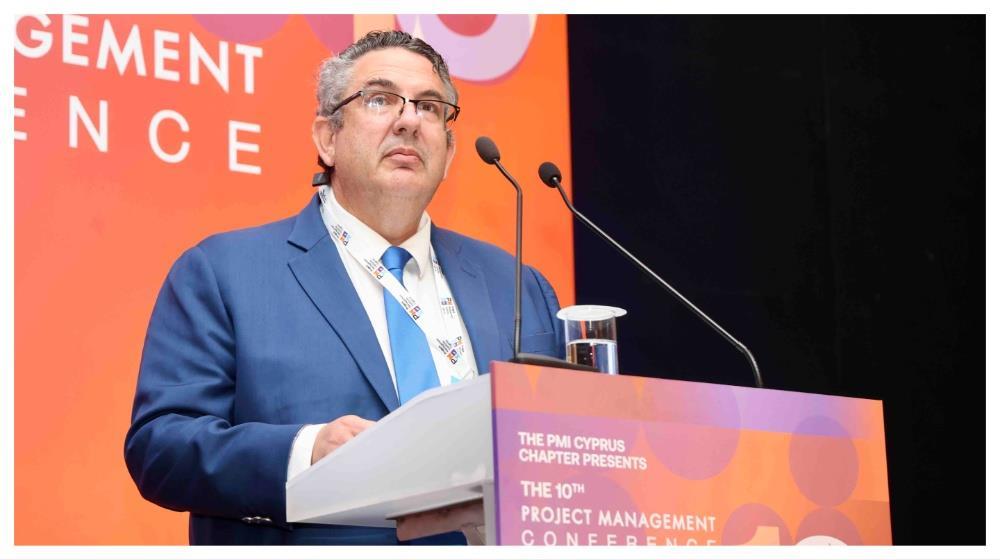
Project management, innovation and technological development are directly linked to a country’s ability to plan and implement its strategic priorities. Speaking on behalf of the Government of the Republic of Cyprus, Chief Scientist Demetris Skourides, delivered a keynote address at the 10th Project Management Conference presented by the PMI Cyprus Chapter, highlighting the importance of effective project implementation in promoting innovation and enhancing the competitiveness of the Cypriot economy.
At the same time, he referred to the radical transition that AI is bringing to the way organisations operate, businesses compete, and governments provide services, placing project management at the center of this transformation.
As Skourides explained, in complex infrastructure projects with multiple contractors and complex procurements, traditional periodic reporting systems are now giving way to intelligent systems that identify potential delays early, anticipate resource constraints and evaluate alternative scenarios before problems arise. This evolution leads to what he described as “intelligent work,” where leadership becomes predictive, adaptive and strategically informed, transforming information into measurable value.
He emphasised, however, the irreplaceable value of human judgment and leadership responsibility in the face of the capabilities of algorithms. “AI can help us understand what can happen, but it cannot determine what should be done,” he underlined, explaining that an algorithm identifies the most efficient allocation of resources, but efficiency is not the only criterion. Critical decisions involve social consequences, ethical responsibilities, financial risks, and conflicting interests that require human accountability.
In closing, the Chief Scientist warned that artificial intelligence systems may produce persuasive suggestions based on incomplete data, reproduce biases or misinterpret context, underlining that the more advanced technology becomes, the more imperative the need for human intelligence, strict governance and a clear understanding of its limits, linking technological progress and research with the need for strategic planning, coordination and effective governance.