


The further strengthening of Invest Cyprus and the expansion of its mission are linked to the government's effort to strengthen Cyprus' international economic presence.
In this context, the President of the Republic, Nikos Christodoulides, announced that the government is preparing specific proposals for the assignment of additional responsibilities to the Organisation, announcing that one of them concerns the export sector.
As he mentioned, this is an area in which the country needs to intensify its efforts, while leveraging the experience and successful track record of Invest Cyprus in attracting foreign investment.
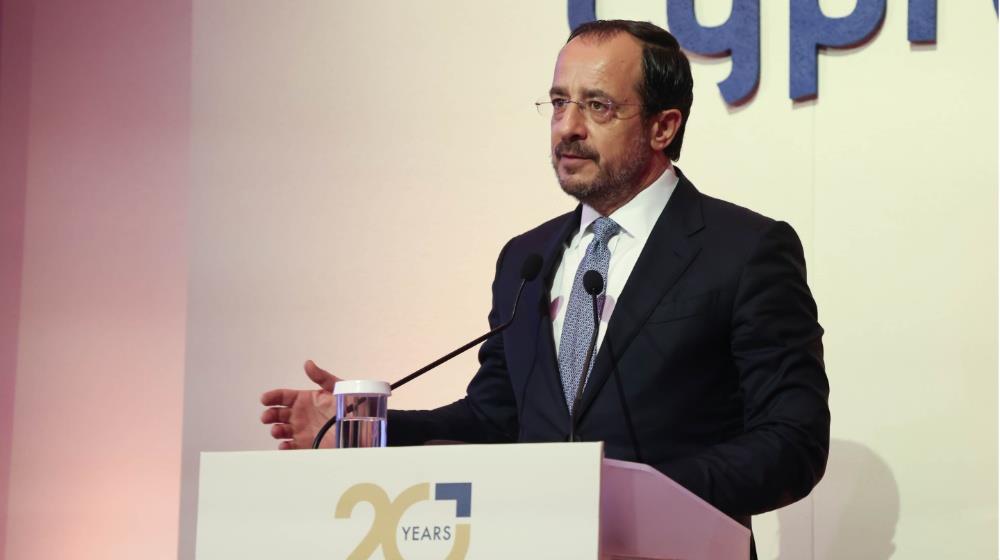
To mark its 20th anniversary, Invest Cyprus organised an anniversary event on Tuesday, 3 November, 2026, at The Landmark Nicosia, Autograph Collection. The event brought together the President of the Republic, government officials, members of parliament, diplomats, former presidents and members of the Organization's Board of Directors, as well as representatives of the investment and business community, honoring its journey and contribution to the promotion of Cyprus abroad.
In his speech, the President of the Republic of Cyprus, Nikos Christodoulides, referred to the course of Invest Cyprus since its establishment in 2006, characterising it as a successful organisation, with a substantial contribution to the promotion of the country and the attraction of foreign investments. Addressing the Chairman of Invest Cyprus, Evgenios Evgeniou, he revealed that the government, in collaboration with the Ministry of Foreign Affairs, has already discussed a specific proposal in the Council of Ministers. As he said, proposals will soon be presented for the undertaking of an additional sector by Invest Cyprus, clarifying that it refers specifically to the export sector.
This intention is part of the broader effort to utilise the Organisation as an institutional body with an expanded contribution to economic extroversion. The President underlined that Cyprus needs to do more in the export sector, linking this perspective to the international interconnection of the economy and the need to expand its productive base.
The economic transformation of Cyprus
Looking back at the establishment of the Cyprus Investment Promotion Agency in 2006, Christodoulides recalled that it took place at a time when Cyprus had recently joined the European Union and the international investment environment was changing. As he stated, it was becoming increasingly clear that maintaining the country’s development path required more than leveraging its traditional advantages.
Subsequently, the Cypriot economy was tested by successive crises, including the global financial crisis, the economic and banking crisis of 2012–2013, the pandemic and subsequent geopolitical and economic turmoil. According to the President, each crisis highlighted the importance of resilience, but also the need for strong institutions, sound public finances, adaptability and a diversified productive base.
"The long-term strength of an economy must be based on strong institutions and must be based on sound public finances, adaptability and a diversified productive base of the economy," he noted, describing the change in Cyprus' economic model.
As he explained, the country is evolving from an economy traditionally associated with tourism, commercial services and shipping, to a more diversified economy, based on knowledge and with stronger international connectivity. Alongside the modernisation of traditional sectors, higher value-added activities are being developed, such as technology, digital applications, research, renewable energy sources, advanced corporate services and regional headquarters of international companies.
The performance of the economy and the contribution of investments
Presenting the course of the economy, the President stated that Cyprus recorded overall growth of over 18% over the three-year period 2023–2025, consistently ranking among the two fastest-growing economies in the European Union. Specifically, in 2025 the economy grew at a rate of 4.8%, which he described as the highest in the EU.
At the same time, he referred to the upgrading of the country's credit rating to category A by all international rating agencies, the maintenance of fiscal surpluses and the reduction of public debt. He also noted that unemployment fell to 4.4% in 2025, while in 2026 it is below 4%, at levels last recorded in 2008. The employment rate reached 81.3%, the highest since the establishment of the Republic of Cyprus in 1960.
He made particular reference to the dynamics of new sectors, with the technology sector now contributing more than 15% to GDP, according to the data he presented. The sector's business ecosystem has multiplied since 2020, while more than 700 technology companies are active in Cyprus, creating jobs and new opportunities for the domestic workforce.
In this context, Mr. Christodoulides highlighted the role of foreign direct investment in the transformation of the economy. As he explained, beyond the inflow of capital, investments transfer know-how, technology, business experience and access to international networks. At the same time, they create opportunities for workers in Cyprus and contribute to the effort to return specialised human resources to the country.
Based on the preliminary data from the Central Bank that he cited, investment inflows amounted to €11.6 billion in 2025. However, as he underlined, the government's goal is to attract investments that substantially upgrade the economy: they create quality jobs, increase productivity, strengthen innovation, develop the local supply chain and cultivate new skills in human resources.
Stability, responsibility and perspective
The President highlighted stability as a key prerequisite for attracting quality investments, particularly in an international environment characterised by geopolitical tensions, economic fragmentation and increased uncertainty. As he noted, investors need predictability and confidence that the rules will remain stable, so that they can make long-term decisions and plan the development of their activities.
At the same time, he set financial responsibility as the second key component for the implementation of the development vision. Fiscal discipline, according to him, creates the conditions for reforms, strengthening infrastructure, supporting education and health, promoting innovation and developing skills. In this way, economic growth can be translated into benefits for society and better prospects for businesses.
In his speech, he also described the comparative advantages of Cyprus as a European and internationally interconnected business destination. Its status as a member state of the European Union and the Eurozone offers institutional stability, while the country's geographical location, at the crossroads of Europe, the Eastern Mediterranean and the Middle East, enhances the potential for developing partnerships with markets in Europe, the United States, India and the wider region.
As he stated, the ambition is for Cyprus to be a destination not only for capital, but also for talent, innovation and international business activity. “This is the Cyprus we dream of. This is the Cyprus we build,” he noted, summarizing the connection between stability and the country’s perspective and ability to attract long-term investments.
In closing, Nikos Christodoulides reiterated the importance of international extroversion as a key axis of the government strategy, noting that diplomatic relations, economic development and communication strategy are interrelated dimensions of a long-term approach. In this context, the prospect of expanding the responsibilities of Invest Cyprus, with the possible undertaking of the export sector, reflects the intention to utilize the Organization's experience in a broader field of economic activity and international presence of Cyprus.
(Source: InBusinessNews)