


International investment flows are increasingly influenced by geopolitical dynamics, artificial intelligence, the energy transition and demographic developments. These factors are changing investors’ priorities and reshaping the prospects of entire sectors of the economy.
For countries such as Cyprus and Greece, understanding these trends is an important tool for developing investment strategies and attracting international capital. The prospects for global investment over the next five years were examined during the panel discussion “The Future of Global Investment: Where Will Capital Flow Over the Next Five Years?” at the 17th Limassol Economic Forum.
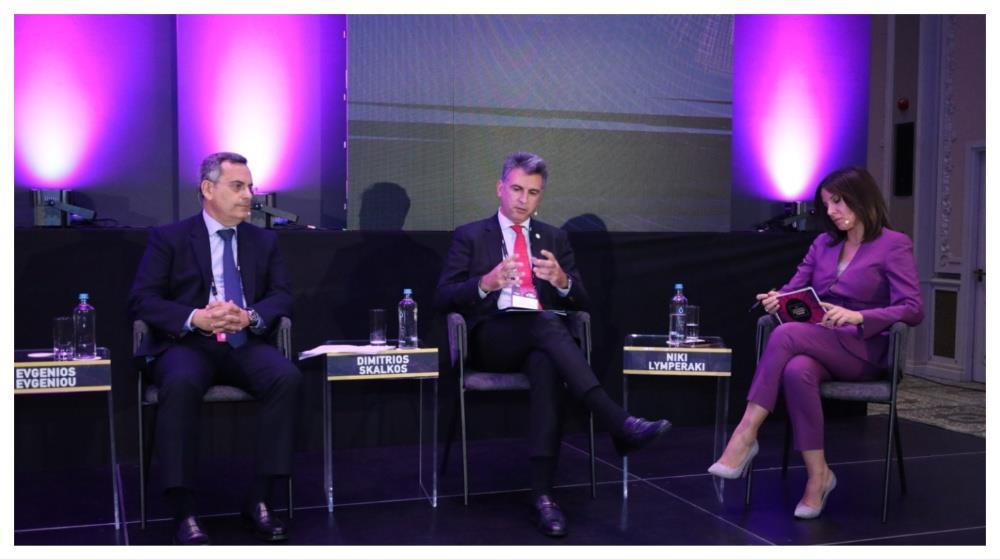
The discussion was moderated by journalist Niki Lyberaki and featured Dimitrios Skalkos, President of Enterprise Greece and Secretary-General for International Economic Relations at Greece’s Ministry of Foreign Affairs, and Evgenios Evgeniou, Chairman of Invest Cyprus. The two speakers analysed the profound changes taking place in the international movement of capital.
According to Evgeniou, globalisation as we once knew it no longer exists. The interconnectedness that characterised financial transactions, trade and supply chains is now being weaponised for political purposes.
As the President of Invest Cyprus explained, investment flows are no longer driven solely by economic or tax considerations. For the first time, the growth rate of foreign investment is lower than that of global GDP.
Evgeniou believes that Cyprus’s economic growth in recent years, which has placed the country among the fastest-growing economies in the European Union, is largely attributable to foreign direct investment. Against a backdrop of intensifying competition to attract capital, he considers the performance of both Cyprus and Greece a significant achievement.
For his part, Skalkos identified four major categories of global investment trends, with a direct impact on Southern Europe and the Eastern Mediterranean.
According to the President of Enterprise Greece, the first category encompasses artificial intelligence, automation applications, cloud computing, robotics and cybersecurity - areas directly linked to economic security.
The second trend concerns the clean and green energy sector, with a particular focus on energy storage technologies and batteries. The third relates to the life sciences and health sciences sectors, particularly biotechnology and pharmaceutical manufacturing.
Skalkos identified infrastructure-driven connectivity as the fourth key pillar, including infrastructure such as pipelines and subsea cables.
In the Greek official’s assessment, in today’s world, financial capital is less fluid, while a country’s real value is determined by how deeply its economy is integrated into global value chains.
The key conclusion is that Cyprus and Greece must urgently adapt their investment models to the new geopolitical and technological criteria if they are to maintain their momentum and secure the long-term stability of their economies.