

In an era when international rules are being tested and balances of power are shifting, Europe is faced with a crucial question: can it shape developments or will it be limited to the role of observer? European integration, which for decades has been based on cooperation, peace and the common defense of values, is called upon to adapt to an environment where strategic responsibility is gaining new importance.
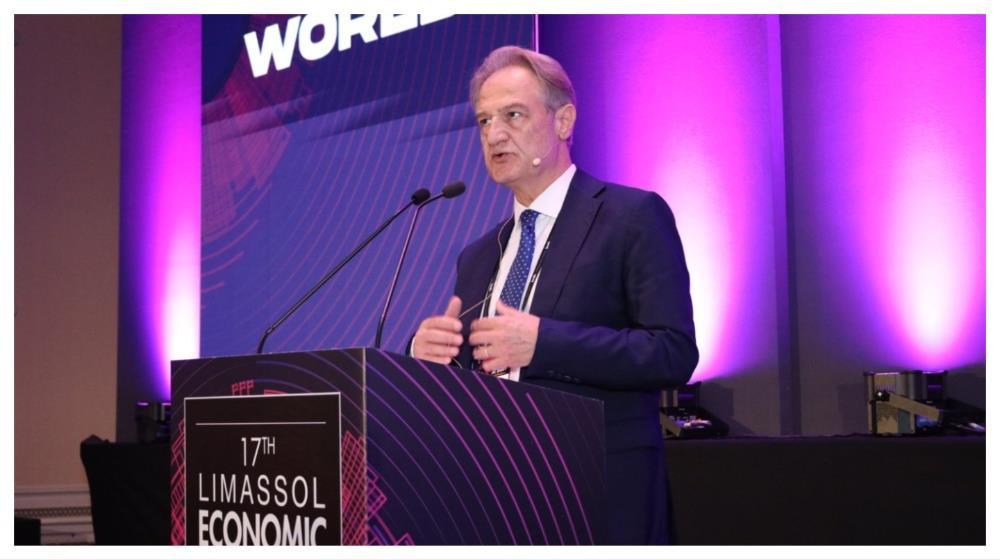
Europe’s potential to defend its common interests and values in an unstable international environment was analysed by Loukas Tsoukalis, President of the Board, Hellenic Foundation for European & Foreign Policy (ELIAMEP)/ Professor, Sciences Po, Paris; Professor Emeritus, University of Athens, during the 17th Limassol Economic Forum. In his speech entitled “The challenge for Europe in times of global disruption”, the professor proceeded with a deep analysis of the systemic threats in the Eastern Mediterranean.
Turning his attention to the local reality, Tsoukalis underlined that he is in a place where an international problem, the Cyprus Problem, still exists, for which there has been no solution for a very long time. Paraphrasing Churchill's famous saying about the Balkans, the professor characteristically stated that "the region produces much more instability than it can consume". As he estimates, in the Eastern Mediterranean, traditional conflicts coexist, such as the confrontations between Greece and Turkey, but also potential conflicts over the exploitation of energy resources in areas of disputed sovereignty. According to his analysis, the simultaneous appearance and interaction of different crises creates a new normality, which is characterized by "multi-crisis" and "permanent crises", causing a constant sense of uncertainty and instability among citizens.
At the same time, Tsoukalis argued that the international system is changing into a stable polycentric and network model, which becomes even more complex after the election of Donald Trump in the United States. In the speaker’s view, Trump’s election marks the return of the logic of pure power, the absence of multilateralism and the weakening of international principles, causing a rift in transatlantic relations and a serious erosion of American credibility. Within this context, the professor described the Eastern Mediterranean as a “sandwich” trapped between two major war fronts, the war in Ukraine in the north and the conflicts in the Middle East with the involvement of Israel and Iran in the south.
As the President of ELIAMEP explained, in such a fluid environment, revisionist states strengthen their aggressive philosophy, while states that seek to maintain the status quo are forced to follow hedging policies. This, in his assessment, makes states “polygamous”, as they are forced to broaden their options and create conjunctural, overlapping or even competitive alliances, with Turkey and Saudi Arabia being typical examples of this behavior.
In conclusion, Tsoukalis pointed out that the European Union, although it has a strategic interest in promoting stability in the region to ensure energy supply and manage migration, has so far demonstrated limited influence. As he argues, the promotion of European electricity interconnection projects, such as the Great Sea Interconnector (GSI), remains sluggish, while even the most recent Mediterranean pact is limited to economic management, infrastructure and renewable sources, without touching on the hard security issues of the region. According to the professor, Greece and Cyprus must seek their own defense and reaction capabilities in the face of this constantly fluid European and international environment.