



The challenges facing businesses in an international environment of fragmentation, economic changes and technological disruptions were discussed by senior executives of the Cypriot market at the 17th Limassol Economic Forum.
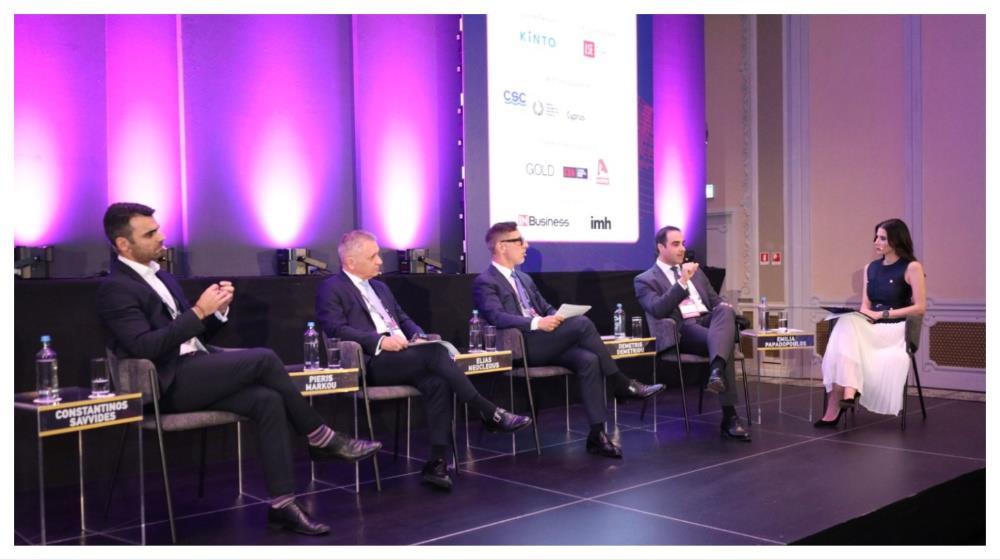
The panel entitled 'Leading Through Uncertainty: How CEOs Are Preparing for the World of 2027,' coordinated by journalist Emilia Papadopoulou, featured leading executives from Cypriot business, presenting their strategies for managing uncertainty in view of 2027. According to the participants' common understanding, the ability of organisations to navigate prudently and decisively in an unstable international environment is the most important factor for survival and growth.
According to the remarks of Constantinos Savvides, CEO of bbf:, Cyprus is in a market where the housing sector has seen prices for houses and apartments almost double in a period of ten years, while investment at the transaction level is expected to be 3 billion higher than the previous peak period. As Savvides states, businesses in Cyprus are naturally showing high self-confidence, with booking data showing that the momentum is maintained, supported by the confirmation of the country's economic indicators by rating agencies. However, he believes that navigation requires both self-confidence and caution, as complete abstention from the market due to geopolitical risks is not an option, since three years ago someone could have underestimated the risks and ultimately missed significant opportunities.
According to Elias Neocleous, Managing Partner of Elias Neocleous & Co LLC, the modern reality requires the demonstration of clear resilience, which translates into the taking of smart and calculated risks by Cypriot companies. As Neocleous argues, rapid technological developments can completely overturn a business model and eliminate corporate value, with artificial intelligence weakening our relationship with truth and making critical thinking more important than ever. He points out that CEOs have a responsibility to protect their profits and shareholders, but at the same time they must integrate technology into their corporate strategy for the future, giving their people an environment to grow.
On his part, Pieris Markou, CEO of Deloitte Cyprus, argued that the use of technology increases efficiency and clients now expect improved services from all those who serve them. According to Markou’s analysis, in the past, specialisation and resources were the privilege of large players, but today new players are entering the market using new technologies more effectively to reduce prices. In his opinion, the adoption of these tools must be done with caution and security, without replacing people, but ensuring that they are properly trained to utilize technology to improve their daily work.
According to Demetris Demetriou, Chief Risk Officer of Bank of Cyprus, whenever you ask three economic questions, you should always start the answer with two words, “it depends”. As Demetriou explained, everything depends on two main drivers, geopolitical developments and technological events. In his assessment, military conflicts have pushed up fuel prices and interest rates, while trade wars increase the cost of trade and inflation. As the Bank of Cyprus executive concluded, when inflation exceeds the target, central banks inevitably proceed with interest rate increases, a phenomenon that has already been observed in both Asia and Europe.