



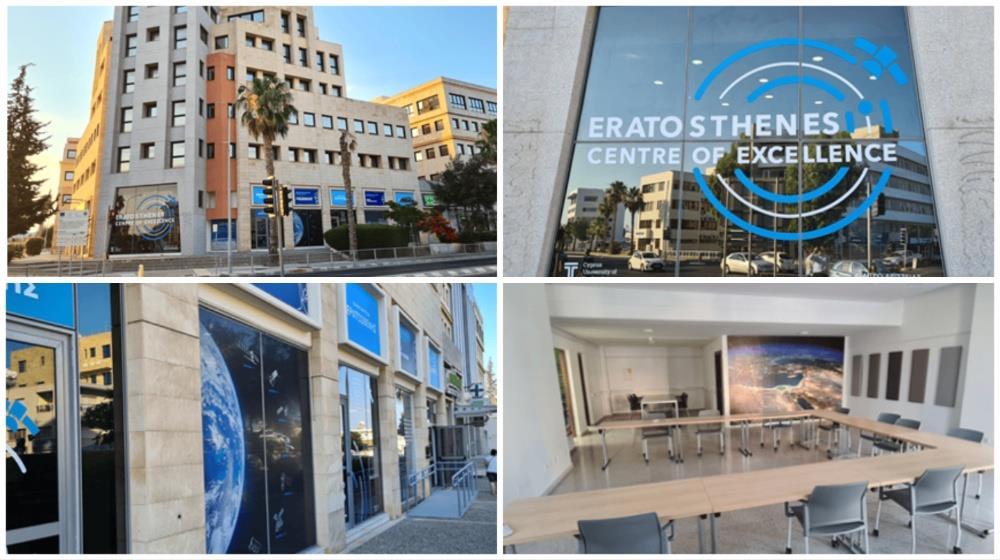
European Commission representatives expressed satisfaction with the work and plans of the ERATOSTHENES Centre of Excellence at the Cyprus University of Technology (CUT) during a tour of its under-construction facilities at Verengaria in Polemidia, Limassol district, which are expected to be completed in 2027.
The delegation of European officials is in Cyprus for a two-day visit during which the fifth reporting period of the EXCELSIOR project is being evaluated (RP5 Review Meeting).
Highlighting the importance of the ERATOSTHENES Centre of Excellence for both Cyprus and Europe, Alberto Fernández-Wyttenbach, Director of Research Programmes at the European Commission’s European Research Executive Agency (REA), said the centre was of strategic importance.
“The ERATOSTHENES Centre is a flagship strategic project for the country, not only in the area of observation of space, but also in satellite telecommunications. It is operating very well, and the support that is going to receive in the future from the Ministry of Research is also demonstrating that there is substantial investment at the political level, as well as an understanding that this is a strategic industrial field that needs to be developed,” he said.
He also noted that Cyprus is now an associated member of the European Space Agency (ESA), adding that “this Centre puts the capabilities of Cyprus up front to the international space community”.
Expressing satisfaction with the work being carried out, Fernández-Wyttenbach stressed that ERATOSTHENES “demonstrates that Cyprus needs to be at the forefront alongside other countries that are also members of the European Space Agency”.
On his part, ERATOSTHENES Centre of Excellence Chief Executive Officer, Professor Diofantos Hadjimitsis, said the site visit formed part of the evaluation of the EXCELSIOR project, which is funded by the Republic of Cyprus and the European Commission to the tune of €38 million.
“European funding will come to an end in December, and we will continue with other sources of funding, including the Republic of Cyprus,” he said.
Saying that the European Commission representatives were “fully satisfied with the progress of the construction work”, Professor Hadjimitsis said the facilities are expected to be completed by the summer of 2027, after which the Centre’s equipment, currently housed at various locations across the city, would be transferred there.
“The Centre will be co-located with CUT’s Department of Civil Engineering and Geomatics, with the aim of pooling our strengths in research and innovation, not only for CUT and Cyprus but also to become a giant in Europe,” he noted.
Furthermore, he said that having its own facilities would allow the Centre of Excellence to eliminate a significant expense associated with renting its current premises, and to bring together approximately 120 staff members who are currently spread across four buildings in central Limassol.
He added that the new building would feature specialised laboratories, rooms equipped with digital technology and collaborative spaces, with an emphasis on energy efficiency and sustainable design.
Meanwhile, CUT Vice-Rector for Financial Planning and Development, Vangelis Akylas, said the university stood firmly behind ERATOSTHENES, which was, in any case, “its own child”.
“We are doing everything we can to support it and, according to the schedule, it is expected to be completed in 2027, becoming a building of high technological standards and architectural beauty,” he said.
He added that construction of the university’s new student residences was also at an advanced stage, with a total capacity of 500 beds.
More specifically, he said Phase A of the student residence project at Verengaria would be handed over soon, while Phase B was expected to be completed in 2027.
The European Commission delegation subsequently visited the EarthView Cyprus station in the community of Pera Oreinis (Nicosia district). The station is operated by a consortium comprising the ERATOSTHENES Centre of Excellence and CYTA.
The visit concluded at the ERATOSTHENES Centre of Excellence’s CARO atmospheric observatory in Limassol, which is equipped with advanced systems for monitoring dust, particulate matter, clouds and wind.