







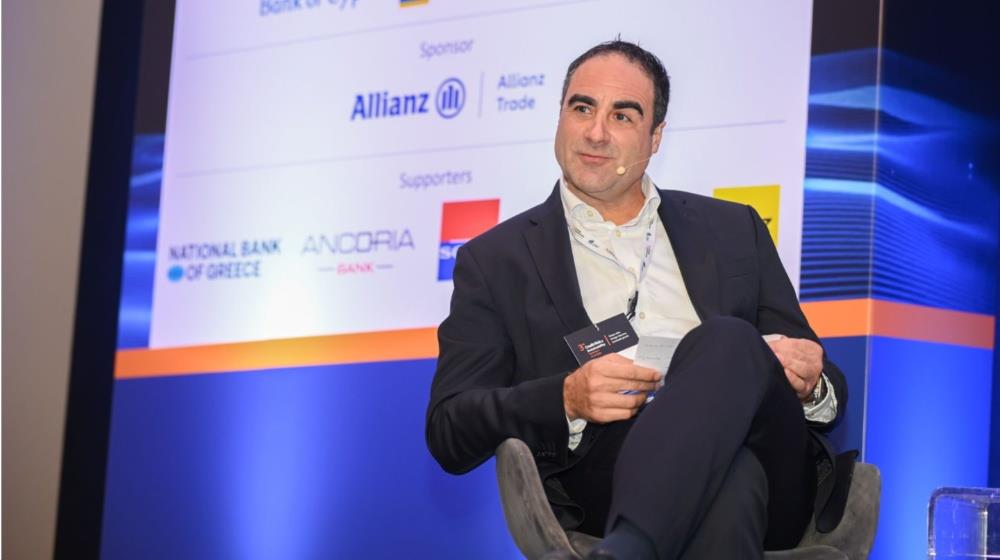
Demetris Demetriou, Chief Risk Officer at the Bank of Cyprus, has called for a more forward-looking, collaborative approach to risk management, warning that historical data alone is no longer sufficient to anticipate an increasingly complex global risk environment.
Speaking during a fireside chat entitled 'Credit Risk, Leadership and AI', moderated by Dimitrios Bourpoulas, ESG Project Leader at Artemis Credit Bureau as part of the 3rd Credit Risk & Sustainability Conference in Nicosia, Demetriou discussed how geopolitical tensions, cyber threats, artificial intelligence (AI) and climate change are reshaping the risks facing banks and businesses.
“The only certainty nowadays is uncertainty,” Demetriou said, reflecting on the pandemic, ongoing regional conflicts, energy disruptions and the rapid development of emerging technologies.
He noted that global interconnectedness means events in one part of the world can have significant consequences elsewhere, including for smaller economies such as Cyprus. A cyberattack launched thousands of kilometres away, for example, can disrupt businesses and financial institutions across borders.
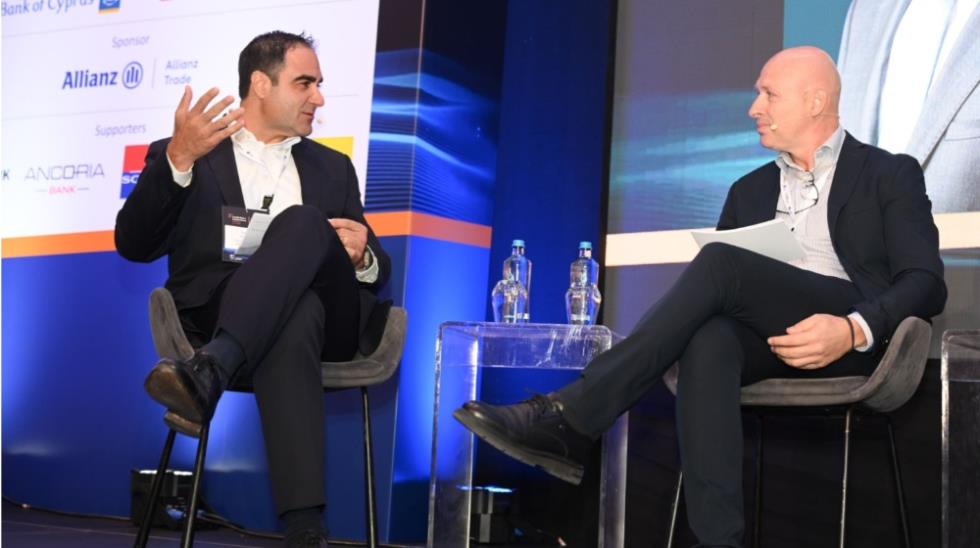
Demetriou explained that banks continue to rely on predictive models, historical data and established controls to assess and mitigate risks. However, technological advances are expanding their ability to collect and analyse information, while also creating new threats that may fall outside existing models.
“When there is no historical precedent, how do you assess a situation and decide how to deal with it?” he asked, highlighting the need for scenario-based planning and simulation exercises, commonly known as wargames.
At the Bank of Cyprus, such exercises have included scenarios involving a major earthquake and a large-scale AI-driven cyberattack. These simulations bring together teams from risk management, treasury, IT, information security and customer communications to assess potential losses and coordinate an effective response.
Demetriou stressed that preparation must extend beyond prevention to include the ability to respond quickly and effectively when a crisis occurs. He also underlined the importance of cooperation between banks, businesses, governments and public institutions, citing the COVID-19 pandemic as an example of the need for collective action.
AI presents a dual challenge, he added: both the technology itself and the speed at which it evolves. While AI can strengthen risk detection and analysis, its misuse could generate substantial damage, while smaller organisations may struggle to keep pace with developments.
The discussion also examined the growing role of environmental, social and governance (ESG) data in credit decisions. Demetriou explained that environmental risks, including extreme weather events and the transition to a more sustainable economy, can affect borrowers’ future cash flows and repayment capacity.
Companies that identify and manage these risks may offer banks greater confidence in the stability of their future cash flows, influencing financing decisions, loan-loss provisions and capital requirements.
Concluding the discussion, Demetriou emphasised that effective risk management must combine better forecasting with practical crisis preparedness.
“History alone is no longer enough to predict the future,” he said, calling for simulation exercises and a more collective approach to managing emerging risks.