







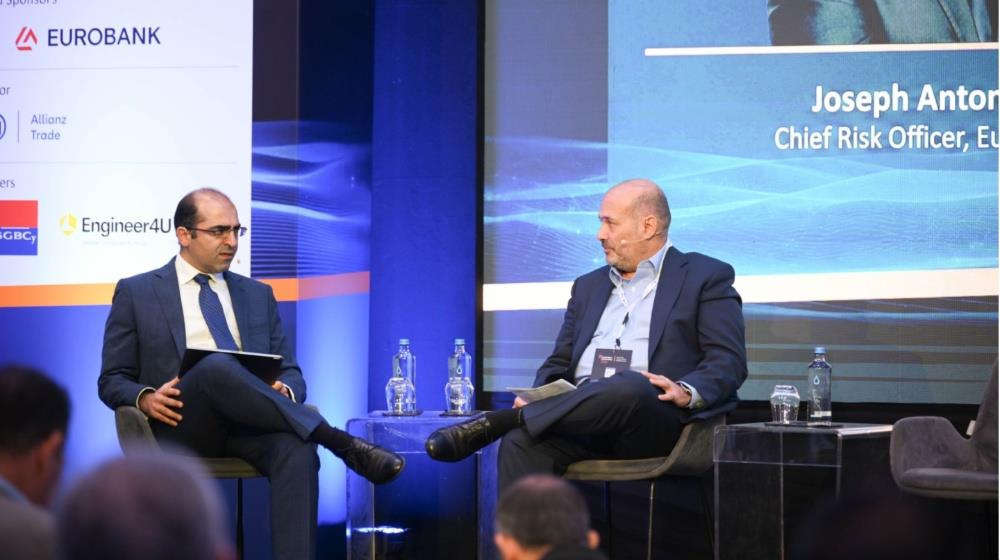
Joseph Antoniou highlights the importance of data quality, strategic prioritisation and geopolitical resilience during a fireside chat at the 3rd Credit Risk and Sustainability Conference.
Banks must combine artificial intelligence (AI), advanced analytics and a strong risk culture to navigate an increasingly complex financial landscape, according to Joseph Antoniou, Chief Risk Officer at Eurobank.
Speaking during a fireside chat with Spiros Giourgas, Executive Director, Digital Transformation Services and Solutions at ICAP CRIF, on the sidelines of the 3rd Credit Risk and Sustainability Conference, Antoniou discussed banking transformation, credit risk integration, technological innovation and the resilience of Cyprus’s economy.
Addressing the challenges of integrating risk management practices following a merger, Antoniou stressed the importance of establishing a common credit underwriting philosophy, consistent policies and a unified risk appetite before implementing major systems changes. Risk management, he said, must protect organisations against reputational and execution risks while enabling operational improvements and sustainable growth.
On AI and advanced analytics, Antoniou described data utilisation as a strategic competitive advantage for banks, warning that institutions failing to keep pace risk falling behind. Applications range from behavioural scoring and predictive models to early-warning systems and real-time credit risk monitoring.
However, he emphasised that technological adoption requires robust governance, sophisticated model validation and reliable data.
“Two magic words are completeness and accuracy,” he said, highlighting the data gaps and legacy systems that continue to challenge traditional banks.
Antoniou also called for disciplined implementation, noting that banks cannot pursue every AI initiative simultaneously. “The perfect is the enemy of the good,” he remarked, advocating clear priorities, focused execution and a long-term transformation strategy.
Turning to Cyprus’s credit risk outlook, Antoniou pointed to the economy’s strong recovery despite successive shocks, including the financial crisis, COVID-19 and geopolitical conflicts. He highlighted economic growth above 3%, a favourable sovereign credit rating, fiscal discipline and well-capitalised banks with strong liquidity as important indicators of resilience.
He acknowledged that renewed geopolitical tensions, energy price increases and potentially higher interest rates could put pressure on household finances. Nevertheless, improvements in credit underwriting and the regulatory framework should help banks absorb economic stress.
“We must be ready for everything,” Antoniou said, stressing the importance of scenario analysis and preparation for adverse developments.
Concluding, he emphasised that risk management must do more than mitigate potential losses. It must also help organisations identify opportunities, adapt to uncertainty and make better-informed strategic decisions.
Also read:Marios Skandalis: ESG is a strategic investment in Cyprus’s economic future