






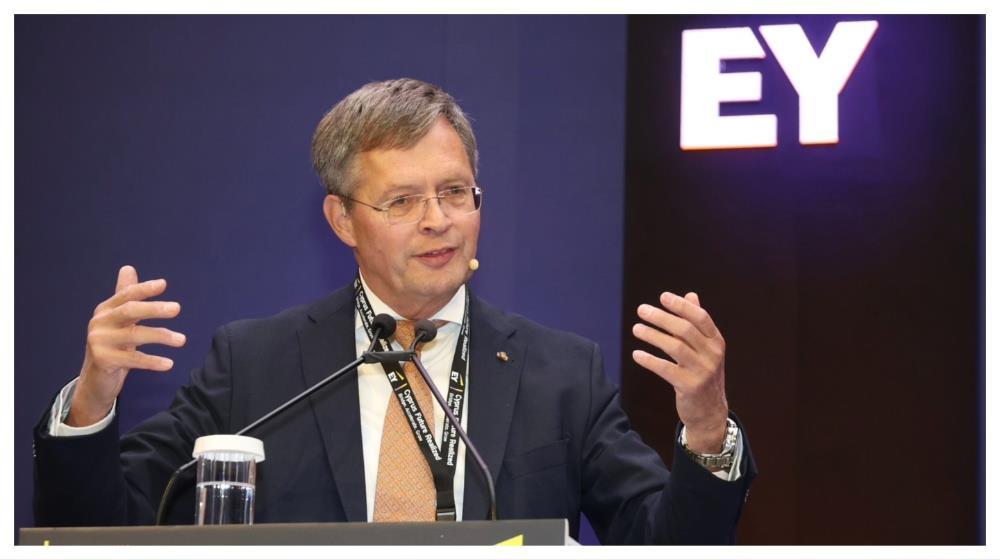
Jan Peter Balkenende, the former Prime Minister of the Netherlands presented his own perspective on the European economic and investment environment at the recent EY Cyprus Future Realized Forum 2026, linking the findings of the study on Cyprus with the data recorded more broadly in Europe in relation to foreign direct investment.
In his introductory presentation at the 9 September event, Balkenende compared the two studies and developed nine observations on the emerging picture. His approach revolved around a key question: how can the trust that still exists in Cyprus and in Europe be transformed into long-term competitiveness?
Trust exists, but it is not enough
As Balkenende mentioned, an interesting element that emerges from both studies is that, despite the turmoil and changes that characterise today's international environment, trust has not been lost. It therefore remains an important foundation on which to build the next phase.
For Cyprus, the question is no longer limited to whether it is considered attractive. The question, as he put it, is how this trust can be transformed into long-term competitiveness. This distinction shifts the discussion from the country’s image to its ability to capitalize on the trust that has already been created.
Cyprus in the great European transition
Balkenende focused on the series of changes taking place simultaneously in geopolitics, energy and sustainability, pointing out that Cyprus is not outside these developments.
On the contrary, several of the challenges facing the country are, according to him, also European challenges, in a more concentrated form. This position is important for the investment debate, as the attractiveness of Cyprus cannot be examined independently of the environment in which European economies operate.
From tax advantage to trust
Referring to the traditional investment image of Cyprus, he noted that tax incentives have long been part of the country's attractiveness and continue to be important.
However, in today's environment of uncertainty, investors are looking for trust, predictability and strong institutions, he stressed. Thus, investment competitiveness is not only linked to a specific advantage, but also to the broader context within which investors are called upon to make decisions.
Small size can become a competitive advantage
Another interesting aspect of his position concerned the size of Cyprus. In a period in which speed is becoming increasingly important for competitiveness, the small size of a country can, according to Balkenende, act as an advantage.
The logic is simple: a smaller country may be able to move faster, reform faster, and innovate faster. For Cyprus, this may be part of the answer to the broader question of how trust translates into competitiveness.
The challenge lies in implementation
At this point, Balkenende raised a crucial parametre: execution. As he mentioned, Europe has no shortage of proposals and clear recommendations for boosting competitiveness. However, doubts often concern whether they can be implemented in practice.
Implementation, therefore, is a key part of the equation for him. The existence of trust, the recognition of challenges and the formulation of proposals need to be accompanied by the ability to implement them.
His overall approach thus linked investment attractiveness to a broader European reality: Cyprus has the confidence and, as a small country, can have a speed advantage. The challenge is effective implementation that will allow these elements to be translated into long-term competitiveness.
The EY Cyprus Future Realized Forum 2026 the Bank of Cyprus as its main sponsor and under the auspices of Invest Cyprus.
(Source: InBusinessNews)