








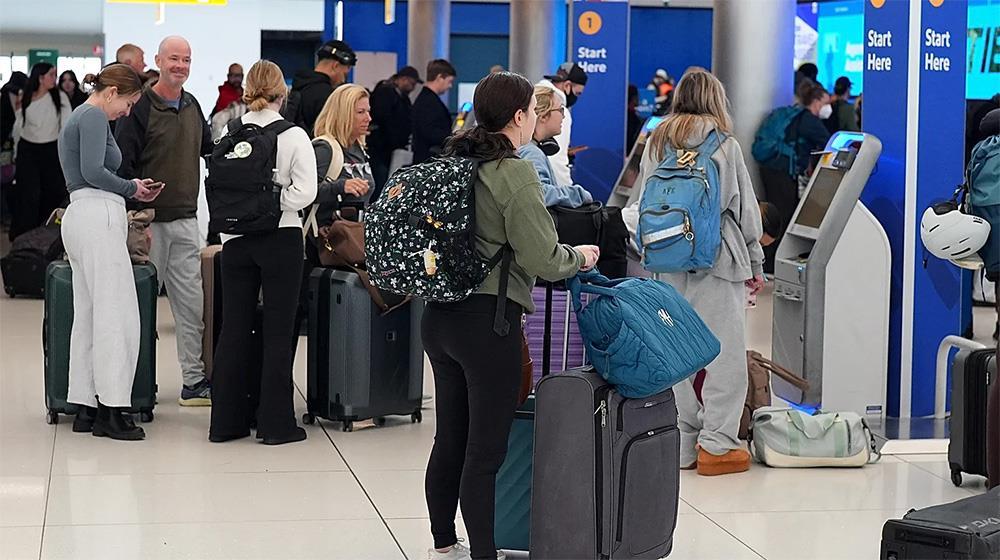
More than 145 million entries and exits have been recorded since the launch of the Entry/Exit System (EES), according to a European Commission announcement published on Monday.
It is noted that the Entry/Exit System records travel document data, biometric data (including fingerprints and facial images), as well as data related to travellers’ entry and exit.
Nationals of EU countries, as well as Iceland, Liechtenstein, Norway, and Switzerland, are not registered in the Entry/Exit System.
According to the announcement, the system has been fully operational at all external Schengen border crossing points since April 10, 2026, and has been designed to "modernise border management and strengthen EU security."
Categories not registered
The Commission states that although the Entry/Exit System records millions of travellers from third countries, certain categories are not registered in the system.
For these travellers, border checks remain unchanged. They must present their ID or passport along with their long-stay visa or residence permit, without the need for fingerprinting or facial scanning.
The exempt categories include nationals of Andorra, Monaco, and San Marino, as well as holders of passports issued by the Vatican City State or the Holy See.
Long-stay visas and residence permits
According to the Commission, third-country nationals holding a long-stay visa or residence permit issued by a country operating the Entry/Exit System are not registered in the system.
However, holders of residence permits and long-stay visas issued by Cyprus or Ireland are registered in the Entry/Exit System.
The announcement also states that third-country nationals who are family members of an EU citizen or a citizen of Iceland, Liechtenstein, Norway, or Switzerland (such as a spouse, child, or dependent parent) and hold a residence card or permit are exempt from registration.
This exemption applies regardless of whether they travel with the family member or not.
For example, a Moroccan spouse married to a French citizen who holds a French residence card will not be registered in the system.
In contrast, if a third-country family member does not hold a residence card or permit, they will be registered. For example, a Canadian married to a Lithuanian citizen without a Lithuanian residence card.
Who the system does not apply to
According to the Commission, the Entry/Exit System does not apply to nationals of European countries using the system, nor to nationals of Cyprus and Ireland.
It also does not apply to third-country nationals holding a residence card who are immediate family members of an EU citizen.
Exemptions also include third-country nationals who hold a residence card or permit and are immediate family members of a third-country national who has EU-like mobility rights.
The system also does not apply to third-country nationals travelling to Europe for intra-company transfers or for purposes such as research, studies, training, voluntary service, student exchange programs, educational projects, or au pair work.
Additional exemptions include holders of residence permits and long-stay visas, nationals of Andorra, Monaco, and San Marino, and holders of Vatican-issued passports.
The system also does not apply to individuals exempt from border checks or granted special privileges, such as heads of state, accredited diplomats, and cross-border workers.
Diplomats travelling for short stays may also be exempt under certain conditions.
The exemption also applies to members of the armed forces travelling on NATO or Partnership for Peace duties, provided they carry the required identification and movement orders under the NATO Status of Forces Agreement.
This exemption may also apply to civilian staff or dependents covered by the NATO agreement.
It further applies to international civilian staff of NATO based in any of the 29 European countries using the system, as well as their dependents.
Additional exemptions include persons not required to cross external borders exclusively at official border crossing points or during fixed opening hours, as well as holders of valid local border traffic permits.
The Commission also states that crew members of passenger and freight trains operating international routes are not registered.
Finally, the system does not apply to persons holding a valid Facilitated Rail Transit Document or Facilitated Transit Document, provided they travel by train and do not disembark anywhere within EU Member State territory.
(Source: InBusinessNews)
