







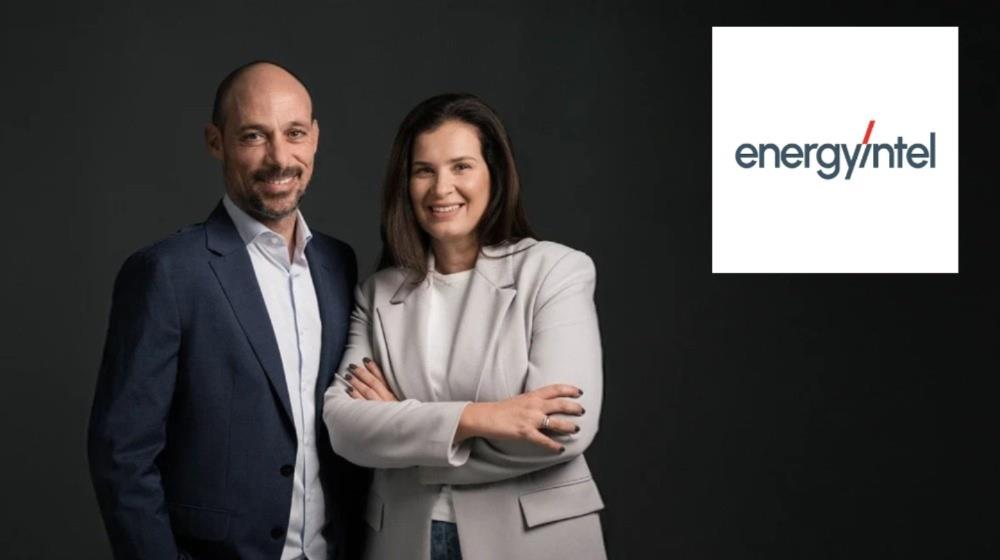
EnergyIntel has developed energy storage technology that is supported by 104 patents, has been independently assessed by the international organisation DNV and has been tested in real operating conditions in four countries, EnergyIntel's co-founders and co-owners, Eugenia Herodotou, Chief Executive Officer, and Marios Alexandrou, Chief Operating Officer.
"The official signing of the €2 million funding agreement, within the framework of the STEP Award through the Research and Innovation Foundation , marks a new phase. It confirms that a technology developed in Cyprus can go from research and testing to industrial production, with a commercial and international perspective," the co-owners of EnergyIntel state, among other things, in an interview with InBusinessNews.
EnergyIntel has been investing in research and development since 2016. What was the initial market need that led you to create your first technological solutions?
Our starting point was a simple but essential observation: energy cannot just be produced. It must be controlled, stored and used where it has the greatest value for the user, the business and the grid. EnergyIntel was founded in 2006 and, after ten years of experience in solar energy, we decided in 2016 to systematically invest in research and development. At that time, the market was still mainly oriented towards the installation of production systems. The discussion about energy management, and even more so about its storage, was limited.
However, we saw that increasing production from renewable sources would create a new, more complex issue: how the energy produced would be utilised in a predictable, efficient and economically rational manner. That is where our technological path began. We wanted to move from the logic of simple installation to the logic of energy intelligence, with solutions that provide more information, better control and greater ability to utilise energy. Storage is at the core of this approach, because it transforms energy from an instantaneous good into a strategic resource.
Today, the official signing of the €2 million funding agreement, under the STEP Award through the Research and Innovation Foundation, marks a new phase. It confirms that a technology developed in Cyprus can move from research and testing to industrial production, with a commercial and international perspective.
How have energy storage technologies evolved in recent years and what role do they play today in the transition towards a more sustainable energy model?
Storage has evolved from a complementary solution, often seen as a backup, to a critical infrastructure of the modern energy system. Its role today is to decouple the moment of production from the moment of consumption. This is crucial in an environment where renewable generation is increasing but not always matching demand. The real evolution is not just about the equipment. It is about how storage is designed, integrated and controlled as an active part of a larger energy ecosystem. The value lies in the data, the forecasting, the scheduling and the ability of a solution to help the user or the grid make better decisions.
Electrochemical batteries have made significant progress and will continue to play a vital role. At the same time, long-term storage technologies, such as thermal storage, open up new possibilities for applications that require more hours of autonomy, stable operation and a lower environmental footprint. The transition will not be based on a single technology. It will be based on a portfolio of solutions, selected based on the real needs of each application.
What are the biggest challenges facing electricity networks today with the massive penetration of renewable energy sources?
Electricity grids are being forced to operate in a very different environment than the one they were designed for. For decades, generation was centralised and relatively predictable. Today, thousands of small and large generation units feed energy into the system, and flows are no longer unidirectional. The key challenge is the asymmetry between generation and demand. There are times when renewable generation is high and consumption is low, and times when demand is high when available renewable generation is low. This creates absorption constraints, a need for balancing, and a greater demand for flexibility.
The answer cannot be just expanding infrastructure. A smarter energy system is needed, with digital monitoring, automation, better forecasting and storage. Storage absorbs energy when there is a surplus and delivers it when there is a need, reducing pressure on the grid and increasing the utilisation of clean generation. Long-term storage is particularly important. In applications where prolonged needs are required, the ability to store for longer hours enhances the stability and resilience of the system. This is one of the issues that will define the energy model of the next decade.
What differentiates EnergyIntel's solutions from other companies operating in the photovoltaic and energy management sectors?
Our differentiation is not based on a communication promise. It is based on systematic investment in research, proprietary technology and application in real conditions. For us, energy is not a set of independent products or services. It is a single ecosystem, in which production, storage, consumption, data and the network must work in coordination. EnergyIntel has developed energy storage technology supported by 104 patents, independently assessed by the international organization DNV and tested in real operating conditions in four countries.
These are not just titles for us. They are proof of technological maturity, reliability and applicability. Our technology is designed to respond to different scales and needs, from industrial applications to projects that can support broader network needs. At the same time, the thermal approach we are developing seeks high recyclability and a lower environmental footprint throughout the solution's life cycle.
Equally important is the knowledge network surrounding our technology. We collaborate with the Aristotle University of Thessaloniki, the National Technical University of Athens, the University of Birmingham and the King Abdullah University of Science and Technology, KAUST. These collaborations strengthen the scientific basis of our work and contribute to the continuous optimization of the technology. Our participation in the Long Duration Energy Storage Council (LDES Council) also connects us to the international dialogue on long-term storage. We monitor market developments, technological directions and regulatory challenges, so that the solutions we develop in Cyprus have an international view and perspective.
How important is the Cypriot market to the company and what strategy are you following for your expansion abroad?
Cyprus is of strategic importance to EnergyIntel. It is the base from which we started, the environment where we developed expertise and the field where we deeply understood the real challenges of an island energy system. It has high solar potential, growing energy needs and the need for greater flexibility, which make it particularly interesting for the development of storage technologies. At the same time, Cyprus offers us a flexible base for testing, prototyping and rapid optimisation, with access to specialised scientific personnel.
This capability allows us to rapidly develop our solutions before transferring them to a larger scale and to international markets. The broader ambition is for the country to not be limited to the role of a consumer of imported energy technologies. It can become a producer and exporter of technology, with new highly skilled jobs, collaborations with universities and research institutions, and a more substantial technological footprint internationally.
Our strategy abroad focuses on markets where the need for storage is real and immediate: countries with high renewable penetration, energy-intensive industries, grids that need more flexibility and organisations looking for better control over energy costs. Today, we see interest from markets such as Greece, Spain, Poland and Bulgaria, as well as from industry in Cyprus. International expansion, therefore, is not just about transferring a product. It is about transferring a proven technology and an implementation model that can be adapted to different energy needs. We want Cyprus to remain the base of our technology and its implementation to gain international reach.
Do you believe that energy storage will be the most important factor for the success of the green transition in the coming years?
Storage will be one of the key factors, but it should not be looked at in isolation. The green transition requires renewable generation, stronger grids, digital governance, a clear regulatory framework, investable business models and technologies that have proven their reliability in practice. The particular value of storage is that it creates trust. Trust for the consumer, who needs greater predictability.
For industry, which needs to manage its costs and operations. For investors, who seek stability and the ability to plan for the long term. And for the grid, which needs flexibility to effectively utilize clean energy. Long-term storage is particularly important, because it can cover longer time gaps between production and demand. The more storage is properly integrated into market mechanisms and system design, the more the energy transition will become practically feasible and economically viable.
Where do you want EnergyIntel to be in the coming years and what is your vision behind the strategic tagline “Energy Evolved”?
We want EnergyIntel to consistently move to the stage of full scale, not only in terms of its production capacity, but also in terms of the role that a Cypriot technology company can play in a sector of international importance. The signing of the contract for the industrial production of our technology is the starting point of a new phase. What is now required is scale, production discipline, consistent quality, international collaborations and the ability to shape an integrated development model around the technology. This is the meaning of “Energy Evolved”. It is not just about a different storage technology. It is about the evolution of the entire value chain, from research to industrial application, from know-how to production and from local development to international commercial exploitation.
We want to connect with a new model of technological extroversion. With a production base that operates reliably, technology that is applied in different markets and a network of partnerships that constantly enhances the evolution of our solution. To do this, highly specialized human resources are required, continuous investment in research and industrial thinking. We believe that this path can create a substantial footprint for Cyprus as well. Innovation acquires real value when it is converted into production, specialized jobs, international collaborations and exportable products. This is our goal: to transform technological knowledge into application, application into production and production into international value.
How difficult has the journey been so far? Were there individuals, companies and organizations that supported you in your first steps, on a logistical level?
Creating a technology company with international ambitions is never easy. Especially when the mission is not to commercialise an already available technology, but to develop new know-how, invest in research for many years and transform the innovation into an industrial product. The challenges were technological, business and financial, but each stage strengthened our belief that value is built with long-term vision and discipline in execution.
EnergyIntel's most important asset is its people. We have created a team of young scientists, engineers and professionals with high expertise, a common orientation and persistence in solving complex problems. Patents, technology and facilities have value because there are people who develop them every day and turn them into reality.
We also had investors and strategic advisors by our side who believed in our vision from an early stage, offering experience, trust and guidance in the transition from innovation to business development. The support of the Research and Innovation Foundation was also essential, as it contributed to creating the framework within which Cypriot research can evolve into technology, industrial production and exportable value.
Today, as we enter a new phase of development, we remain committed to the same principle: great technologies are not created by isolated ideas, but by teams of people who have knowledge, perseverance, and a common purpose.
(Source: InBusinessNews)
