








The adoption of artificial intelligence in businesses is typically associated with automation and increased productivity. In practice, however, initial AI projects often act as a demanding stress test for the entire organization, revealing the true quality of its data, processes, and decision-making. The better a company’s internal structure, the greater the value AI can ultimately deliver.
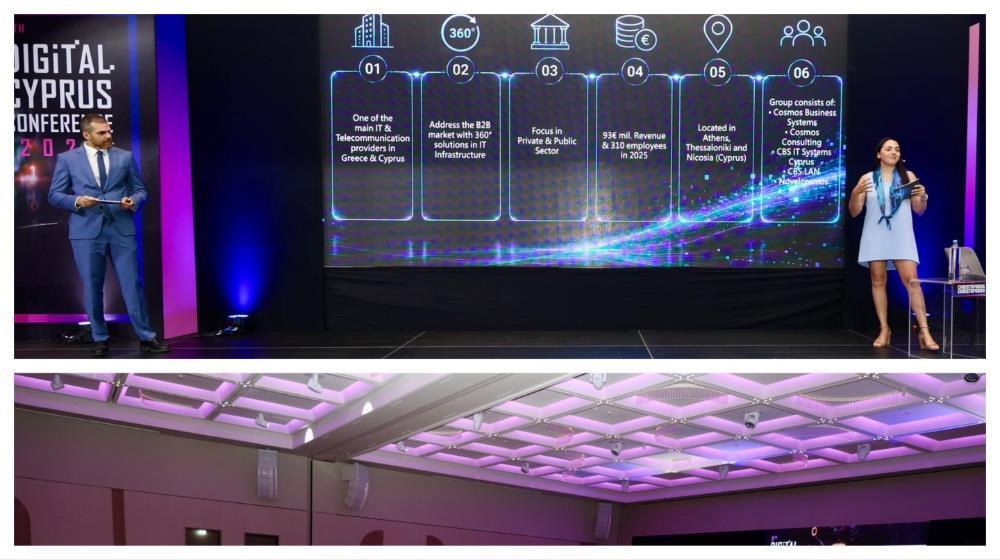
This conclusion was highlighted at the 5th Digital Cyprus Conference 2026, organized by CITEA and IMH, through the experience of Cosmos Business Systems SA in developing an AI chatbot for the Archium™ document management platform.
Christina Dafni, Director of Consulting & Software, and Giannis Torakis, Technical Manager of the Software Department at Cosmos Business Systems SA, explained that their team tasked AI with enhancing the intelligence of searching and utilizing corporate documents. The outcome, however, was not what they initially expected: the AI acted as a mirror, exposing the company’s actual operational state.
One of the key findings related to business decision-making. While AI can accelerate the execution of a strategy, the strategy itself remains a human responsibility. The clearer the business objectives and requirements, the higher the quality of AI-generated outcomes. Conversely, vague instructions inevitably lead to vague results.
Particular emphasis was also placed on data quality. During the chatbot’s development, the team found that the biggest obstacles stemmed from scanned documents without readable text, legacy files with problematic character encoding, and inconsistently entered metadata. As they noted, even the most advanced AI model cannot produce reliable results when the underlying information is incomplete, contradictory, or poorly organized.
The speakers also highlighted the critical role of metadata management, stressing that high-quality metadata is essential for the effective performance of AI applications. Their experience showed that many issues attributed to AI actually originate from how organizations manage their corporate data.
Another important takeaway concerned human skills. AI acts as a multiplier of knowledge and productivity, but it requires strong foundational expertise. Developers and professionals are now expected to evaluate, validate, refine, and take responsibility for outcomes, rather than simply produce code or content.
In closing, the speakers emphasized that despite the rapid advancement of artificial intelligence, the most important success factor remains the human element. Deep customer understanding, insight into real business needs, experience, and judgment are qualities that no AI system can replicate. Technology can accelerate processes, but real value is still created by the people making the right decisions.
