







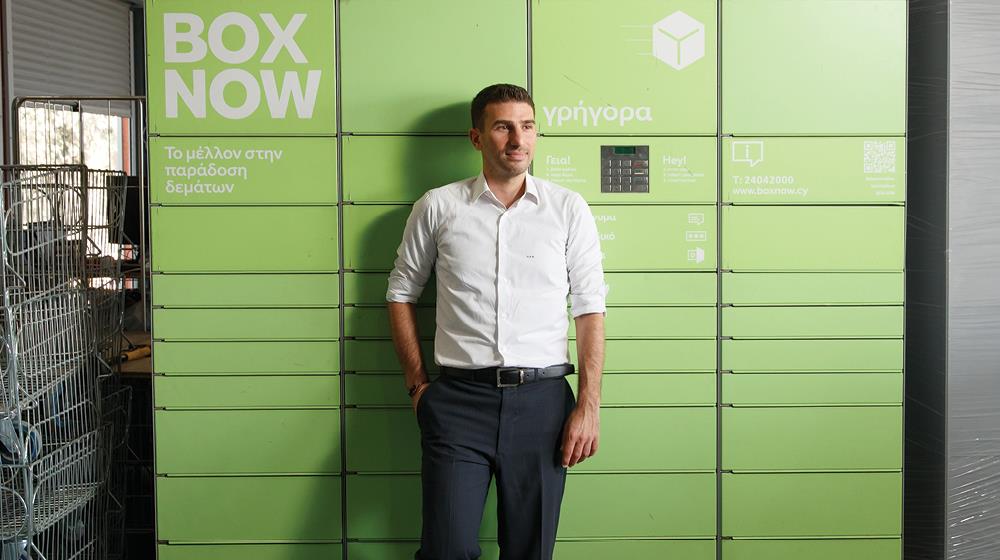
“Trust also grew quickly as consumers experienced the simplicity, speed and reliability of the system first-hand. Cypriot consumers are digitally aware and open to solutions that improve everyday life, especially when combined with affordability and sustainability. This is also shown by the fact that more than 100,000 people have already downloaded our mobile application which allows them to send, receive and track parcels from their phones,” says Byron Kaklopopoulos, the CEO of BOX NOW.
In a recent interview with GOLD magazine, he explores the company’s expansion into the local market, and discusses how technology is reshaping the logistics sector.
What led BOX NOW to set up operations in Cyprus two years ago?
Following the Group’s success in Greece, Bulgaria and Croatia, Cyprus was a natural next step for BOX NOW. We saw a clear opportunity to introduce a modern parcel delivery model – using outdoor parcel lockers – which was already proving highly successful in other European markets. BOX NOW operates as a courier/last-mile operator in the dynamic and rapidly growing e-commerce market, serving consumers who value convenience, speed and flexibility. Cyprus also has strong digital adoption and a population that is increasingly comfortable with self-service technologies. Cypriot customers had the fastest adoption rate among the four countries in which our Group operates. Our goal was, is and will always be to offer consumers a delivery experience that fits today’s lifestyle: 24/7 access, fast delivery and no need to wait at home for a courier.
How many parcel lockers are available in Cyprus? Are there plans to expand?
BOX NOW currently operates a rapidly growing network of locker locations across Cyprus, with more 180 lockers and more than 20,000 compartments covering almost three million parcels and 300,000 customers. The network covers all major cities and towns, as well as many suburban and regional areas, allowing customers to access deliveries close to their homes or workplaces. Expansion remains a key priority for us. We are continuously evaluating new locations based on customer demand, e-commerce growth and accessibility, with the aim of making BOX NOW available within a few minutes of every consumer.
How have Cypriot consumers adopted this more modern method of delivery services?
Cyprus traditionally relied on more conventional courier and logistics models, largely because of its geography and market structure. However, as I have already noted, consumers adapted to automated locker delivery much faster than many expected – even us! Convenience and the proximity of the lockers to their home or workplace have been the main driver. Customers appreciate being able to collect parcels whenever they want, without waiting for home deliveries or adjusting their schedules around courier visits, which seemed to be a major sticking point for the customers here in Cyprus. The younger generation adopted the service almost immediately but we are now seeing broad acceptance across all age groups. Trust also grew quickly as consumers experienced the simplicity, speed and reliability of the system first-hand. Cypriot consumers are digitally aware and open to solutions that improve everyday life, especially when combined with affordability and sustainability. This is also shown by the fact that more than 100,000 people have already downloaded our mobile application which allows them to send, receive and track parcels from their phones.
How have changing technologies, such as the rise of AI, affected the logistics sector?
Technology – especially artificial intelligence – is transforming the logistics sector at every level. AI helps companies optimise delivery routes, predict parcel volumes, improve warehouse operations and manage capacity much more efficiently. This leads to faster deliveries, lower operating costs and a better customer experience. At the same time, automation and data analytics allow logistics providers to anticipate demand patterns and respond more effectively during peak periods. AI also improves customer communication through real-time updates, smarter tracking systems and more personalised services. For companies like BOX NOW, technology is not simply a support tool – it is at the core of how modern logistics operates and evolves. We have embraced AI and incorporated it into our services: we use an AI agent as the first point of contact for our call centre, we are investing a lot in developing our mobile application and we are automating our warehouse operations.
As global turbulence continues to affect many economic sectors and activities, how is the logistics sector dealing with supply chain issues?
Over the past few years, the logistics sector has faced significant challenges, from supply chain disruptions and rising transportation costs to geopolitical uncertainty and inflationary pressures. The sector has responded by becoming more flexible, data-driven and resilient. One of the biggest lessons has been the importance of diversification and operational agility. Companies are investing more in technology, local infrastructure and predictive planning to minimise disruptions. Automated locker networks contribute to efficiency because they reduce failed delivery attempts and optimise last-mile operations. Despite global challenges, the logistics industry has shown strong adaptability and continues to evolve to meet both business and consumer expectations. We believe that during this challenging time – particularly due to the ongoing US-Iran conflict – the sector will face some short-term difficulties, such as gas costs and delays, but it will come back stronger.
What will the logistics sector look like in the future, especially in small markets like Cyprus?
The future of logistics will be defined by speed, automation, sustainability and customer satisfaction. Consumers expect deliveries to be faster, more flexible, and environmentally friendly. In smaller markets like Cyprus, smart logistics infrastructure will play an even more important role because efficiency and scalability are essential. We expect automated parcel locker networks to continue expanding significantly, becoming a standard part of urban infrastructure for parcel deliveries. Technology will further improve delivery precision, while AI and predictive analytics will make logistics operations more efficient than ever before. Sustainability will also remain central, with companies investing in greener transportation models and energy-efficient systems such as ours coming under the spotlight for all the right reasons. For Cyprus specifically, the future is very promising. Small markets can often adapt more quickly to innovation because of their flexibility and strong digital adoption. The fact that Cyprus has a stable economy and a privileged geographical location will assist further. We strongly believe that Cyprus has the potential to become an excellent example of how modern, technology-driven logistics can improve both the consumer experience and operational efficiency
This interview first appeared in the June edition of GOLD magazine. Click here to view it.
Photo by Michalis Kyprianou.