








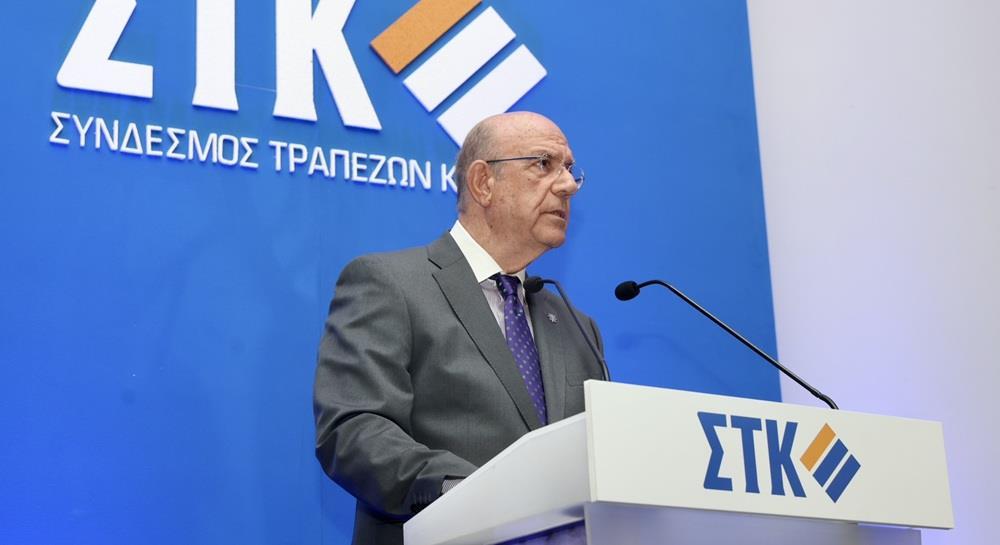
Finance Minister Makis Keravnos told the Annual General Meeting of the Association of Cyprus Banks on Tuesday that financial stability remains a “fundamental pillar” of a healthy and resilient economy, while stressing that Cyprus’ banking sector must continue to support growth through balanced and rational lending practices.
Speaking against the backdrop of strong economic performance, Keravnos said Cyprus has entered a new period of stability, growth and resilience, citing robust GDP growth, near full employment and a steady decline in public debt. He added that the banking sector is well capitalised, with the CET1 ratio at 25.1 per cent in March.
He also highlighted the government’s efforts to tackle non-performing loans through legislation and regulatory changes, while warning that some parliamentary proposals could create legal and institutional problems. Keravnos said the European Central Bank has raised concerns that such measures could expand financial risks and worsen the problem for borrowers rather than solve it.
The minister also pointed to the sector’s profitability, which he said remained around €1 billion in 2025, but argued that banks should do more to channel funding into healthy lending for businesses and productive sectors. He said the government’s return of Cyprus to investment grade after 11 years is helping create a more favourable environment for foreign investment, technology companies and startups.
Full address by the Minister of Finance
Mr. President and Members of the Board of Directors of the Association of Cyprus Banks,
Dear Director General of the Association,
Ladies and Gentlemen,
Once again, albeit in a challenging period, I am pleased to attend the Annual General Meeting of the Association of Cyprus Banks, an association that has consistently demonstrated significant and substantial work, especially in recent years, during which the challenges have been intense and continuous.
Financial stability constitutes a fundamental pillar of a healthy and resilient economy. Maintaining and preserving this pillar requires the consistent implementation of sound economic policy, while a balanced and rational strategy by the banking sector is also a necessary condition.
The Government and the Ministry of Finance, within the framework of their responsibility for maintaining economic stability, have implemented since assuming office a prudent, responsible, and effective economic policy, as well as a strict fiscal policy. This approach has already yielded tangible results, despite the adverse international economic environment.
With responsible governance and fiscal discipline, Cyprus has entered a new period of stability, growth, and economic resilience.
This positive trajectory is clearly reflected in key economic indicators. Over the past three years, the Cypriot economy has recorded steady and strong growth rates, among the highest in the Eurozone. In particular, in 2025 growth reached 3.8%, significantly exceeding the European Union average, while forecasts for 2026 remain particularly positive, with growth expected once again to exceed the European average.
At the same time, the Cypriot economy operates under conditions of near full employment, reflecting the dynamism of the labor market and increased economic activity.
Meanwhile, public debt continues on a steady downward path and is expected to be reduced to approximately 50% of GDP by the end of the year, marking one of the most significant reductions among EU Member States.
Ladies and gentlemen,
This period also coincides with a particularly important role undertaken by our country at the European level, within the framework of the Cypriot Presidency of the Council of the European Union during the first half of 2026, which is now drawing to a close.
In this context, particular emphasis was placed on strengthening the Banking Union, as well as on critical dossiers, including the digital euro. These developments directly affect the banking ecosystem and its future role.
It is fortunate that Cyprus’s banking sector will face these developments from a position of strength, with robust capital indicators.
The banking sector remains strong and well-capitalized, with the Common Equity Tier 1 (CET1) ratio standing at 25.1% in March 2026, significantly above minimum European requirements.
The increase in lending and investments in securities, based on first-quarter 2026 data, has also led to an increase in the sector’s assets.
NPLs, legislative proposals and ECB
Non-performing loans have recorded a significant reduction on banks’ balance sheets; however, they remain at high levels in the real economy, creating challenges for the smooth functioning of the economy.
To address this phenomenon, the government has promoted bills and regulations that ensure a stable and effective management framework.
Borrowers have additional tools at their disposal, while the institutional safety net is being strengthened. At the same time, the capacity for debt restructuring and settlement is being enhanced. Significant additional powers have also been granted to the Financial Ombudsman.
I could not fail to refer to certain related legislative proposals submitted by Members of Parliament which, despite the expressed views of the Ministry of Finance, the Central Bank, and the Legal Service that they may contain unconstitutional and other legal and institutional issues, were passed by Parliament. As a result, referrals and appeals were submitted to the Supreme Court by the President of the Republic, and consequently the opinion of the European Central Bank was sought regarding the suspension of foreclosures and the restructuring of loans and guarantees.
The European Central Bank expresses strong concerns about the expansion of financial risks that could evolve into fiscal risks, as well as the worsening of borrowers’ problems instead of their resolution.
The profitability of the banking sector remains at very satisfactory levels, reaching approximately €1 billion in 2025, albeit reduced compared to 2024 due to changes in interest rates.
As the Ministry of Finance, we would, of course, prefer that the profitability of our banks stems more from healthy lending to businesses in productive sectors and less from the widening of interest rate margins by the European Central Bank.
To this end, the Government has implemented and continues to implement an economic policy that has enabled our economy to regain investment grade after 11 years. This development creates a favorable environment for foreign investment, technology companies, and startups.
I am confident that the banking sector has recognized this and therefore we expect the creation of more appropriate financing products for our businesses and improvement through diversification of the loan portfolio across economic sectors.
The banking system as a key lifeline of the economy
Undoubtedly, the banking system constitutes a key lifeline of the Cypriot economy and a decisive factor for maintaining its growth momentum.
In this context, the formulation of financing terms, taking into account both market conditions and the long-term sustainability of borrowers, must contribute substantially to supporting economic activity, investment, and financial stability.
I believe that in recent years significant steps have been taken in the right direction. However, there is still room for further progress, with the aim of facilitating access to financing for households and businesses, particularly small and medium-sized enterprises, which form the backbone of the Cypriot economy.
At the same time, the banking sector is called upon to play a leading role in the transition to a more sustainable and green growth model.
Financing investments that promote energy transition, environmental sustainability, and economic resilience is a key prerequisite for achieving national and European green development goals.
This transition is a strategic priority for the Government, and I am confident that the banking sector will continue to be a valuable partner in this collective effort.
Ladies and gentlemen,
We live in an era of rapid developments and profound transformations that significantly affect the global economic and financial environment.
A characteristic example is the crypto-assets sector, which is rapidly reshaping the global financial landscape and creating new conditions for markets, investors, and supervisory authorities.
Technological progress and digital innovation offer significant opportunities for growth, efficiency, and the expansion of financial services. At the same time, however, they highlight new risks and challenges related to financial stability, market integrity, investor protection, and cybersecurity.
In this context, the full and consistent implementation of the European regulatory framework is particularly important.
In particular, the effective implementation of the Markets in Crypto-Assets Regulation (MiCA) is a key prerequisite for ensuring the smooth functioning of the market, enhancing transparency, trust, transaction security, and effective supervision of the sector.
Rapid technological developments
Equally important are rapid technological developments and the increasing integration of artificial intelligence in the financial sector.
Banks are called upon to leverage the capabilities offered by artificial intelligence to enhance efficiency, improve the quality of services provided, upgrade risk management processes, and develop more targeted and personalized products and services for their customers.
At the same time, this transition must be accompanied by strong safeguards and responsible governance.
Issues such as cybersecurity, data protection, algorithm transparency, and the ethical use of technology are now of paramount importance.
It is now clear that digital transformation, including the use of artificial intelligence, is not merely a technological option but a strategic necessity for maintaining and strengthening the competitiveness of the banking sector.
For this reason, it is important to actively participate in shaping developments rather than merely adapting to them after the fact. I am confident that our country’s banking sector understands the importance of this challenge and will continue to lead efforts in innovation, modernization, and the responsible use of new technologies.
In conclusion, I would once again like to congratulate the Association of Banks for the work it carries out and for its productive cooperation with the relevant State Services.
On this occasion, I would also like to express the Government’s appreciation to those banks that actively demonstrate corporate social responsibility and to encourage all banking institutions, as the most important economic institutions of our country, to place tangible social responsibility towards society and citizens at the forefront of their actions.
I wish you every success in the proceedings of your General Assembly
