






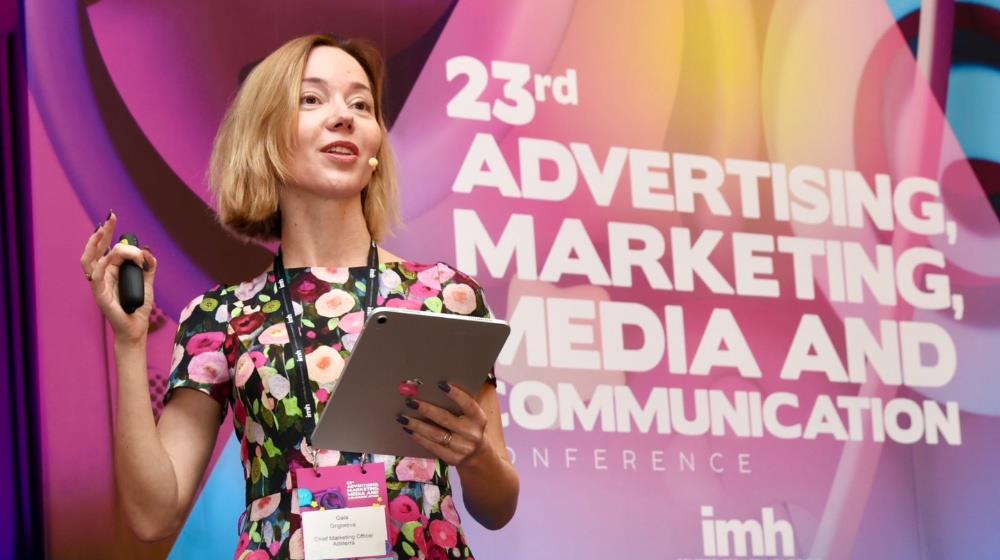
“Growth is relational. Technology accelerates work, while AI increases speed, complexity, and accountability. At the same time, reputation is shaped publicly. For this reason, culture is now visible from the outside, and growth depends on trust,” said Gala Grigoreva, CMO of Adsterra, during her keynote presentation titled “The Social-First Executive: Leading Culture, Community & Commerce” at the 23rd Marketing, Advertising, Media & Communication Conference.
During her speech, Grigoreva described leaders as “architects of trust” for their audiences. “That trust is built through transparency, consistency, integrity, empathy, and the courage to act competently,” she noted, stressing the growing importance of conscious leadership.
She added that, in today’s marketing landscape, an ideal leader is also a storyteller. “A leadership story that promotes a product must answer four key questions: Where are we going? Why does it matter? Who are we becoming? And what will we not sacrifice?”
Grigoreva emphasised that people follow meaning before they follow metrics. Alignment, she explained, is driven by shared values, which in turn enable authentic communication and shape organisational culture.
According to her, conscious leadership is rooted in a combination of emotional intelligence, empathy, curiosity, and creative thinking- qualities that make leaders adaptable. These are complemented by critical thinking and a strong ethical mindset, which not only support business functionality but also provide stability in times of uncertainty, when employees seek clarity and reassurance.
“A conscious leader must create meaning and navigate complexity and ambiguity, while collaborative problem-solving is essential to co-regulate teams and build trust,” she said.
Referring to case studies, Grigoreva highlighted cultural intelligence as a competitive advantage, noting that it enables brands to build relevance rather than simply expand reach. Citing CSA Research, she said that 76% of shoppers prefer product information in their own language, while localised campaigns can generate five to nine times higher conversion rates.
As an example, she pointed to Nike’s “Nothing Beats a Londoner” campaign, which resonated with audiences by showcasing the city’s youth culture, real neighbourhoods, and local energy, rather than idealised imagery.
“Cultural intelligence starts with genuine interest and respect,” she said. “In the end, purpose is credible when it is useful to others.”
She concluded by emphasising that organisations should strive to provide visibility, allocate resources, ensure credibility, open doors, and actively contribute to strengthening communities, both locally and globally.