







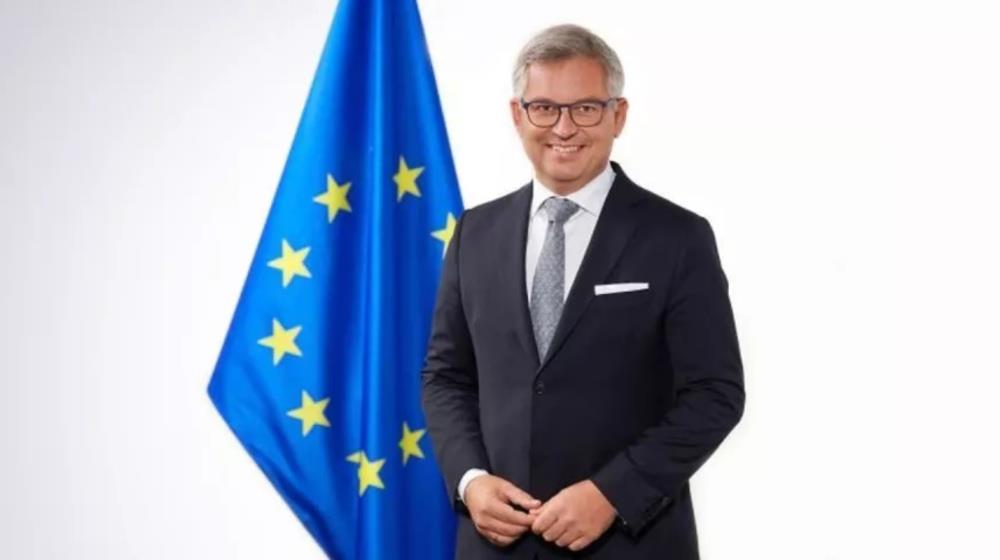
The European Commission will soon present its evaluation report on Cyprus’ bid to join the Schengen area, European Commissioner for Migration Magnus Brunner said, following the Justice and Home Affairs Council meeting in Luxembourg.
However, Brunner stressed that “the decision of when and how Cyprus joins the Schengen area lies within the Council, not within the Commission.”
Responding to a question by CNA on the evening of 4 June, the Commissioner said that Cyprus’ accession would be an important development for the European Union. “The Cyprus accession to the Schengen area would be a significant step, of course, forward for the European Union as a whole. And our primary focus as the Commission is on ensuring that Cyprus meets the higher Schengen standards,” Brunner said. “So therefore, we evaluated the situation in Cyprus and we will present the report soon,” he added.
The Commissioner underlined, however, that the final decision rests with EU member states. “But to make that clear. The decision of when and how Cyprus joins the Schengen area lies within the Council, not within the Commission. So, there's been a lot of progress and, thanks very much for the good progress and for the good cooperation. It would be a significant step, and we will see when the report comes out, it comes out soon, and then it's the Council to decide.”
Brunner was speaking alongside Cyprus Justice Minister Costas Fytiris and Deputy Minister for Migration and International Protection Nicholas Ioannides, who co-chaired the Council meeting during the Cypriot Presidency of the Council of the EU.
The EU Commission presented to Ministers its annual State of Schengen Report, which includes an assessment of developments across the Schengen area and was expected to contain references to Cyprus’ progress towards its first formal Schengen evaluation.
Cyprus making sustained efforts since joining the EU in 2004
Commenting on Cyprus’ preparations, Fytiris said the country has been making sustained efforts since joining the EU in 2004. “Since 2004, Cyprus has been making special efforts,” he said, noting that the country had implemented the core elements of the Schengen acquis with the support of the European Commission and EU services. “We had 120 recommendations and, with their help, we undertook a tremendous effort,” he added.
Fytiris said that he believes that Cyprus will be ready by the end of 2026. “We believe that by the end of 2026 we will be ready. The evaluation report, which we are eagerly awaiting, will vindicate our efforts and we will become a full member of the Schengen area,” he stressed. He added that Cyprus’ accession would strengthen the EU as a whole. “A united Europe means the free movement of European citizens throughout Europe, and particularly for Cyprus, which is located in a very sensitive but very important region. Cyprus’ accession to the Schengen area as a full member will add value to the European Union as a whole,” he said.
Regarding the broader agenda of the Council, Fytiris referred to the presentation of the 2026 State of Schengen Report, which reviews the implementation of the Schengen acquis over the past year. “During our discussion, it became clear that three main priorities identified last year remain valid also for our work during the next Schengen Council cycle,” he said. The priorities include accelerating the digitalisation of procedures and systems, strengthening the resilience of external borders and the effectiveness of returns, and enhancing internal security.
Fytiris also highlighted progress in the deployment of large-scale EU information systems in the field of justice and home affairs, particularly the Entry/Exit System (EES), which became fully operational on 10 April 2026. “For it to contribute to the EU’s internal security and border management as we intended, we all need to use this system in full compliance with our legal obligations,” he said.
Geopolitical developments
On geopolitical developments, the Minister noted that Ministers exchanged views on the impact of the situation in the Middle East, including the conflict involving Iran.“Currently, there are no signs of increased migratory flows stemming from the conflict in the Middle East. Nonetheless, having this useful exchange was a good opportunity to ensure coordination,” he said.
The Council also approved the implementation framework of the EU Drugs Strategy and endorsed a new EU Action Plan against drug trafficking. Fytiris described the discussion as particularly timely, noting that illicit drugs will also be discussed by EU leaders later this month.
Deputy Minister Ioannides, for his part, thanked both Fytiris and Commissioner Brunner for their cooperation during the Cypriot Presidency and focused on migration issues discussed during the meeting. Ministers reviewed the implementation of the Pact on Migration and Asylum, more than two years after its adoption. “The discussion revealed that there is significant progress in the implementation of the Pact. I am confident that we are ready to address the remaining challenges and deliver on our commitments,” Ioannides said.
He also recalled that Cyprus will host an informal ministerial conference on 12 June to mark the Pact’s entry into application.
External dimension of migration
A substantial part of the discussion focused on the external dimension of migration, particularly cooperation with Somalia. “When it comes to the external dimension of migration, we have adopted a whole-of-route approach and we aim at promoting sincere cooperation and mutually beneficial strategic partnerships with third countries,” he said.
According to Ioannides, irregular arrivals of Somali nationals to the EU more than doubled between 2024 and 2025. He stressed that Ministers agreed on the need to use all available tools. “We need to make use of all the tools at our disposal, including restrictive visa measures, when a third country insists on not being responsive regarding return and readmission,” he said.
Referring to Ukraine, Ioannides reiterated the EU’s continued support. “Our support for Ukraine is unwavering. There are more than four million Ukrainian refugees benefitting from temporary protection,” he said.
He explained that Ministers discussed the future legal status of displaced Ukrainians in order to provide clarity and allow member states to prepare the necessary administrative procedures. “We now expect the Commission to come up with a legislative proposal soon, so that we can proceed with the necessary work to ensure the continuation of our support to Ukraine and its people,” he said.
Ministers were also briefed on the migratory situation in the English Channel and the North Sea. While irregular arrivals to the EU have decreased compared to 2025, a significant number of irregular crossings from the EU towards the United Kingdom continue to be recorded.
Concluding his remarks, Ioannides welcomed the successful completion of negotiations with the European Parliament on the Return Regulation. “I am referring to the successful conclusion of negotiations with the European Parliament on the Return Regulation, following two months of intensive interinstitutional negotiations,” he said.
(Source: CNA)
