







The Minister of Agriculture, Rural Development and the Environment, Maria Panayiotou, has announced a set of measures to combat foot-and-mouth (FMD).
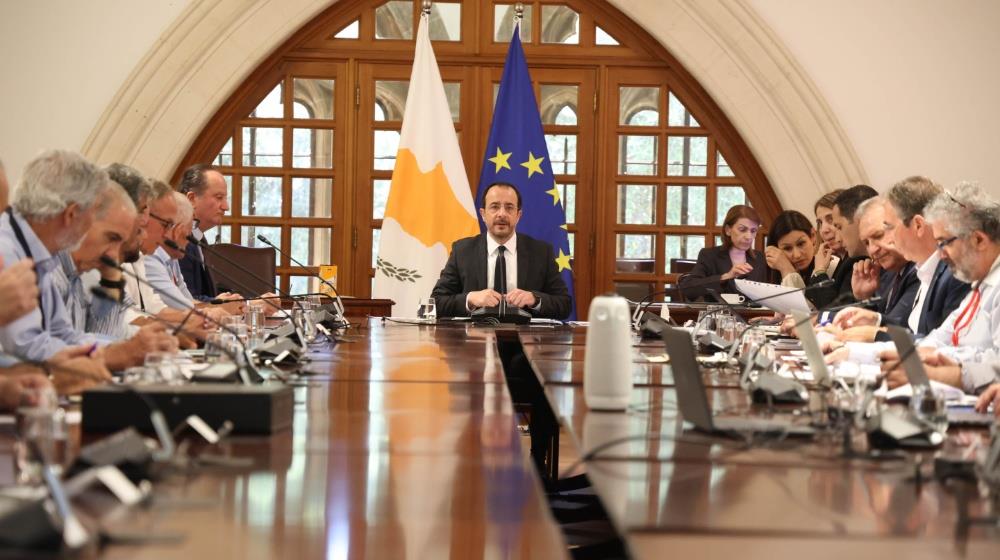
The immediate completion of culls, increased compensation for sheep and goats, stricter fines for animal movements and transactions with the occupied territories, sampling using two methods for detecting foot-and-mouth disease, and the rapid completion of the island-wide vaccination campaign are among the measures decided. Prior to the 2 June, announcement, the President of the Republic held separate meetings with the Epidemiological Team and agricultural organisations at the Presidential Palace.
The measures announced were received with satisfaction by the agricultural organisations, while the newly formed association “The Voice of Livestock Farmers,” which also participated in the meeting, appeared largely satisfied as well.
The Minister of Agriculture stated that the first decision is the immediate completion of the culling of animals on farms where the virus has been confirmed, estimating that the process can be completed within the next 24 hours.
The second measure is the application of both virus detection methods, PCR and ELISA tests, in areas where active outbreaks remain.
As she said, the results will be evaluated by the Epidemiological Team, which will decide on the further use of these methods.
At the same time, the nationwide vaccination campaign is continuing and nearing completion.
According to data presented by the Minister, the administration of the second dose has covered 84% of cattle, 78% of sheep and goats, and 41% of pigs.
Panayiotou also announced stricter fines for illegal transactions with the Turkish-occupied territories and other illegal movements.
The proposal to be presented to the Cabinet on Thursday provides for administrative fines of up to 100,000 euros and court-imposed fines of up to 250,000 euros.
She also noted that inspections to ensure compliance with biosecurity measures will be intensified, with more active involvement from the Police and the National Guard.
Panayiotou also announced a further increase in compensation for sheep and goats, with the amount to be assessed in the coming days.
The head of the Special Scientific Committee for the Reconstruction of the Livestock Sector, Stavros Malas, welcomed the measures that were decided, referring to four key tools available to the state and the scientific community to combat the epidemic.
“The first is to stop the source, which is the movement of animals from the occupied areas—the primary reason the virus entered the free areas,” of the Republic of Cyprus, he said.
He added that “Cypriot livestock farming, and specifically parts of the sheep and goat sector and the dairy sector, have developed a regular symbiotic economic relationship with the occupied areas”.
“This must stop. There can be no sustainable livestock farming if this continues,” he said, while welcoming the stricter measures that have been decided upon.
Malas noted that vaccines and tracing are essential scientific tools for combating the epidemic, pointing out that vaccination is proceeding at a rapid pace despite limitations on available vaccine supplies.
He placed particular emphasis on the decision to strengthen virus tracing and detection, adding that if outbreaks are not identified, the sheep and goat farming sector faces the greatest risk, and stressed that “our country cannot afford to lose the sheep and goat farming sector.”
He described the next three months as critical, noting that by the end of the year, decisions must be made regarding the future of the livestock sector.
“The issue of biosecurity is crucial; it had to be addressed and will be intensified even further,” said Dimitris Tsiartas, a member of the Epidemiological Team.
As he noted, modern sheep and goat farming requires specialised knowledge and a scientific approach, pointing out that current conditions differ significantly from those of previous decades.
He added that the changes taking place internationally in the livestock sector have left Cyprus vulnerable, underscoring the need to strengthen the country’s scientific evidence base and its engagement at the European level.
At the same time, he noted that the European Union must face up to its responsibilities, adding that Cyprus must present well-documented scientific arguments on issues of concern to the sector and other member states.
“No one should expect any relaxation of measures for at least the next two to three months; we need to be extremely strict,” said Tsiartas.
“We had a very constructive meeting with the President of the Republic. To achieve the goal that is common to all of us, we need unity and mutual understanding,” said Panikos Hambas, Secretary General of the Union of Cypriot Farmers (ΕΚΑ).
He emphasised the importance of informing livestock farmers, expressing the view that regional meetings should be held in each district and for each sector of the livestock industry, with the participation of the Epidemiological Team, the Veterinary Services, and the relevant authorities.
The EKA Secretary General also welcomed the increase in compensation for sheep and goats, while describing the stricter penalties for illegal trafficking from the occupied territories as particularly important.
“The President of the Republic brought a spirit not only of unity but also provided us with substantial information regarding the consultations he has conducted and the demands he has made of the European Union, which is particularly satisfying to us as members of the Panagrotikos Association,” stated the Secretary General of the Association, Tasos Giapanis.
He made special mention of the increase in fines for illegal transactions and other illegal activities related to the occupied territories.
“Following the President’s intervention, the fine rises to €100,000, an immediate fine, and by court order it can reach up to €250,000. We welcome this with all our hearts; this is exactly what we were asking for to stop this trade with the occupied territories,” he stated.
In a clarifying statement, Stavros Malas noted that “it was not decided to abandon the ELISA test and switch to PCR. It was decided to conduct both PCR and ELISA tests, and to do so much more aggressively.”
As he explained, “PCR detects the active virus in a single unit, while ELISA detects the virus in a latent state, and both pose a problem for Cypriot livestock farming.”
At the same time, he clarified that “both animals that test positive on PCR and those that test positive on ELISA will be culled, whether they are positive for one or the other.”
“The news is not good; 6,000 to 7,000 sheep and goats are slated for culling,” said initially Neophytos Neophytou, President of the “Voice of Livestock Farmers” association.
He noted that “the President of the Republic was positive and decisive regarding the other issues.”
Regarding the Green Line, he stated that “the President did not focus solely on smuggling. He also addressed the legal entry and exit points to the occupied areas, where his instructions were clear to ensure that there are many more and more extensive checks.”
“We applaud the fines to be imposed,” he added.
“As for the issue of compensation, I must admit that I am completely satisfied because the President stood up as he should have, rising to the occasion,” he noted.
(Source: CNA)
