







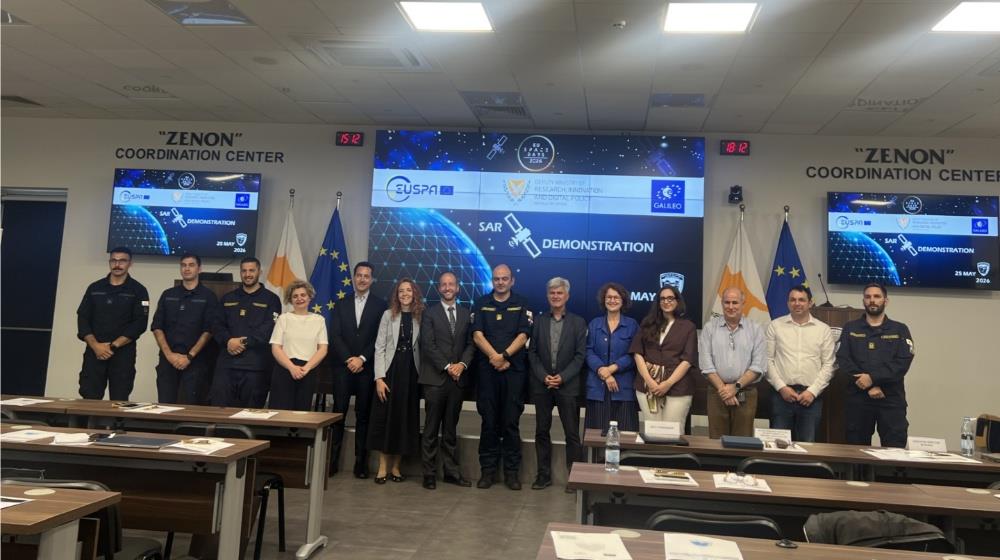
Cyprus' crucial role in search and rescue services in the region, as well as the significant contribution of European space programs to the protection of human life, were highlighted during a search and rescue exercise held at the Joint Rescue Coordination Center in Larnaka.
According to the Deputy Ministry for Research, the 25 May exercise took place in the framework of the European conference 'EU Space Days 2026' and was attended by representatives from the Deputy Ministry of Research, Innovation and Digital Policy, the Cyprus Space Office, the European Commission’s Directorate-General for Defence Industry and Space (DG DEFIS), as well as the European Union Agency for the Space Programme (EUSPA).
Participants had the opportunity to observe a small-scale Search and Rescue (SAR) exercise, under the coordination of the JRCC, with the participation of maritime assets and helicopters of the National Guard Cyprus and the Cyprus Police.
The objective of the exercise, it is noted, was to demonstrate, under real conditions, the process of alerting Search and Rescue services through emergency beacons, as well as to highlight the operational contribution of satellite systems to the timely and effective response to distress incidents. Particular emphasis was placed on the European satellite navigation system GALILEO and its contribution to SAR operations.
The press release says that JRCC operates the Cyprus Mission Control Centre (CYMCC), which is one of the 33 centres worldwide within the framework of the international Cospas-Sarsat programme. The GALILEO system also participates in this framework through its satellite and ground infrastructure. In addition, one of the three MEOLUT ground stations in Europe is located in the Kakoratza area in Cyprus.
Cyprus’ key role in the provision of Search and Rescue services
This activity highlighted Cyprus’ key role in the provision of Search and Rescue services in the region, as well as the significant contribution of European space programmes to the protection of human life, it adds.
In his speech, CEO of EUSPA Rodrigo da Costa said that “at EUSPA, our mission is to ensure that the European Union’s space systems are not only developed, but securely operated, continuously maintained, and translated into reliable operational services. This means turning space infrastructure into tangible capabilities that support citizens, governments, and industry, with a constant focus on security, resilience, and trust.”
“Galileo is the European Union’s flagship satellite navigation system, delivering secure positioning and timing services to billions of users worldwide. Over the past decade, it has evolved into a robust multi-service system, supporting critical applications across transport, logistics, emergency response, and critical infrastructure. Its Search and Rescue capability, including the unique Return Link Service, is a clear example of how European space technology directly contributes to saving lives by improving the speed, accuracy, and reliability of distress response,” he added.
Referring to the exercise, he said that “it demonstrates that the effectiveness of Galileo Search and Rescue depends on close cooperation across the entire European ecosystem. EU institutions, Member States, operational rescue authorities, and industry partners all play a key role in ensuring that the system works seamlessly in real conditions. It is this collective effort that transforms space capabilities into operational services, enabling faster response times and ultimately helping save lives in critical situations.”
Detecting and locating emergency beacons
Meanwhile, JRCC Commander Giorgos Economou said that JRCC Larnaca proudly hosts the Cyprus Mission Control Centre (CYMCC), one of the 33 operational Mission Control Centres worldwide within the international Cospas-Sarsat satellite system.
This global system, he went on to say, was established to detect and locate emergency beacons, providing airmen and mariners in distress with a vital lifeline by alerting Rescue Coordination Centres.
"The European Union Galileo satellite system is fully integrated into this framework, contributing to both its advanced space constellation and ground segment capabilities. One of the four European Medium Earth Orbit Local User Terminals (MEOLUTs) is strategically installed here in Cyprus" he said.
Today, he told participants, "you will have the opportunity to observe how Galileo is integrated into the global SAR network and to learn about a revolutionary capability: the Return Link Service (RLS)".
For JRCC Larnaca, it is both a challenge and a responsibility to coordinate all operational domains in order to achieve the ultimate objective of every Search and Rescue mission: zero loss of human life, he concluded.
Space technology as a strategic pillar for public security and civil defence
Speaking on behalf of the Deputy Minister, George Komodromos, Deputy Permanent Secretary of the Deputy Ministry said that the Deputy Ministry of Research, "is the authority responsible for our national space strategy and our active participation in European space programs. We view space technology as a strategic pillar for public security and civil defence. To this end, the Government of the Republic of Cyprus has a clear political commitment to promoting space applications for Disaster and Risk Management."
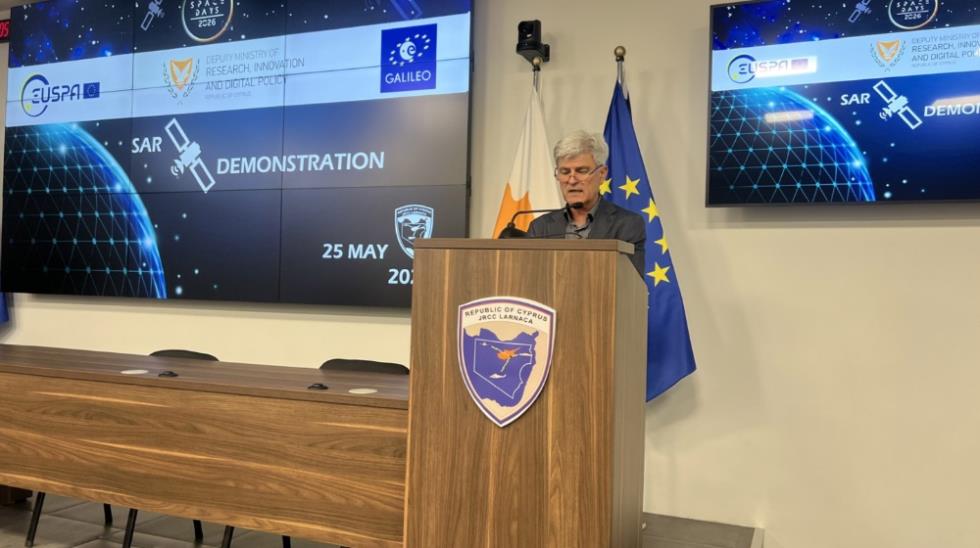
Today’s exercise, he noted, "is a practical showcase of this commitment. We are utilising critical infrastructure, specifically the MEOLUT earth station. As part of the EU Galileo System’s Search and Rescue service, this infrastructure is essential for detecting and locating emergency beacons with life-saving precision. It is important to note that Cyprus is one of only three countries in Europe hosting such specialised infrastructure".
Satellite services, he said, are not just technical achievements, they are tools that save lives, reduce damage, and support emergency response in times of crisis.
"Through this demo, we demonstrate that Cyprus is not only a consumer of space services but a key contributor to the European space ecosystem" he concluded.
(Source: CNA)
