







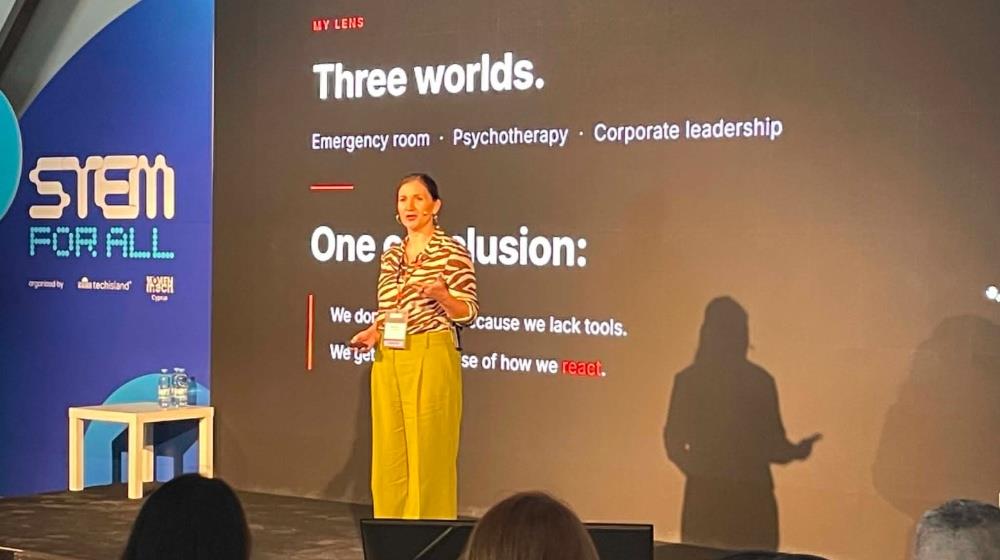
Aleksandra Sulimko, COO of TheSoul Publishing, said at the STEM For All event organised by TechIsland and Women In Tech Cyprus that many organisations misunderstand the real challenge behind AI transformation.
“Most companies do not have an AI problem - they have a reaction problem,” she said.
Sulimko explained that while AI tools are making employees significantly more productive, organisations are often failing to translate those gains into meaningful collective results. According to her, the issue is less about technology itself and more about how people emotionally respond to uncertainty and rapid change.
Drawing on experience spanning emergency medicine, psychotherapy, and corporate leadership, Sulimko said people tend to fall into automatic behavioral patterns when placed under pressure. Those reactions, she argued, become especially visible during periods of technological disruption.
“Technology evolves faster than humans emotionally adapt,” she noted during the presentation.
A key focus of the talk was the growing disconnect between accelerating AI systems and workplace psychology. Sulimko said organisational messaging around innovation can unintentionally trigger fear among employees, even when leaders intend to encourage progress.
Calls to “move faster” or “think differently,” she explained, are often internally interpreted by workers as warnings that they may become replaceable.
According to Sulimko, those fear-based reactions can quietly undermine transformation efforts by creating resistance, overwork, and defensive workplace behaviors.
She compared the situation to the high-pressure environment of an emergency room, where people rely heavily on automatic responses when operating under stress. In corporate settings, she said, those same reaction patterns influence how teams respond to uncertainty, change, and AI adoption.
The presentation also explored behaviors commonly emerging inside organisations adapting to AI. One example involved employees who respond to uncertainty by taking on excessive responsibility in an attempt to remain indispensable.
While such individuals may appear highly committed, Sulimko warned that the pattern is often driven by fear rather than sustainable leadership. Over time, she said, this can lead to burnout, resentment, and weaker collaboration within teams.
Beyond individual behavior, Sulimko stressed that emotional reactions ultimately shape company culture itself.
“Organisations do not move at the speed of strategy,” she said. “They move at the speed of their collective reactions.”
The session concluded with a more optimistic message, emphasising that awareness of these patterns can help organisations adapt more effectively. By recognising automatic reactions, employees and leaders alike can make more deliberate decisions during periods of change.
As businesses worldwide continue investing heavily in artificial intelligence, Sulimko argued that long-term success will depend not only on technical capability, but also on understanding how people behave under pressure.
Her presentation positioned AI transformation not simply as a technological revolution, but as a fundamentally human challenge unfolding inside modern organisations.
