








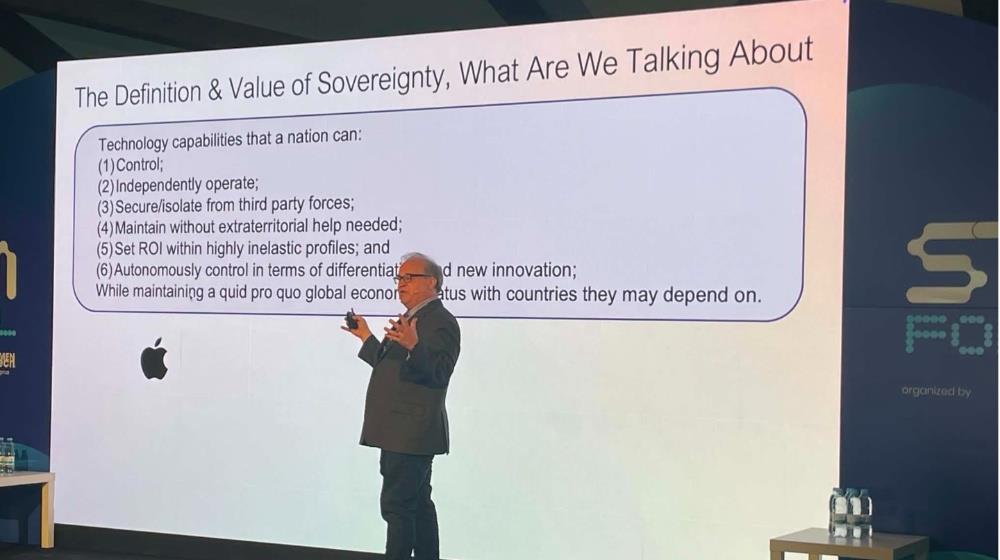
Keith Witek, Chief Operations Officer of Tenstorrent Inc. spoke at the STEM For All event organised by TechIsland and Women In Tech Cyprus warned that artificial intelligence is rapidly reshaping global power structures, pushing nations into a new race for technological sovereignty.
Witek argued that countries able to control critical technologies such as semiconductors, AI infrastructure, cloud systems, and software platforms will hold a decisive economic and strategic advantage in the coming decades.
“Technology sovereignty is no longer optional,” he said, framing control over advanced computing systems as a matter of both economic competitiveness and national security.
Witek described technological sovereignty as the ability of a nation to independently operate, secure, maintain, and innovate within essential technology sectors without relying heavily on outside powers. The concept extends beyond simple manufacturing capability, encompassing everything from semiconductor design and AI development to software ecosystems and cloud infrastructure.
He highlighted how global technological influence remains concentrated among a small group of countries. The United States currently dominates the sector through massive market capitalisation and leadership in software, cloud computing, semiconductors, and artificial intelligence. China remains the closest challenger, while countries including Japan, South Korea, Taiwan, Germany, the Netherlands, and the United Kingdom continue to occupy strategic positions within the global tech supply chain.
Using the historical dominance of Microsoft and Intel during the personal computer era as a case study, Witek argued that foundational technologies often create decades-long monopolies that are extremely difficult to disrupt. Operating systems and processor architectures became global standards that generated enormous profits and influence for a small number of companies, while competitors struggled to gain meaningful market share.
According to Witek, the same dynamic is now emerging in artificial intelligence.
“The next generation of technological choke points is already forming,” he said, pointing to AI processors, semiconductor foundries, advanced manufacturing equipment, cloud infrastructure, and operating systems as some of the most strategically important assets in the modern economy.
He discussed the highly interconnected global technology ecosystem, showing how advanced chips rely on specialised stages including chip design, fabrication, packaging, software integration, memory systems, and cloud deployment. Witek warned that many of these sectors are controlled by only a handful of companies worldwide, creating vulnerabilities for countries dependent on foreign suppliers.
He added that countries should not attempt to dominate every technology sector simultaneously. Instead, Witek encouraged nations to identify technologies that align with their existing strengths and geopolitical advantages, allowing them to build differentiated value within the global market.
Beyond infrastructure and investment, the talk stressed that retaining skilled talent, improving education systems, attracting capital, and supporting open technology platforms will be essential for countries hoping to remain competitive in the AI era.
Witek concluded by arguing that speed and ambition will determine which nations secure a “sovereign seat at the table” in the rapidly evolving global technology landscape.
