





The Department of Communication at the University of Nicosia successfully hosted the seminar “Reimagining Journalism Through Immersive Technology” on Thursday, 14 May 2026, at the UNESCO Amphitheatre, University of Nicosia.
The event, held with the support of the EU-funded iStream project, brought together students, journalists, educators, researchers and other stakeholders to discuss how immersive technologies are reshaping journalism, public-interest media and the future of news.
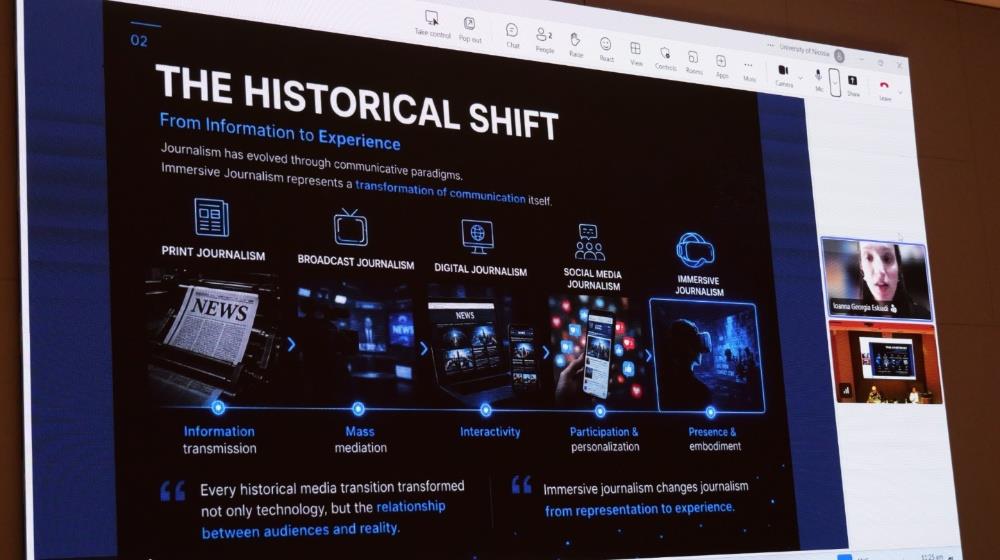
The seminar examined how technologies such as VR, XR, AR, smart glasses and artificial intelligence can open new possibilities for storytelling, civic explanation, public understanding and journalism education. Discussions focused on the potential of immersive journalism to respond to key challenges facing news media today, including platform dependency, audience fragmentation, disinformation and the need for more meaningful forms of public engagement.
The programme included presentations by Professor Nicholas Nicoli, Associate Head of the Department of Communication, University of Nicosia; Professor Harald Rau, Research Professor of Communication Management at Ostfalia University of Applied Sciences; Professor Soulla Louca, Head of the Department of Digital Innovation, University of Nicosia; and Dr. Ioanna Georgia Eskiadi, Researcher in Emerging Media Technologies at the Aristotle University of Thessaloniki.
A panel discussion followed, offering participants the opportunity to reflect on the future of immersive journalism and its role in media education, professional practice and public-interest communication.
Dr. Nicos Philippou, Head of the Department of Communication at the University of Nicosia, said:
“The success of this seminar demonstrates the importance of bringing together students, journalists, educators and stakeholders to discuss the future of journalism. Immersive technologies create new possibilities for how news can be experienced, explained and understood, and our Department is committed to engaging critically and creatively with these developments.”
Professor Ioulia Papageorgi, Dean of the School of Humanities and Social Sciences, said:
“This event reflects the School’s commitment to research, innovation and public engagement. By examining immersive journalism and emerging technologies, the seminar
created a valuable space for dialogue on how media education can respond to the changing needs of society and the future of communication.”
The seminar was supported by iStream – Higher Education programmes on Immersive Journalism approach, an Erasmus+ Cooperation Partnership in Higher Education that aims to modernise journalism education through immersive technologies and reduce the skills gap in the media and communication sectors. More information about the project is available at www.istream-project.eu.