







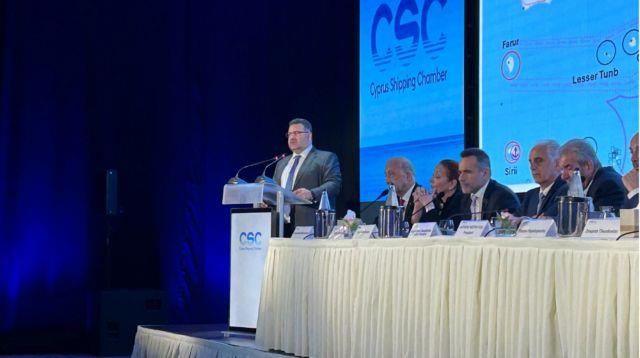
Professor Marios Panagiotis Efthymiopoulos warned of growing geopolitical instability and its impact on international shipping during his keynote address at the 37th Annual General Meeting of the Cyprus Shipping Chamber on Wednesday.
Speaking on the theme of securing shipping amid geopolitical volatility, risks and strategic adaptation, Efthymiopoulos analysed the challenges facing the maritime sector and the wider implications for investment, logistics and regional security.
The professor described Cyprus shipping as one of the country’s strongest strategic pillars, stressing its role in connecting the island with global markets and international trade routes.
“Cyprus shipping remains not only one of the pillars of the economy, but it also connects Cyprus to the rest of the world,” he noted.
Efthymiopoulos said the maritime sector now operates in an environment shaped increasingly by security concerns, geopolitical tensions and economic uncertainty. Despite these pressures, he stated that Cyprus continues to demonstrate professionalism and resilience as an international shipping hub.
He stressed the importance of restoring investor confidence, improving security conditions and reducing operational costs while simultaneously boosting efficiency and capacity across the sector.
“We need to bring back investment and safety, limit costs but boost efficiency and capacity, and re-examine geopolitical realities,” he said.
Referring to the wider global environment, the expert noted that despite ongoing conflicts and instability, certain economies continue to experience growth even during wartime conditions, describing the phenomenon as “an industry in itself.”
He also warned that global maritime chokepoints are becoming increasingly vulnerable pressure points affecting international trade and shipping operations.
Speaking specifically about the Strait of Hormuz, Efthymiopoulos referred to shipment delays, heightened security concerns and disruptions to logistics chains, stressing that the impact on global trade flows is becoming a major challenge for the maritime industry.
According to the professor, the current period represents “a time of extreme instability” for international shipping, requiring stronger coordination, strategic planning and clear European directives.
Highlighting Cyprus’ geographical and strategic position, he described the island as a gateway to the European Union and stressed the need to strengthen the country’s maritime and investment infrastructure.
“When we speak about investments, we need to treat Limassol, Larnaca and Vasilikos as essential,” he stated, adding that Cyprus must position itself as a reliable and secure destination for international investment.
Efthymiopoulos further stressed the importance of protecting national assets and strengthening Cyprus’ international image in order to attract long-term investment opportunities.
“We need to become from the hub to Europe to the hub of Europe,” he concluded.
