







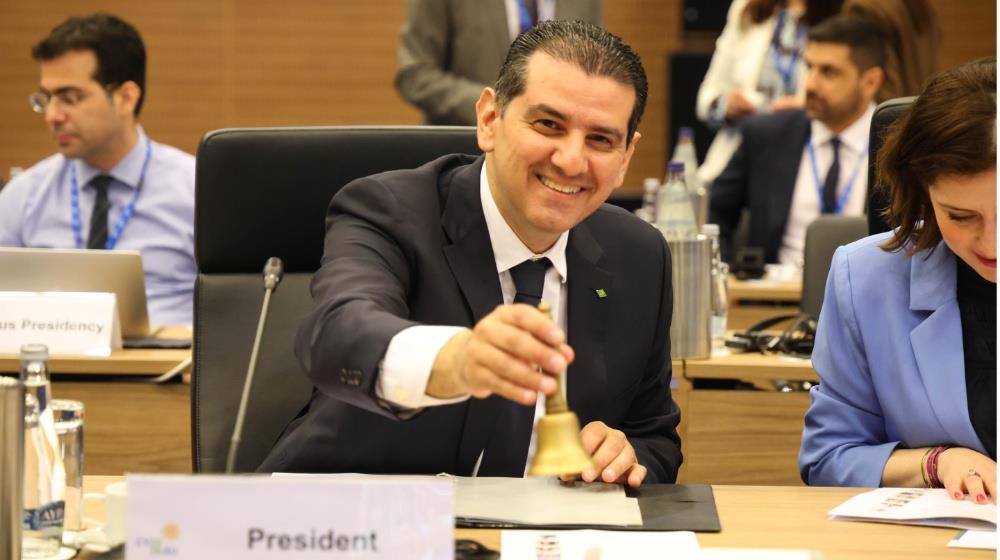
Cyprus’ Presidency of the Council of the EU aims to deliver a resilient energy system, capable of withstanding external shocks, while ensuring that energy remains affordable, Minister of Energy, Commerce and Industry, Michael Damianos has said.
He was speaking on 13 May, during the informal meeting of Energy Ministers at the “Filoxenia” Conference Centre in Nicosia, in the context of the Cyprus’ Presidency of the Council of the EU.
In his opening statement, Damianos noted that “we meet today against a complex geopolitical backdrop 75 days into the start of the conflict in the Middle East and amid persistent energy challenges that demand a stronger, more resilient energy union.”
He said that Cyprus has assumed the Presidency of the Council with a strong sense of duty and commitment. “Our efforts, we feel, highlight our commitment to a European Union that is competitive and strategically autonomous. Under our motto, ‘an autonomous Union open to the world’, we are focused on safeguarding Europe's economic and energy security, as well as energy affordability for people, businesses, and industry while remaining open to the world and firmly grounded in a shared European values,” he noted.
Damianos said that today's discussions are aligned with that mission. “We aim to deliver a resilient energy system capable of withstanding external shocks while ensuring that energy remains affordable,” he stressed.
Outlining today’s format, he said that there are three items on the agenda: AccelerateEU Communication, electricity storage and energy security and the role of gas post-2030, “where we will be joined by representatives of the Agency for the Cooperation of Energy Regulators and the East Mediterranean Gas Forum to share their perspective.”
Moving on to the first item on the agenda, the Minister said that, in light of the current geopolitical developments, the conflict in the Middle East, and the closure of the Strait of Hormuz, EU once again faces challenges linked to external factors and the volatility of the international fossil fuel market.
“Although Europe does not currently face immediate security of supply risks, our resilience depends on how we address these external shocks through unified action. In this sense, our coordination and cooperation remain essential in confronting the ongoing global energy crisis,” he highlighted.
Damianos pointed that “we must balance the implementation of targeted temporary measures to ensure affordability with the long-term structural reforms needed for a truly resilient energy union.” As he noted, following the call by the European Council, the European Commission, with Commissioner Jorgensen steering the efforts, has recently presented the AccelerateEU Communication.
“The swift and coordinated implementation of the AccelerateEU toolbox by the member states is now critical. Today's meeting provides an opportunity to exchange views on the implementation of the toolbox and potential measures at both Union and national levels,” he said.
Earlier, arriving at the “Filoxenia” Conference Centre, Damianos said that “the situation is critical. We need to ensure that energy crisis and transportation risks should not undermine our competitiveness and should not undermine our economic stability,” noting that the Ministers will discuss the situation in the Middle East, energy, electricity, storage and the development of indigenous energy resources.
At the same time, he continued, the Ministers will discuss keeping the potential on a hydrogen-ready transition pathway and reducing green gas emissions by 90% until 2040. “We're sure that by joint work, by cooperation, we can take decisions that will last for decades,” he said.
Answering a question regarding support for possible measures, like windfall profit tax for energy companies, the Minister stressed that decisions are taken jointly, rather than sporadically. “There have been measures around the EU, but I think the general idea is that we keep as a union in the way that we actually deal with the crisis,” he noted.
Asked about growing dependence on the USA for energy companies, the Minister said that the idea is to try and get out “as much as we can of our own natural resources,” noting that in this point in time relying on the US capabilities to do that is probably a must.
Asked whether the EU should become a major gas exporter, since it aims for net zero emissions in the next 25 years, Damianos said that “we have gas reserves. We just need to make sure that we use those gas reserves in the next few decades.” He noted that there is no doubt that the EU will need fossil fuels and that natural gas is better and greener than anything else. “As you have seen from the crisis in 2022, many European countries have substantial issues with Russian gas. Now there are issues with mainly the prices of gas around the world because of the crisis in the Middle East and because of the production in Qatar,” he added.
Commission to present best practices to reduce consumption
Dan Jorgensen, European Commissioner for Energy and Housing, said upon his arrival at the meeting, that this is a fossil energy crisis and we need to stay on course on the transition away from fossils. “We need to make sure that we double down on our efforts to become more energy efficient, to replace more fossil fuels with renewables,” he said.
The Commissioner noted that today he will be presenting a catalogue of best practices and ideas to member states on what they can do to reduce their consumption, to get the demand down.
“It's clear that the best thing we can do for our citizens and our industries is to make the incentives for them to transition away from fossils and onto renewables as attractive as possible,” he said, adding that he understands that some member states are also, in the short term, in a situation where they need to subsidize certain types of industry or help vulnerable citizens. Although he said that this is legitimate, “we are very firm in our recommendations that these measures need to be targeted and they need to be temporary”, he stressed.
Stavros Papastavrou, Minister of Environment and Energy of Greece, said, upon his arrival, that the conflict in the Middle East has highlighted, in a striking way, the challenges Europe faces regarding geopolitical and energy security. “Greece was the first to respond to the attack against Cyprus, and in doing so, we took a step of historic significance, because we reminded Europe of Article 42.7 of the European treaties concerning European solidarity,” he said.
He noted that the Greek government also acted promptly and effectively on the domestic front. “We implemented a package of targeted measures to support businesses and households in dealing with the consequences of the crisis. Now we must move forward with the creation of a unified, genuine European Energy Market, with new interconnections, strategic infrastructure, and a diversified energy mix, so that we can ensure affordable and abundant energy for the many. Europe must move forward decisively in order to effectively protect its citizens and its energy security,” he concluded.
Sara Aagesen, Vice-President and Minister for the Ecological Transition and the Demographic Challenge of Spain, said that Italy, Germany, Austria, Portugal and Spain sent a letter to the Commission, asking for common measures at EU level in order to address this possible windfall profits.
“We are waiting for the proposal and respect that they will provide a proposal soon. We wait for a common response, which is the most effective way of dealing with this,” she said.
Cristian-Silviu Busoi, Secretary of State in the Ministry of Energy of Romania, said that Romania is promoting the role of natural gas during transition. “It's a question of security if we produce our own natural gas inside European Union, onshore or offshore,” he said, adding that “we need more natural gas in Europe. We need a gas for the transition and even beyond 2050. He noted that Romania is coordinating with Cyprus in promoting the role of natural gas in Europe.
The Ambassador of Ukraine to the Republic of Cyprus, Sergii Nizhynskyi, was also present at the meeting. Arriving at the event, he noted that last winter was very hard for the Ukrainian people, and said that we should prepare for the next winter. “A lot of Ukrainian companies are ready to cooperate, not only with Cyprus, but in general with the EU and to promote this very sensitive question for us," he noted.
(Source: CNA)
