







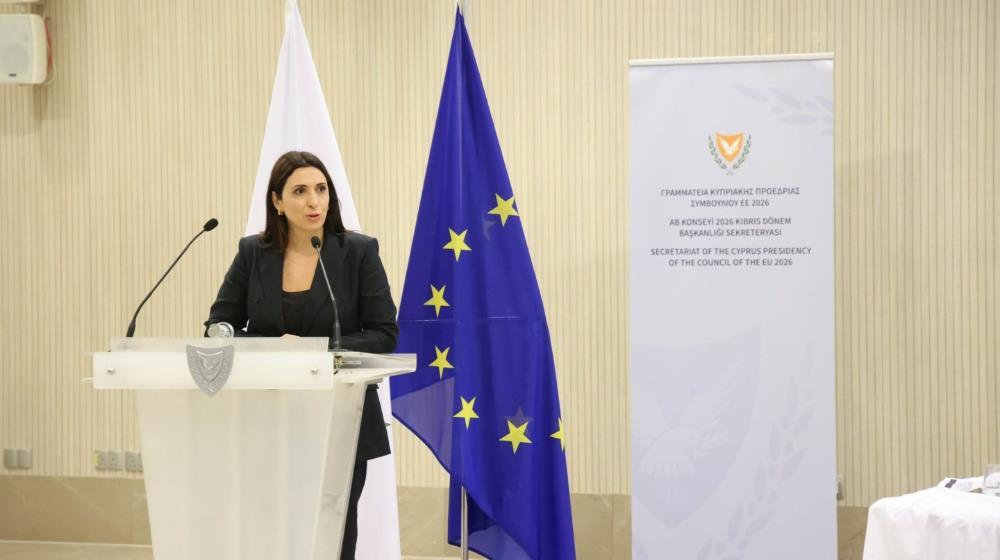
The multiannual financial framework, EU's enlargement, and the promotion of a more autonomous Europe are at the center of the informal meeting of EU Ministers for European Affairs taking place on Monday in Nicosia. Speaking upon her arrival at the Filoxenia Conference Centre, Deputy Minister for European Affairs Marilena Raouna said there is a “very clear vision and objective,” to strengthen and promote a more autonomous Union that remains open to the world.
She noted that strategic autonomy lies at the heart of all the actions of the Cyprus Presidency, from defence and security to competitiveness, the economy, and trade.
Referring to the substance of today’s discussions, she said that they will focus on three main issues, such as the multiannual financial framework, which, as she stressed, is one of the most important files of the Cyprus Presidency. The other two concern enlargement, as well as discussions with the United Kingdom on cooperation in security and defence matters.
She noted that “this discussion follows the discussion leaders had here in Cyprus on 23 and 24 April. We have now moved from the technical stage of the negotiations to the political stage, focusing on the financing equation, so that by the end of our Presidency in June we will be in a position to submit a mature negotiating framework with figures.”
She added that the second issue on the agenda would be EU enlargement.
“I am delighted that today in Nicosia we are hosting candidate countries and potential candidate countries for a discussion focused on the fundamentals, on democracy, and on the rule of law,” she said.
She underlined that for Cyprus, “it is clear that a more autonomous Union, a more secure Union, is an enlarged Union.”
She also referred to President Nikos Christodoulides’ visit to Moldova on Europe Day, saying it was a very clear message to the people of Moldova “that Moldova belongs in Europe and that for partners who deliver on their commitments, the European Union also delivers on its own.”
Raouna added that during the third session of today’s discussions, British Minister for Europe Nick Thomas-Symonds will be hosted, noting that the United Kingdom is a like-minded partner and that, in light of geopolitical developments, this relationship is of utmost importance.
“We will discuss with Minister Symonds how we tackle together foreign interference and the manipulation of information,” she said.
She also said that security and defence cooperation with the United Kingdom would be discussed and that, at the same time, “we are preparing for the next EU-UK summit.”
Raouna added that today’s discussion would pave the way for the next discussions in Brussels.
Replying to a question on whether she believes the European Commission’s proposal responds to every aspect of the crisis for the coming years and what message today’s session sends, Raouna said that “in recent years we have learned our lesson. The European Union has had to tackle multiple crises, whether it be the pandemic, the migration crisis — and Cyprus, as you know, is a frontline member state when it comes to migration — or Russian aggression against Ukraine. And each and every time, the European Union managed to respond.”
She also pointed out that the new multiannual financial framework takes this experience into account and incorporates elements aimed at achieving a better and more flexible response.
She added that “the discussions in the various working groups have touched on these issues, and we want to build on those elements to see what more we can do to strengthen these mechanisms.”
Asked about the governmental change in Hungary and how this development affects the process, Raouna said that enlargement is one of the key priorities of the Cyprus Presidency, “and from day one we have been working with all enlargement partners in order to advance their accession negotiations. And we did so for Moldova and Ukraine.”
She noted that the technical work has been completed in all areas, and that discussions are ongoing with the new Hungarian government.
“There has been communication both by President Christodoulides and by Foreign Minister Kombos. We will continue engaging with our Hungarian partners in order to find a way to ensure that there is consensus, as the Cyprus Presidency has consistently done from the very beginning,” she said.
In her opening remarks at the start of the first session, Marilena Raouna also said that “our informal meeting is an opportunity to reflect on how we can continue strengthening our Union, based on the very clear vision of the Cyprus Presidency for a more autonomous Union, open to the world.”
She said that during the session there would be an exchange of views “on some of the key issues shaping the future of the Union, starting with the Multiannual Financial Framework, followed by a discussion on enlargement, with a focus on the fundamentals, the backbone of the enlargement process, and particularly on the rule of law of our enlargement partners.”
She concluded that this will be followed by an exchange of views with the United Kingdom, a like-minded partner in addressing the common challenges that put our democracies at risk.
The Republic of Cyprus currently holds the Presidency of the Council of the EU for a six-month term that started on January 1st, 2026, as part of a Trio Presidency along with Poland and Denmark.
