









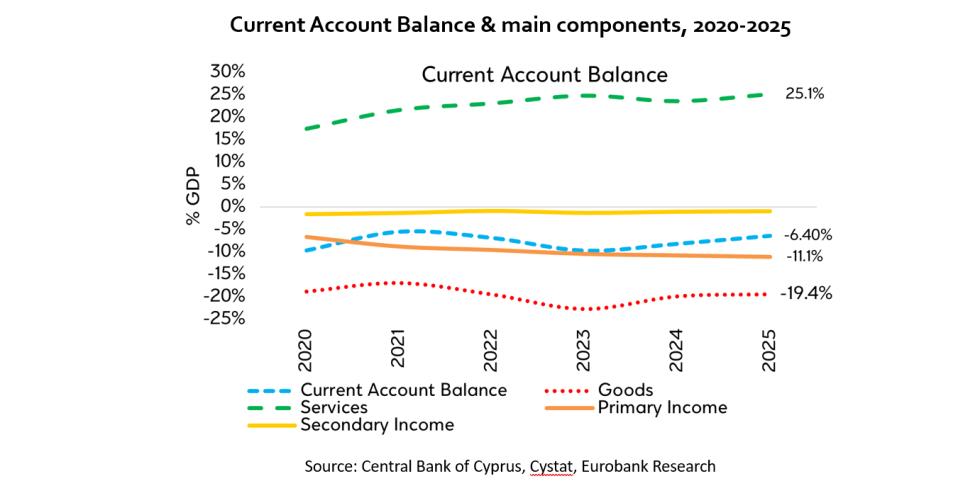
Cyprus’s current account balance (CAB) continued to improve in 2025, as its deficit narrowed by 1.8 percentage points (ppts) of GDP relative to 2024, to 6.4% of GDP, extending the 1.5 ppt correction from the 15-year peak recorded in 2023 (9.7% of GDP).
The improvement was driven primarily by a further expansion in the services surplus, which rose to a historical high of 25.2% of GDP, from 23.5% in 2024. A modest narrowing in the goods deficit by 0.4ppts of GDP also contributed, however, the deficit remained elevated at 19.5% of GDP. By contrast, the primary income deficit widened further to 11.2% of GDP from 10.8%, reflecting increased net expatriation of direct investment profits. The secondary income balance remained slightly negative at 0.9% of GDP, marginally improved from -1.0% in 2024.
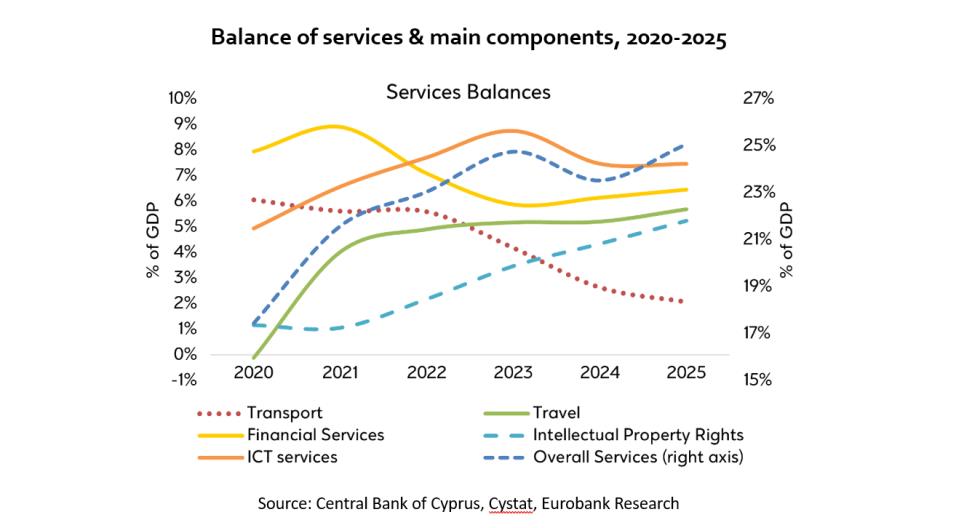
The record-high services surplus reflects broad-based strength across key sectors. Surpluses increased in intellectual property services, tourism, and financial services, reaching 5.3%, 5.7%, and 6.5% of GDP, respectively, compared with 4.4%, 5.2%, and 6.1% in 2024. In contrast, transport and other business services recorded weaker surpluses, of 2.1% of GDP each vs. 2.6% and 2.2% a year earlier, while in ICT services, a main contributor to GDP growth over 2021–2025, surplus remained stable at 7.5% of GDP. The improvement in tourism is closely linked to record-high arrivals and inflation-adjusted receipts, with tourist numbers exceeding 4.5 million and real revenues surpassing €2.8 billion (in 2015 prices). The strengthening of financial services reflects ongoing structural transformation, including consolidation through mergers and acquisitions, alongside successive sovereign credit rating upgrades culminating in a return to A-tier status after 13 years in November 2024, which has supported investor confidence.
The limited improvement in the goods balance as a share of GDP largely reflects the denominator effect of stronger nominal output growth, rather than a meaningful correction in trade dynamics. In value terms, the goods deficit widened by 2.5% in 2025, driven by a 1.4% increase in imports and a marginal 0.2% decline in exports. Higher imports were primarily attributable to petroleum products, accounting for more than half of the annual increase (53.9%), followed by pharmaceuticals (share of 16.5%). The rise in petroleum imports was linked to the normalisation of maritime trade flows through the Red Sea, which also supported a sharp increase in exports of refined petroleum products (+298.8%). This surge offset the strong decline in exports of ships, thereby containing the overall deterioration in goods exports to the previously mentioned.
Looking ahead, the recent improvement in the current account will be challenged in case of persistence of the geopolitical tensions in the Middle East. Tourism appears particularly exposed, given that last year’s strong performance was underpinned by increased arrivals from the EU (59.8% of the total rise) and Israel (33.1%). A potential slowdown in European economic activity would likely weigh on tourism receipts, while regional instability could further dampen travel demand. The transport sector is also vulnerable to disruptions in key shipping routes and weaker global trade dynamics. More broadly, heightened uncertainty is expected to reinforce risk aversion and constrain investment flows. That said, Cyprus has historically benefited from safe-haven inflows during periods of regional instability, e.g., during the war in Gaza in 2023-2025, particularly in real estate.
Various effects are expected from higher energy prices on the goods balance. Given the very high energy dependence of Cyprus on crude petroleum and the relatively inelastic nature of domestic energy demand, much higher oil prices will tend to deteriorate the merchandise trade balance. At the same time, the exceptional strength in refined petroleum exports observed in 2025 is unlikely to be sustained, implying a potential moderation in both related exports and crude oil imports. The net effect on the goods balance will depend on the relative responsiveness (elasticity) of domestic energy consumption and export demand to price changes. Finally, weaker transport activity could incentivise asset sales in shipping and aviation, potentially supporting the goods balance in the latter part of the year.
*Michail Vassileiadis, Research Economist, Eurobank Group
