






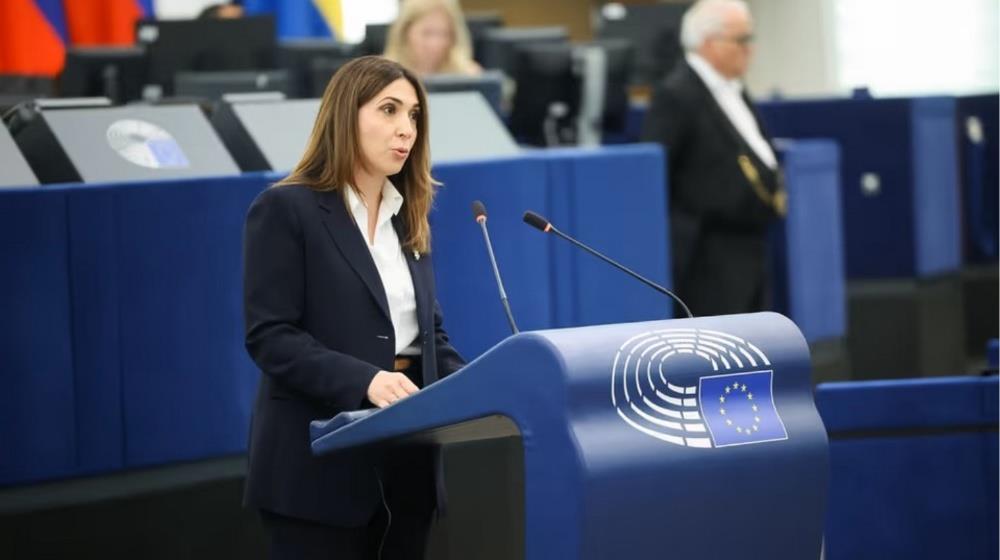
It is key to accountability that EU funds are used in accordance with the applicable rules, and that expenditure respects the principles of sound financial management, Cyprus’ Deputy Minister for European Affairs, Marilena Raouna, said at the debate at the European Parliament Plenary on the recommendation to grant the Commission discharge in respect of the implementation of the EU budget for 2024.
During the April 2026 plenary session, the European Parliament is to decide on granting discharge for the 2024 financial year to the different institutions and bodies of the EU. The vote on the discharge for the European Commission is the most important one, as its budget covers around 95 % of the whole EU budget. Since 2021, the discharge procedure includes the grant component of the Recovery and Resilience Facility (RRF). Separate discharge is granted to the Commission concerning the management of the European Development Funds (EDFs). The Committee on Budgetary Control (CONT) recommends that Parliament grant discharge to the Commission, all executive agencies and the EDFs for the 2024 budget.
Raouna, representing the Council of the European Union, presented its recommendation on the discharge to the Commission for the implementation of the budget for 2024.
The Council, she said, “shares the great importance attached by the European Parliament to the discharge exercise”. “It is key to accountability that EU funds are used in accordance with the applicable rules, and that expenditure respects the principles of sound financial management”, she added.
In this regard, she noted, on 17 February, the Council adopted its recommendation to grant discharge to the Commission, while acknowledging areas that require improvement, some of which are also identified by the European Parliament.
In particular, Raouna said, “the Council is concerned that for the sixth year running, the Court of Auditors’ opinion on expenditure is unfavourable, and the overall error rate continues to be above the materiality threshold”. At the same time, an improvement from previous years is noted, she added.
Raouna highlighted two elements of the Council’s recommendation.
“Firstly, the Council welcomes the fact that in 2024 the error rate has decreased by two percentage points. The Council considers that it would be appropriate to grant discharge to the Commission in respect of the implementation of the budget for the financial year 2024, recognising the efforts of the management and control authorities, both at Commission and Member State level”, she said.
Clearly, efforts are necessary by all stakeholders to continue working together towards bringing the error rate further down, she added. “In this regard, the Council aligns with the European Parliament in stressing that in order to achieve a decrease in the error rate and ensure the effective and correct management of EU funds, simpler, more transparent and more predictable legislation and implementing measures should remain a top priority. At the same time, this should not mean lowering the standards needed for accountability”, she said.
Regarding transparency, Raouna said that the Council “regrets the difficulties encountered by the Court in getting access to documents from some international organisations, which consequently impact the Court’s capability to carry out their audit”.
The Deputy Minister said that her second point relates to the chapter dedicated to the Resilience and Recovery Facility in the Court’s report, which, she said, “was thoroughly examined by the Council”.
“The Council took good note of the findings. Here as well, simplification and clarification of the regulations on the performance model, coupled with application of the principle of proportionality in the performance of controls, can foster improvements and reduce administrative burden”, she said.
Noting that the instrument comes to its end in the coming months, she expressed hope that the lessons learned would benefit future work.
Finally, she pointed out that the Council underlines the importance of the performance of the EU budget and its assessment, since it represents a measure of the value delivered by the EU. Therefore, she said, the Council systematically calls for an increase of focus on result-based performance indicators that can be directly linked to the EU actions, with the aim of simplification and reducing administrative burden.
(Source: CNA)