






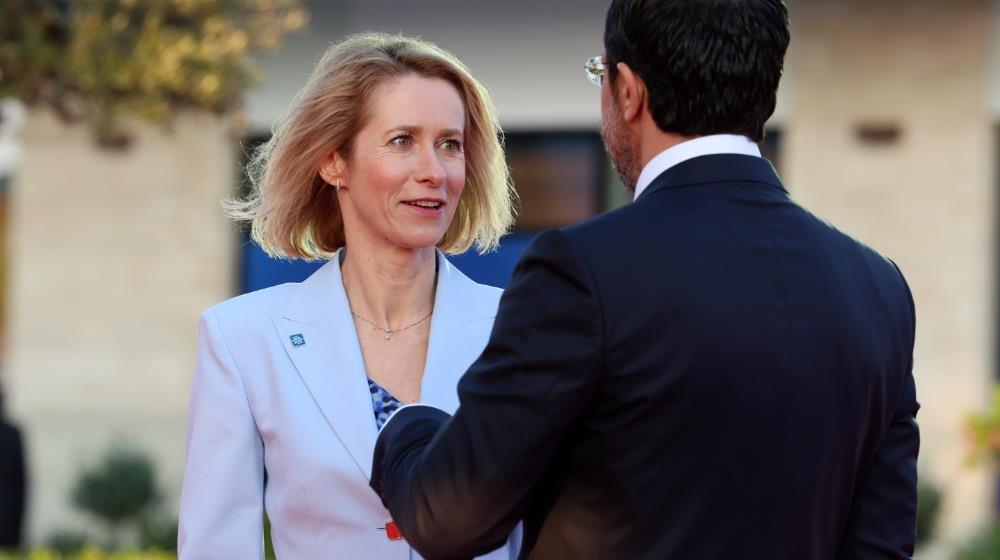
EU leaders discussed the need to move ahead with a 21st sanctions package against Russia, while also addressing Iran’s missile programme, support for proxies and threats to freedom of navigation, EU High Representative for Foreign Affairs and Security Policy Kaja Kallas said on Friday, arriving at the informal meeting of EU Heads of State or Government in Nicosia.
Speaking ahead of the informal Summit, Kallas said the discussions focused on the international crises facing the EU, starting with Ukraine. She described as “good news” the agreement on a €90 billion loan for Ukraine and the adoption of the 20th sanctions package against Russia.
Prime ministers, she said, pushed for work to continue on a 21st package of sanctions, arguing that this would send “a very clear signal to Russia that they can’t outwait us” and that the EU would continue supporting Ukraine.
On the Middle East, Kallas said the wars in the region affect all EU member states and that the Union must look at what more it can do to support peace and stability. She said current negotiations with Iran should not be limited to the nuclear issue, but should also cover Tehran’s missile programme and its support for proxies.
Asked about the possible lifting of sanctions against Iran, Kallas warned that if talks focus only on the nuclear file, without nuclear experts at the table, the result could be “weaker than the JCPOA.” She said Iran’s missile programme, support for proxies and hybrid and cyber activities in Europe also had to be addressed, otherwise “we will end up with a more dangerous Iran”.
Kallas also said freedom of navigation was “non-negotiable” and that the Strait of Hormuz must remain open “without any tolls”. She said EU operations Aspides and Atalanta, already active in the region, could be used and strengthened with ships, tools and capabilities as the fastest way to support a “coalition of the willing.”
Referring to regional partners, Kallas said the EU plans to engage more with Syria and will hold a high-level political dialogue with foreign ministers in May. She said Europe could help Syria with constitutional work and institution-building, while stressing the need for inclusivity in government and for addressing the concerns of different groups, including Christians.
She also referred to Jordan’s role in supporting Palestine and Palestinian refugees, saying the EU was interested in hearing Amman’s assessment of the war, and to Lebanon, noting that the Lebanese Armed Forces need more support to disarm Hezbollah and strengthen state control.
Kallas said EU foreign and defence ministers had discussed whether the Union could put together its own mission once UNIFIL ends, but with a different mandate aimed at addressing Lebanon’s current needs.
She added that in contacts with American counterparts, US requests from Europe after a cessation of hostilities had included demining and escorting ships, areas in which the EU could contribute.
(Source: CNA)
