







Continuing in Nicosia today, Friday, 24 April and taking place at one of the most critical times for the European Union, the EU Council's Informal Meeting of Heads of State or Government, hosted by the Cyprus Presidency is anticipated to be one of the most extensive and politically complex summits ever held within the EU, with the presence of Europe, Ukraine and the Middle East.
The two-day summit, which began in Ayia Napa late yesterday afternoon, is taking place in an environment of intense geopolitical realignments, with the Gulf crisis, the Ukrainian crisis, European defense and the Union's strategic autonomy dominating the agenda, alongside the new Multiannual Financial Framework 2028–2034 and the effects of the energy crisis on European economies, citizens and businesses.
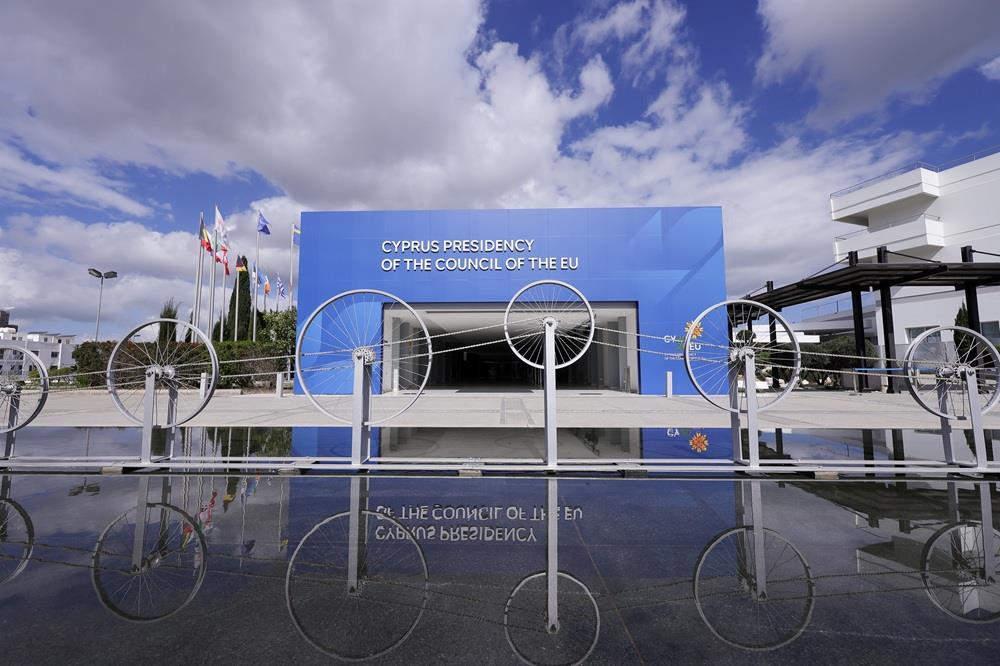
Today, Friday, the Summit's work will be hosted in Nicosia, at the Philoxenia Conference Center.
A summit with a geopolitical footprint
The Informal Meeting in Cyprus is not just another routine European meeting. On the contrary, it functions as a platform for shaping strategic choices for the European Union's future, from Ukraine and defence, to the Middle East, energy, and the European nion's institutional resilience.
At a time when Europe is searching for a role, identity and speed of reaction, Nicosia has been placed at the centre of developments, not as a spectator, but as a shaper.
Zelenskyy's presence and the highly symbolic message
Of particular importance is the presence of Volodymyr Zelenskyy, who was in Cyprus for the ceremonial part of the first day, instead of the video conference that was initially announced. His physical presence is considered an indication of the political importance that Kiev attaches to the Summit, at a time when crucial negotiations are underway for a new European support package for Ukraine worth €90 billion.
This package has "stumbled" over the objections of outgoing Hungarian Prime Minister Viktor Orban, who links his stance to the interruption of the flow of Russian oil to Hungary through Ukrainian territory, adding yet another flashpoint to the already complex European landscape.
Cyprus as a bridge between the EU and the Middle East
The Cypriot initiative for the expanded Summit also highlights Nicosia's role as a bridge between the European Union and the Middle East. The leaders of Egypt, Lebanon, Syria and Jordan, as well as the Secretary-General of the Gulf Cooperation Council, have been invited to attend.
As has been pointed out by the Cypriot side, the Middle East and the Gulf constitute the "EU's neighbourhood", with the security of the two regions being inextricably linked. The aim of the Summit is not simply dialogue, but the exploration of specific collaborations in areas such as energy, trade and security, as well as the strengthening of regional stability.
The priorities of the session
-The new Multiannual Financial Framework 2028–2034
-The changing geopolitical environment and regional conflicts
-The EU's contribution to crisis de-escalation and navigation
-European defense and preparedness against hybrid threats
-The effects of the energy crisis on European economies
The direct impacts of the Gulf crisis on European economies, due to high energy prices, will also be discussed, as well as the tools available to the EU to address possible further negative consequences for citizens and businesses.
Particular emphasis is being placed on the discussion on strengthening European solidarity in the event of a crisis, with a focus on the effective implementation of Article 42.7 of the EU Treaty, which concerns the mutual assistance clause.
Informal Summits do not issue conclusions, but provide the necessary political direction so that the work can progress and decisions can be made at the next Council in June.
Christodoulides: "We need an operational plan for crises"
In a recent interview with the Associated Press, President of the Republic Nikos Christodoulides stressed the need for the EU to proceed with the formulation of an "operational plan" on how it would react in the event of the activation of the mutual assistance clause.
As he noted, Article 42.7 has never been implemented in practice, which creates an institutional vacuum in terms of how member states should react. At the same time, he raised the issue of the compatibility of obligations of states that are also members of NATO, highlighting the need for clear operational coordination.
His intervention also takes on a national dimension, as Cyprus has already faced security incidents, requesting assistance from European countries in a recent drone incident in the southern coastline area.
Ukraine and the European perspective
Ukraine's European path is also at the centre of attention, with Nicosia seeking to accelerate technical preparations for future negotiating chapters, once the political conditions for unanimity are established.
At the same time, the EU has already reached an agreement on financial support for Ukraine within the framework of the budget, amounting to 90 billion euros, an element that highlights the strategic importance of the issue.
The Cyprus Presidency of the EU Council in numbers
The Cypriot presidency has already gone through its first quarter with intense activity:
-73 informal meetings in Cyprus with approximately 6,000 participants
-14 high-level meetings (of which 10 ministerial meetings)
-Total estimated 260 meetings by the end of the Presidency
-Approximately 30,000 visitors in total to Cyprus
-21 ministerial meetings and 2 intergovernmental conferences in Brussels
-More than 860 meetings at the level of Committees and Working Groups
-26 political trilogues and over 30 interinstitutional technical meetings
The Presidency has already promoted crucial legislative packages in areas such as defense, migration, energy and competitiveness, while it has contributed to promoting international agreements of the EU.
(Source: InBusinessNews)
