








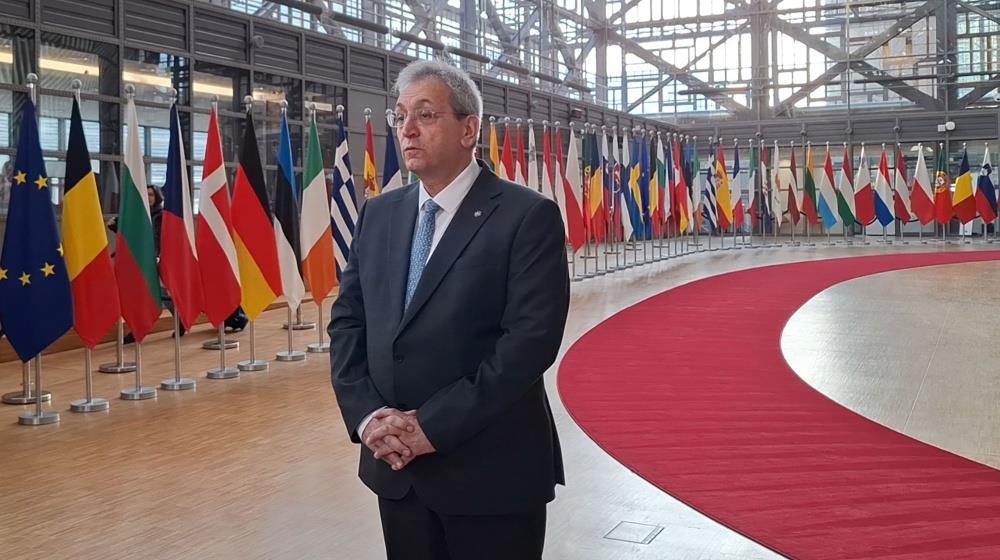
Emphasis on mental health, skills, and a fair transition in the digital age was placed by the Minister of Labour and Social Insurance, Marinos Moushouttas, who presented the comprehensive approach of the Cyprus Presidency of the Council of the EU, on the future of work.
The 15 April presentation was in the context of the Interparliamentary Committee on 'Human work in the digital age,' during a joint meeting of the European Parliament’s Committee on Employment with representatives from national parliaments in Brussels.
From the outset of his intervention, the Minister noted that “the accelerated transformation of work in the digital age lies at the core of the economic and social future of humanity,” highlighting the need to redefine policies with a human-centered approach.
Referring also to a recent study by the International Labour Organization, the Minister noted that “only about 2.3% of jobs are at risk of full automation.” However, he clarified that the real change is qualitative, noting that many roles “undergo significant changes in terms of tasks, rather than disappearing entirely.” As he underlined, the impact of artificial intelligence (AI) “lies in the radical transformation of the way millions of people work on a daily basis,” shifting the discussion from job losses to the nature of work.
Particular emphasis was placed by Minister Moushouttas on psychosocial risks. He warned that “mental strain, fear of job loss, loss of control, concerns about privacy, isolation and sleep disturbances are increasingly being recorded.”
In the same context, he referred to the phenomenon of constant connectivity, which is increasingly observed in today’s digital age, noting that “excessive connectivity outside working hours and frequent online meetings significantly increase stress levels,” while highlighting the need for a “healthier balance between professional and personal life.”
The Minister elaborated extensively on the need for a shift in the philosophy of using AI, underlining that “the AI should enhance human capabilities rather than replace them.” As he explained, this requires “clear communication, transparent governance and inclusive policies that ensure that all workers, regardless of age, gender or background, can benefit from the changes brought about by AI.” As he stressed, “lifelong learning, upskilling and reskilling must be supported, alongside clear guidelines for roles and responsibilities, particularly in high-risk environments where human oversight and accountability must remain central.”
Referring to European developments, he described the Platform Work Directive as a “decisive positive step,” noting that it improves working conditions for platform workers, strengthens transparency in algorithmic management and ensures correct employment classification, thereby contributing substantially to the protection of workers’ rights and well-being in the digital economy. “Its effective implementation will be crucial to ensuring that technological progress goes hand in hand with social justice,” he noted.
He also made special reference to the initiatives of the Cyprus Presidency, pointing out that strengthening skills is a “key priority,” referring to the recent EPSCO Council of March, while also mentioning that tools such as the Youth Guarantee and the Joint Employment Report help “ensure that no one is left behind in the twin transition.”
The Minister also presented a forecast regarding future skills needs, noting that “by 2030, nearly 59% of the workforce will require new or significantly updated skills, while many workers still lack access to training related to AI.” He said that that this “requires stronger and more inclusive lifelong learning systems that support continuous development at all stages of working life,” thereby underlining that the challenge is not only quantitative but also qualitative.
Furthermore, the Minister pointed to the need for targeted interventions, such as “the promotion of healthy digital boundaries” and “monitoring workload in hyper-connected workplaces,” while also highlighting the importance of ethical frameworks, noting that “transparency of algorithms and protection of workers’ privacy” are required.
Minister Moushouttas also attributed a key role to social dialogue. “Effective tripartite dialogue is a strategic tool,” he said, while noting that in Cyprus this practice has contributed to shaping “balanced solutions for the economy and society.”
Moreover, the Minister sent a message regarding the role of today’s decisions. “The future of work is not predetermined; it is something we actively shape,” he said. As he stressed, if managed responsibly, “AI can become a powerful tool for enhancing safety, health and well-being at work.”
Later in the day, the Minister is scheduled to hold meetings with rapporteurs and shadow rapporteurs on the revision of Regulation 883/2004, which coordinates social security systems within the EU and EEA, with the trilogue expected to take place in two weeks.
(Source: CNA)
