







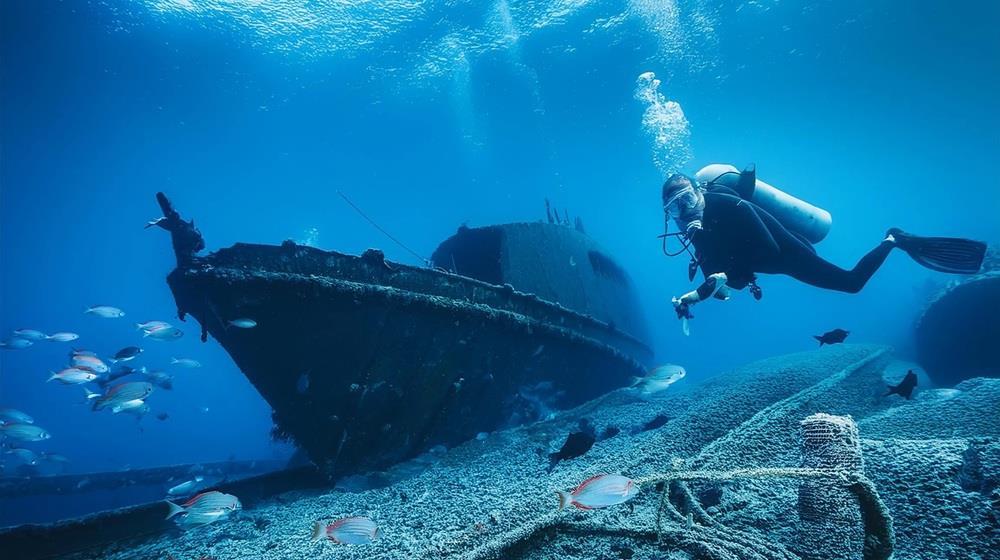
A government bill recently submitted to Parliament and referred for discussion to the House Tourism Committee attempts to regulate diving tourism in Cyprus.
As stated last November following its approval by the Council of Ministers, the Deputy Minister of Tourism, Costas Koumis, in essence, the Deputy Ministry of Tourism, through this bill, aims to fill the legislative gap that exists in the recreational diving sector, by substantially investing in improving the quality of the services provided, as well as in strengthening the sector's safety.
"As a Government, we remain consistent in our commitment to improving and upgrading the services provided within the tourism framework," Koumis said that the time.
However, according to what is stated in the introductory report, the bill, entitled 'The Diving and Recreational Diving Service Providers Law of 2025' also aims to regulate the provision of recreational diving services.
The bill, it is added, regulates the licensing of recreational diving service providers. This definition includes: diving centres, diving schools, scuba diving instructors, licensed diver transporters by sea (via a registered and approved coastal vessel or other licensed vessel) and ho are the natural or legal persons who provide one or more of the above services, on the basis of international standards for control and assurance of the procedures that are followed and that entail minimising the risk of accidents.
Furthermore, based on the bill, recreational diving service providers will be granted a three-year license.
Additionally, the Deputy Ministry of Tourism will maintain a register of licensed providers of recreational diving services, impose penalties on those who provide recreational diving services without an operating license, as well as investigation and verification procedures, with the aim of attributing responsibility in the event of an accident.
Recreational diving service providers
Furthermore, based on the provisions of the bill, a recreational diving service provider means a natural or legal person who provides one or more of the following services, in accordance with the National Standard CYS EN ISO 24803:
- Scuba diver training services in accordance with the certified training program of the Organisation, by which it has been authorised;
- Organised diving services, including transportation, underwater escort, surveillance and emergency support services, offered by a service provider to autonomous divers who are qualified and experienced at a level commensurate with the diving activity;
- Guided diving services – which include services or organised diving during which scuba divers are accompanied by the service provider, provided that they have the qualifications provided for, as the case may be, by the National Recreational Diving Standards;
- Diving equipment rental services;
- Introductory diving activities services;
- Swimming with a mask and snorkel.
Application for operating license
It is noted that the provision of recreational diving services is subject to the granting of an operating license by the Permanent Secretary of the Deputy Ministry of Tourism and no natural or legal person may offer training, promote, organise or provide any recreational diving service unless such person holds a valid operating license.
An application for an operating license will be submitted on a prescribed form, based on the legislation, with the payment of a one-time fee of €200, which is non-refundable, and the Permanent Secretary of the Deputy Ministry of Tourism will be able to issue an operating license for the following categories:
- Diving centres,
- Scuba diving schools,
- Diving instructors who operate as service providers and do not belong to a diving centre/underwater diving training school, and
- Licensed transporter of divers by sea.
The operating license is issued if the applicant meets the following conditions:
- It has instructors with the relevant skills and qualifications required by the regulations and National Recreational Diving Standards,
- It has a copy of a valid certificate from an accredited certification body for the service provider's compliance with the national standard CYS EN ISO 24803 “Recreational Diving Services – Requirements for Recreational Diving Provider” with the currently valid version of the standard,
- Maintains a valid insurance contract, for Insurance Coverage against civil liability for Professional Negligence or from another organization engaged in the provision of diving insurance, as a service provider, with a licensed insurance company or an internationally recognised mutual insurance cooperative based in a member state of the European Union,
- Has submitted a photocopy of his/her identity card or passport and a copy of a clean criminal record, with an issue date no earlier than one month from the date of submission of the application,
- Has a tax residence certificate, or is registered for VAT, Social Security, as well as registration with the Registrar of Companies as a company or as a trade name,
- Has submitted a medical certificate, which will be in accordance with regulations issued under this Law for all persons involved in diving activities. The submission of a medical certificate is not required for a service provider, who is a natural person, when he does not participate in scuba diving training, but only for personnel who may participate in diving activities,
- Every service provider operating as a diving centre or school must have an appointed Director, who will also be responsible for the legal operation of the diving center/school in accordance with the provisions of the Law,
- It provides statistical data in accordance with the Regulations issued on the basis of this Law.
Based on the provisions of the bill, the operating license will last for three years from the date of issue/renewal, except in the event of revocation due to failure to secure certification with the National Standard CYS EN ISO 4803.
Revocation of permission
It is also noted that the operating license may be revoked by the Permanent Secretary of the Deputy Ministry of Tourism in the following cases:
- When a serious violation of the provisions of the Law and the Regulations issued pursuant thereto is detected by the service provider, and after this has been notified in writing by the Permanent Secretary to the service provider, and with the necessary justification,
- After the service provider has been found liable for a fatal diving accident or a diving accident that has caused permanent serious disability based on a finding of the State Medical Council, following a Court order, following a relevant application by the Law Office of the Republic, for a specific period of time,
- When any of the conditions for granting the provider's license cease to exist, in which case the operating license is definitively revoked, and
- When a change is detected in the scope of services performed by the service provider and in the nature of its services provided, without the approval of the General Director, which would render the provision of such services incompatible with the terms of its operating license.
Criminal prosecution
With regard to criminal liabilities and prosecutions , according to the provisions of the bill, a service provider who provides recreational diving services without an operating license will be guilty of an offense and, if convicted, will be subject to a fine not exceeding eight thousand euros (€8,000) or to imprisonment not exceeding two years, or to both of these penalties.
In addition to any other penalty provided for by Law, the Court, upon conviction of any person for an offense, may, at its discretion, order the suspension of the operation of the service provider for such period as it deems appropriate.
Furthermore, a service provider who fails to comply with the Court Order will be guilty of an offence and will be liable, upon conviction, to imprisonment for a period not exceeding one year or to a fine not exceeding three thousand euros (€3,000) or to both penalties.
At the same time, the Court which hears a charge against any person for an offense committed in violation of the provisions of the Law, may, upon a unilateral request from the Permanent Secretary of the Deputy Ministry of Tourism, order the suspension of the operating license until the final hearing of the case.
It is further emphasised that anyone who refuses or fails to comply with any provision of the Law, in which no special provision is made, will be guilty of an offense and is subject, if convicted, to a fine not exceeding two thousand euros (€2,000) or to imprisonment not exceeding six months, or to both these penalties.
Also, anyone who obstructs the Permanent Secretary, or his authorised officer, in the exercise of his powers, granted to him by the Law, fails to provide him with all necessary facilities, shall be guilty of an offence and shall be liable, upon conviction, to a fine not exceeding two thousand euros (€2,000) or to imprisonment not exceeding six (6) months or to both the above penalties.
It is emphasised that criminal prosecutions for offenses in violation of the Law and the Regulations issued pursuant thereto will be brought in the name of the Permanent Secretary of the Deputy Ministry of Tourism in all Courts and in accordance with the instructions of the Attorney General of the Republic.
Transitional provisions
It is worth mentioning that in order to give all recreational diving service providers the necessary time to secure the relevant license, the bill also included transitional provisions, according to which:
- Each service provider must, within one year from the date of entry into force of the Law, submit an application to the Permanent Secretary of the Deputy Ministry of Tourism for the issuance of an operating license.
- Until the Cyprus Quality Promotion Organisation has successfully undergone its peer evaluation pursuant to Article 10 of Regulation (EC) No. 765/2008, with regard to the conformity assessment activities for which accreditation is sought, an applicant certification body may be accredited by another accreditation body, subject to the provisions of the Accreditation, Standardization and Technical Information Law and the provisions of Regulation (EC) No. 765/2008.
- All, without exception, the provisions of the Law do not apply in relation to the Cyprus Federation of Underwater Activities (CFUA) and the clubs/associations that are affiliated to it, nor to any other sports Federations that are affiliated to the Cyprus Sports Organisation (CSO) and the clubs/associations that are affiliated to these Federations.
(Source: InBusinessNews)