






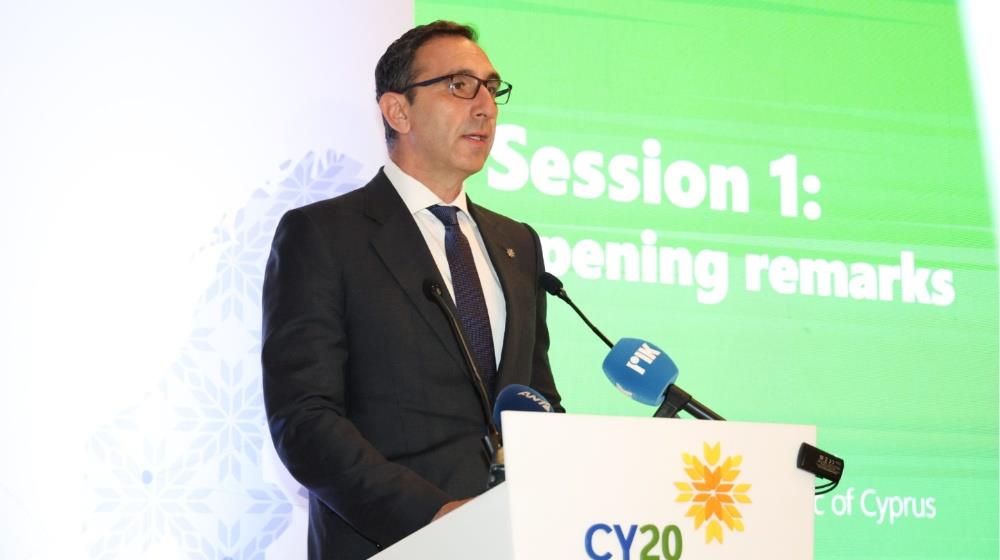
Promoting territorial cohesion as a key driver of Europe's long-term competitiveness is among our central priorities, Minister of Interior Constantinos Ioannou has said.
Ioannou was addressing the inaugural session of the Territorial Futures Forum, organised in the framework of the Cyprus Presidency of the Council of the European Union, in Nicosia on the evening of 14 April.
In this context, he added, competitiveness should be understood not only in aggregate economic terms, but also in relation to the regions, their specific characteristics, their development potentials and their capacity to adapt to change.
"A truly competitive Europe is one that mobilises the strengths of all its regions while ensuring balanced and inclusive development," the Minister said.
He added that inequalities in economic performance, access to services and connectivity persist across the European Union. "Addressing these challenges requires place-based policies, effective cross-sectoral coordination and responsiveness to the diversity of territorial realities," he said.
He also said that competitiveness must be understood not only in overall economic terms, but also in relation to regions and their specific characteristics, their growth potential and their capacity to adapt to change. "A truly competitive Europe is one that mobilises the strengths of all its regions while ensuring balanced and inclusive growth," he said.
Ioannou also pointed out that strengthening territorial competitiveness requires an anticipatory and forward-looking approach, underlining that "foresight is increasingly recognised as a valuable tool for policy-making", as it allows for a better understanding of long-term trends, emerging risks and uncertainties, supporting more informed decision-making and enhancing the capacity to design resilient and future-oriented policies.
Referring to Cyprus, he noted that "for Member States such as Cyprus, located at the geographical edges of the Union, this perspective is particularly important", noting that constraints such as insularity and accessibility continue to shape development prospects and highlight the importance of coordinated and proactive policy responses.
He also stressed the need to strengthen the capacity to support both territorial cohesion and competitiveness in a constantly evolving environment, noting that this involves "strengthening the knowledge base underpinning policy-making at EU level", including through more systematic use of prospective analysis and ensuring that long-term strategic objectives are more effectively translated into policy action.
However, he said, "the integration of perspective analysis into territorial governance remains limited", which he said "calls further reflection on how it can be more consistently embedded into policy development and implementation".
He further stressed that the Forum is a direct contribution in this direction, explaining that "by combining analytical evidence with policy dialogue, in the context of the Strategic Reflection Process and in line with the mandate of the Joint Ministerial Declaration adopted in Warsaw in May 2025, the Territorial Future Forum supports a more informed and forward-looking approach to territorial development".
The Minister underlined that "a competitive, resilient and cohesive Europe is one that recognises its territorial diversity as a strength and enable all regions to contribute to its development" and, wishing the proceedings well, noted that the Territorial Future Forum is a valuable opportunity to promote this objective through the dialogue, evidence and perspective it offers.
(Source: CNA)