








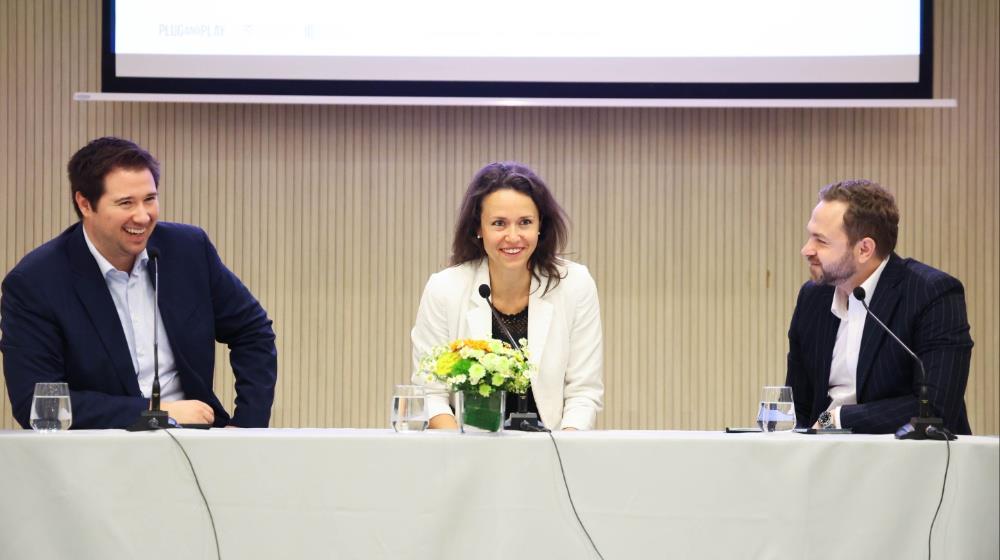
Cyprus is strengthening its position as an emerging innovation hub, with government stakeholders and ecosystem leaders highlighting talent development, international connectivity and commercialisation as critical pillars for future growth during the launch of the Plug and Play Tech Center in Cyprus.
Speaking during a panel discussion at the 7 April launch at the Presidential Palace, Alfredo Gomez, Regional Director, Plug and Play, EMEA, moderated a conversation with Rita Kotana, Startup Partner & Mentor, and Dr. Konstantinos Kleovoulou, Director of Research and Innovation at the Deputy Ministry of Research, Innovation and Digital Policy, focusing on how the country can attract, retain and scale talent.
Gomez noted that, “A word that keeps coming up, and it doesn't matter whether you speak with corporates, whether you speak with the government, whether you speak with startups, is talent. Talent is one of the key pillars that this government has put a lot of effort into developing, into bringing back some of the brightest minds from Cyprus that have left the country, that want to relocate back into the country.”
He also mentioned the many migrants who have come to work in Cyprus to build their own startups and their own tech communities. As the discussion’s moderator, he asked the two panellists to comment on what talent means for Cyprus, and what Plug and Play’s arrival contributes.
Kleovoulou noted that while Plug and Play’s initiative would definitely help attract and retain talent, Cyprus also already had a strong base, including a growing number of researchers and engineers. “At the same time, our ecosystem is becoming increasingly international,” he added.
“Our government has put in place incentives and tools, from visas to tax to mobility schemes... But to fuel our ambition to reach that unicorn, we will need more time. And talent follows opportunity. People stay where they can grow. People return where they can build. International talent follows opportunity. They follow connectivity. They follow opportunities for scaling up. And this is exactly where Plug and Play and such an innovation platform becomes so relevant because it can elevate our value proposition and can help us transition Cyprus from a country with talent to a country where talent can genuinely see its future, he said.
Born in Hungary and who also worked extensively in Germany, Kotana, who relocated to Cyprus approximately a year ago, shared her experience of moving and working in Cyprus.
“I was very surprised by how easy it was to actually come here, even when it comes to company creation. I went through that painful, crazy experience in Germany a couple of years back. It takes ages, it costs a lot of money. You do need to know German very well to get through it,” she said.
Noting that she was still learning Greek, Kotana continued, “You actually can handle all those things here without knowing the language. And of course, as I go around and meet other experts, the benefits are there. The structural attractiveness is there, taxes, lifestyle, even the weather.”
The expert also noted the many people with an entrepreneurial spirit in Cyprus.
Kotana also highlighted a common challenge among startups, particularly those with academic backgrounds: a tendency to delay market entry. “The very first MVP version is ready to be tested. You have to go out and ask your potential customers,” she said, advocating for earlier validation and customer engagement.
Gomez pointed out that the government was changing policy and regulation to help the country move towards an innovation-filled future, asking the panellists to share their views on what Plug and Play could contribute to these efforts.
Kleovoulou said that he saw the US company’s arrival as less of filling a gap and more of “adding an extra layer into our ecosystem that was grown and is increasingly ready and poised to scale.”
“Over the past few years,” he continued,” We have put the policy framework in place and the incentives. We have strengthened our research base. We have invested in state-of-the-art infrastructure. We have supported talent development, increased access to funding, and created an attractive ecosystem for startups, for founders. for companies. But the real challenge, I would say, for an ecosystem at this stage is not only to create more startups, more innovations, and more results, but to help them. successfully commercialise them and globalise them. And this is exactly where Plug and Play comes into the equation. It brings this extra layer that I mentioned in the beginning, the layer of scaling up, of globalisation. It's doing so by providing access to its global network of investors, to its corporate partners, to providing the right know-how and the right mentorship and everybody in the same room and unlocking international commercialisation pathways and international market opportunities.”
He continued that Cyprus and Europe in general, face what's often called an innovation paradox, explaining, “They have a strong capacity to generate ideas, to create results, covered with a weak ability to translate them into commercial value and to globally scale. And this is exactly where our strategy as a government is focusing now, and this is where Plug and Play comes in, to break this pattern, this paradox, and we firmly believe that we are on the right track, and with such partnerships, we have a very good chance of succeeding.”
Gomez, meanwhile, also pointed out the Plug and Play initiative had come at a good time, considering Cyprus’ current Presidency of the EU Council.
Kotana reinforced this view, describing Cyprus as “a gateway ecosystem… a connection point to the Middle East, Europe, Israel, increasingly Africa.”
As the discussion concluded, Gomez underscored the importance of collaboration between government, startups and international partners, noting that such initiatives come at a pivotal moment for Cyprus’s innovation trajectory.
“It’s a message that you're giving as a country… we’re open for business, we’re willing to help,” he said.
