






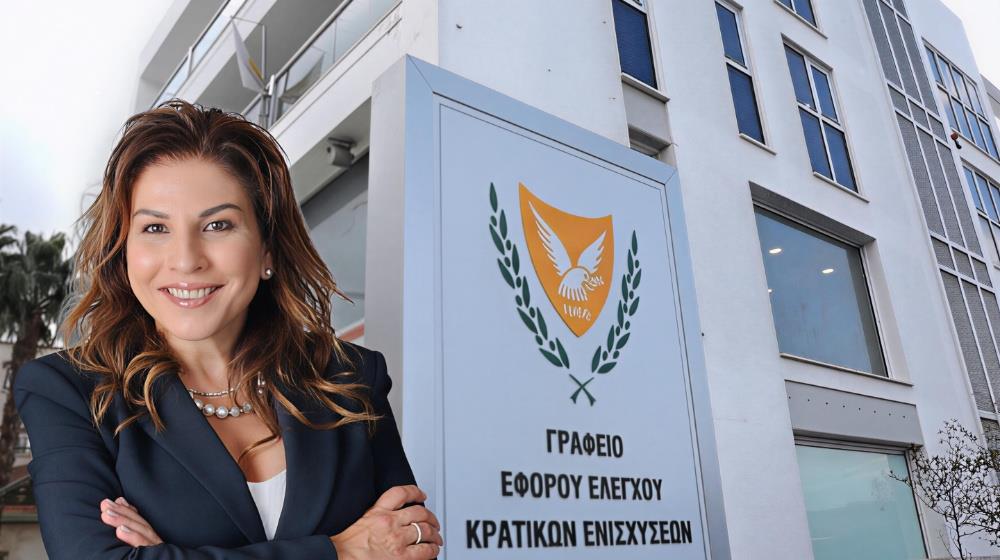
"The private sector undoubtedly has its own charm. However, the position of State Aid Control Commissioner has won me over, mainly because of the value it adds to the development of the Cypriot economy," admits, honestly, State Aid Control Commissioner Stella Michaelidou.
In an interview with InBusinessNews, she describes her vision and speaks about the recognition of the Office's work, as well as the positive response of the European Commission, despite the daily challenges it faces.
At the same time, Michaelidou characterises as "a huge and unprecedented success in the history of the Office" the decision for the construction and the agreement for the use of the Limassol football stadium, known as the AlphaMega Stadium.
Relatively recently, the Office of the State Aid Control Commissioner received praise from the Commission for the implementation of Phase 1 of the Central System of State Aid and De minimis Registries of the Republic of Cyprus. More generally, is there satisfaction from the Commission for state aid issues and the work you are doing?
Upon taking office in 2021, I had set as a personal goal the implementation of Phase A of the De minimis Regulation, through which all competent authorities register de minimis aid in a central, automated register. This is an objective with multiple benefits, both for users and for competent authorities. Automation has brought significant operational cost savings and contributed to a more effective implementation of the De minimis legislation.
The recognition we received from the Commission was a special honour and significant recognition for our Office, as we pioneered and served as an example to be followed. It is indicative that the European Commission urged the member states to proceed, within a set timeframe, with the implementation of Phase A of the Central Registry of State Aid and De Minimis Aid, stating: "Do it like Cyprus".
Beyond this recognition, I would say without reservation that there is a positive response from the European Commission for the progress that has been achieved in recent years in our Office, both in matters of compliance and transparency with the European framework, as well as in matters of organisation, communication and responsiveness.
Of course, there is always room for improvement, as the state aid sector is highly dynamic and constantly evolving. The European Commission's requirements are increasing, responsibilities are being decentralised to the Member States and state aid is being expanded to contribute more effectively to their economies.
Overall, our progress to date demonstrates that we have evolved into a reliable partner at the European level, with a substantial contribution.
What is the role of the Office of the State Aid Control Commissioner during the Presidency of the Council of the European Union?
Our Office chairs the Competition Working Group on State Aid issues during the Cyprus Presidency of the Council of the European Union.
Our participation is of particular importance, as the European Commission attaches increasing importance to the role of state aid, both in ensuring healthy competition between member states and as a tool for implementing development policy.
In this context, our presidency is not just participatory, but substantive, as we actively contribute to policy formulation, the exchange of expertise and the monitoring of developments at the European level.
At the same time, within the framework of the Presidency, we will organise the State Aid Modernisation Working Group in Cyprus on June 9, 2026, with the participation of all member states, where issues of common interest will be discussed.
What was the most important state aid case examined by the Commission to date?
Undoubtedly, it was the decision to build and agree on the use of the Limassol football stadium, known as the AlphaMega Stadium.
It was a huge and unprecedented success in the history of our Office – but especially of the Republic of Cyprus. This decision legally protected the state, strengthened its credibility at the European level and put an end to discussions about illegal state aid.
From the beginning, I believed that there were strong arguments, based on state aid rules, to convince the European Commission. For this reason, I insisted that the Commission should be notified, in order to ensure the necessary legal certainty.
The case was notified in December 2022 by our Office, on behalf of the Cyprus Sports Organisation, with the position that the construction and the agreement to use the stadium constituted state aid, which, however, under specific conditions, could be deemed compatible with the European framework.
We presented the specifics of the case through documented arguments, accompanied by an independent economic study and in-depth analysis. Ultimately, the European Commission concluded in February 2026 that this was compatible state aid.
The process was particularly demanding, as the Commission's questions and requirements were numerous, complex and repetitive, which made the entire examination difficult and time-consuming.
In cases where unauthorised state aid is identified, what is the procedure followed to correct the situation?
In such cases, the remediation process is activated, which is fully aligned with the European Commission framework.
Initially, an assessment of the aid is carried out, and the competent authority is informed, with the aim of either amending the measure to make it compatible with the rules, or immediately terminating it, if it has already been implemented.
In the event that the aid has already been granted and is deemed incompatible, then the principle of recovery may be applied, as provided for by the relevant legislation. That is, the amount is requested to be returned from the beneficiary, in order to restore healthy competition.
How do European regulations and European Commission decisions affect the work of your Office?
European regulations constitute the basic legal framework within which we operate. State aid control is a European competence par excellence, therefore every opinion, decision, approval and compliance procedure of our Office is based on the applicable regulations and the case law formed through the decisions of the European Commission.
At the same time, the Commission's decisions act as guiding precedents, which interpret the rules in practice and determine how they are applied in specific cases. This means that our Office must closely monitor developments, study new legislation and constantly adapt its approach.
In addition, European rules impose specific transparency, notification and control procedures, which directly affect the way we cooperate with national authorities.
Overall, European rules are not just a compliance framework, but the core on which the entire operation and mission of our Office is structured.
What are the main challenges you face today in the operation of your Office?
The Office has been operating since 2001 under approximately the conditions, in a sector that is evolving rapidly and accompanied by increased responsibilities. As a result, institutional, organisational and operational issues arise, the most important of which can be summarised as follows:
I. The staffing of the Office is based on approximately 85% on secondments and interchangeable personnel, which does not allow for the creation of a stable, efficient and specialised team with experience.
II. The absence of a sufficient number of permanent staff and a comprehensive organisational chart makes it difficult to accumulate expertise, as well as the long-term planning and organisation of the Office.
III. The limited knowledge of the officials of the competent authorities in the subject of state aid, due to its highly technical and specialised nature, leads to delays and/or an increased risk of non-compliance. This also implies a greater need for guidance and supervision by our Office. At the same time, the limited knowledge does not allow the utilisation of other more efficient tools and regulations, which could be used as a lever for development in the Cypriot economy.
IV. Although the institution of the State Aid Commissioner is a crucial tool for ensuring healthy competition between member states, investment security and the proper use of public resources, this value that the institution provides to the Republic of Cyprus has not been sufficiently established in its administrative practice and does not receive due recognition.
Addressing the above challenges requires strengthening institutional armour, investing in the specialisation of human resources and cultivating a culture of compliance.
How and to what extent have you added value to the institution of State Aid Control Commissioner to date?
We have cultivated a culture according to which state aid is not an obstacle, but a lever for development. At the same time, we have strengthened the credibility of the institution, reduced operating costs and simplified procedures, emphasising efficiency and investing in knowledge and upgrading the Office's image.
An important step was taken in the field of staffing, with the filling of three permanent positions for the first time since the establishment of the Office - 25 years ago - while at the same time we promoted the release of all permanent positions in the organisational chart.
We invested in technology and in the simplification of procedures, channelling the benefits to the competent authorities, through the implementation of Phase A of the Central Registry of State Aid and De Minimis Aid.
We placed particular emphasis on knowledge and compliance, through training, presentations and circulars, while strengthening our presence and voice at the European level, through our active participation in consultations with the European Commission.
At the same time, we promoted the use of modern tools that allow for the granting of aid in priority sectors of the European Union, with approval at the national level.
We also emphasised our presence in Parliamentary Committees, through documented opinions, while we strengthened the Office's extroversion, both towards society – through the creation of digital media – and towards the business community, through collaborations with the Cyprus Chamber of Commerce & Industry (CCCI) and the Cyprus Employers & Industrialists Federation (OEB).
Additionally, we proceeded with the relocation of the Office to a modern professional space.
Overall, we focused on the institutional strengthening of the Office, its staffing, the further enhancement of expertise and the establishment of a modern culture of compliance, which essentially supports the development of the economy.
Your six-year term at the Office of the State Aid Control Commissioner will end next March. Is there a possibility of renewal or are you considering returning to the private sector? What are your next professional plans?
In my opinion, the goal in everything one does is progress, evolution and development. And not only personal development, but also that of one's team, as well as the progress and development of the institution it represents. Unquestionably, my daily priority is to continue the work we have begun, with the aim of further strengthening and institutionally consolidating our Office.
I believe that when you exceed your expectations and goals, when you work with ethics, dedication and efficiency, and when you contribute productively and beneficially to the whole, life takes you where you belong. And there you carry all your experiences and knowledge with you, but most importantly you carry the professional status you have built along the way.
The private sector undoubtedly has its own charm. However, the position of State Aid Control Commissioner has won me over, mainly because of the value it adds to the development of the Cypriot economy. From the very beginning, my goal was to upgrade and develop the institution, to highlight it, so that it offers substantial benefit to society and to each citizen.
I am grateful for my journey to date and I continue tirelessly, with the same dedication, despite the difficult circumstances, to realise my vision: that state aid rules are not an obstacle, but a lever for growth, a tool for investment security and a factor of trust and stability.
This is a vision that still requires a lot of time to bear fruit and hard, systematic and collective work from a dedicated team in order to be realised.
(Source: InBusinessNews)
