







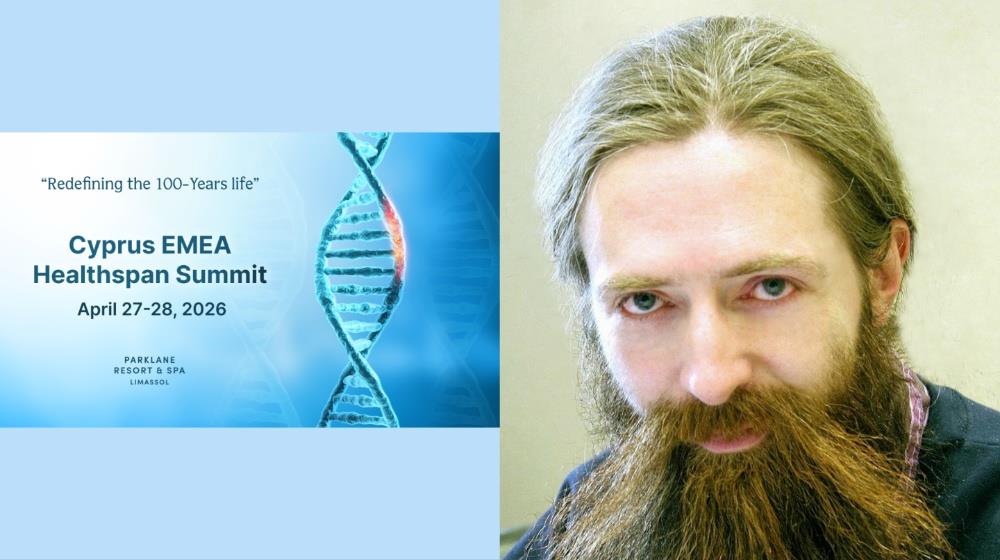
In the landscape of modern biotechnology, few figures are as synonymous with the "Moonshot" as Dr. Aubrey de Grey. Once a lone voice in the halls of Cambridge arguing that aging is a solvable engineering problem, de Grey has lived to see his once-fringe theories become the catalyst for a global longevity economy projected to reach $600 billion by 2027.
As the founder of the LEV Foundation, his "engineering" approach to human biology aims to solve aging not as an inevitability, but as a technical failure.
With billions now flowing into longevity biotechnology and the Cyprus EMEA Healthspan Summit on the horizon, the conversation has shifted from "if" to "when." We sat down with Dr. de Grey to discuss the roadmap to Longevity Escape Velocity, the economic shift from healthcare to "wealth-care," and why the Mediterranean is becoming the new frontier for the world’s most ambitious medical moonshot.
"Aging is the world’s most expensive problem," de Grey argues. "It's time we treated it like one."
Dr. de Grey, a decade ago, LEV was a radical theory. Today, with billions in capital flowing into the sector, it is a boardroom discussion. Where do you believe we are on the "speedometer" toward escape velocity right now?
LEV is defined in terms of how rapidly best-practice human lifespan is increasing, and it’s hardly increasing at all at present. But that’s not actually the right way to be measuring progress, because the medical approach that will get us to LEV is a divide-and-conquer one, with lots of different treatments being administered at the same time, which means we shouldn’t expect to see progress until most of the components are in place. The right way is to look at how rapidly those component medicines are being developed, and that’s speeding up enormously. When combined with the likely impact of mouse lifespan results on the public’s support for the necessary research, it seems at least 50% likely to me that we will reach LEV by 2040.
Governments are currently grappling with the "Silver Tsunami" and collapsing pension models. How does your engineering approach to aging transform an aging population from a systemic liability into a massive economic engine?
Actually, ANY approach to keeping people healthier for longer will be a massive economic engine, as has been documented by various eminent economists in recent years. But for sure, the “preventative maintenance”, damage-repair approach will be even more dramatic in that regard, because preventative medicine is always far less expensive to deliver than chronic treatment. The pensions system will be very different in 20 years, regardless, as a result of the rise of automation and the end of full employment, but we can look forward to a future in which people will be not only far healthier but also far healthier in their 70s and beyond.
You’ve called for a mobilisation of public will to treat aging with the same urgency as a global pandemic. What is the "business case" you make to world leaders to view aging as a manageable technical failure?
There’s a clear humanitarian imperative, and once the public breaks out of its fatalism about aging, there will also be an unstoppable electoral imperative - but both of those will be as nothing compared to the economic imperative. At present, well over 80% of the medical budget of the Western world goes on keeping the elderly alive while they are sick. Even the initial panel of rejuvenation therapies, which will presumably be more expensive to deliver than those that come thereafter, will pay for themselves many times over, really quickly. It will therefore be in the unequivocal national interest to front-load whatever investment is needed to ensure that everyone who is old enough to need these treatments can access them.
Most of Big Pharma is built on the "one drug, one disease" model. Your RMR studies suggest we need a "Swiss Army Knife" approach. Why has the industry been slow to adopt multi-therapy trials, and what do your latest results at LEVF demonstrate?
Multi-component treatments are difficult to interpret and manage, and therefore face much stiffer regulatory hurdles. Even some really obvious examples, such as coadministration of CAR-NK cells with tumour-infiltrating lymphocytes in cancer immunotherapy, are not being adopted. Therefore, the initial requirement is for public opinion, and thence public policy, to undergo a sea change in the direction of this sort of medicine. As things stand, Big Pharma can’t be blamed. Our results at LEVF are not impressive enough to cause that. But they eventually will be!
If you achieve "Robust Mouse Rejuvenation" (doubling the remaining lifespan of middle-aged mice), how do you expect the global capital markets to react the following morning?
It won’t happen with a single announcement. We have the advantage, being an independent non-profit, that we can publicise interim results while the study is ongoing. That means that the expert community will be aware of the way things are going, and will become progressively more excited with each week that passes. As their excitement rises, they will start to say more and more optimistic things on stage and on camera. And that will make their interviewees - which will include major global influencers - start saying more and more optimistic things to their audience. That process will continue over a period of maybe one year, as the mice continue to age and not die, and at some point, there will be statements from people in power - heads of state, people like that. THAT is what the capital markets will react to. Exactly how they will react, well, the share price of companies that have anticipated the end of humanity’s pro-aging trance and have invested appropriately will rise rather sharply...
You recently launched the Rodent Aging Interventions Database (RAID). In an era of AI-driven drug discovery, how critical is open-source, high-quality biological data to de-risking longevity investments?
We’re really proud of RAID. Not much AI was used in generating it in its current form, but it is still immensely useful for researchers who want to know what other researchers have achieved in rodent life extension. And in the future, the same sort of database will exist in a more extensive form thanks to AI.
We’ve seen a shift from "biohacking" to "longevity biotechnology." As a founder, what is the most common mistake VCs make when evaluating a rejuvenation startup in today's market?
I’m probably not the best person to answer that question, since I have always led non-profits - but I’ll answer it anyway! I would say that the single most common mistake is to assume that a rejuvenation startup should be able to hit milestones at the same sort of pace that is typical in tech. Fact is, biotech takes longer than tech, and investors need to be patient.
With the FDA yet to officially recognise aging as a "disease," how are you working to change the regulatory "rules of the game" to allow for preventative rejuvenation therapies?
The FDA cares much less about terminology than most people think. They just care about evidence. When we talk about rejuvenation therapies, we are talking about a clinical endpoint that is inherently multi-faceted, because different people get sick in different ways when they get old - and that’s really hard to formalise as a binary criterion that a treatment either succeeds or fails in achieving. The TAME trial did it, though, and the fact that it was never funded shouldn’t matter: what should matter is that the clinical endpoint can be repurposed for any other trial in the future. But with all that said, we certainly need to modernise the regulatory rules - and that’s happening too. There are special economic zones like Prospera in Honduras, and there are also new laws being passed in various US states, starting with Montana.
There is a growing divide between "prosumer" wellness (supplements) and"deep-tech" rejuvenation (epigenetic reprogramming). Which side of this fence will produce the first trillion-dollar company?
Supplements are inherently, well, supplementary. They will never generate bona fide rejuvenation on their own, whereas reprogramming (together with other damage-repair treatments) will. Supplements will still be important to optimise the damage repair treatments for each individual, but the companies that will lead the way are the damage-repair ones.
Your keynote at the upcoming Cyprus EMEA Healthspan Summit (organised by the St. Moritz Longevity Forum) comes as the region positions itself as a bridge between European biotech and Middle Eastern capital. How do you view the role of regional hubs like Cyprus in bypassing the "regulatory inertia" of the US and UK?
Cyprus has the rare advantage of being geographically at the interface between Europe and the Middle East and also being part of the European Union, in which smaller nations often have disproportionate influence. I will be extremely interested to learn more in April about how it can leverage that advantage in taking biotech generally, and longevity biotech in particular, forward in a manner that helps both Cyprus itself and the wider world.
Do you see the EMEA region as a more fertile ground for the first "LongevityCities" or dedicated clinical zones for the rejuvenation therapies you are currently testing?
The therapies we are currently testing in mice are mostly not ready for clinical trials, let alone actual clinics. However, I view the ecosystem as providing a pipeline from the laboratory to the bedside, and certainly different jurisdictions have different advantages for different steps in that pipeline. Dedicated places like Prospera are ideal for giving early adopters access to experimental therapies that have not yet been approved anywhere. The EMEA region, and indeed other more traditional jurisdictions, are better suited for the high-volume access that is needed thereafter.
A frequent criticism is that longevity will become a "luxury good." How do we ensure that the technologies coming out of the LEV Foundation do not create a permanent biological class divide?
I can’t do better than my answer to question 3. Even in places like the USA where so many things are restricted by ability to pay, the economic imperative to ensure that no one gets sick when they get old will be overwhelming.
If we sit down again in ten years, what does a "standard medical check-up" look like for a 60-year-old in a world that has embraced your philosophy?
If my predicted timeframes come to pass, ten years from now we will be in the middle of the “real war on aging”. We won’t have fully comprehensive rejuvenation yet, but everything we do will be geared towards hastening its arrival and maximising the number of people who benefit. A lot of that, especially because of advances in both detection and analysis of individual aspects of biological age, will come down to check-ups - but from the point of view of the patient, it will probably not be much different from today, at least from today’s more high-end check-ups. What will be different is what is done about it. For example, it’s quite possible that in 2036 we will have anti-cancer immunotherapies similar to today’s CAR-T cells, but which can be manufactured in weeks to match a cancer that has been detected from just a few circulating cells.
Dr. Aubrey de Grey will be delivering his keynote address at the Cyprus EMEA Healthspan Summit this April at Parklane, a Luxury Collection Resort & Spa, Limassol. Organised by the St. Moritz Longevity Forum in partnership with the MHV Group- and supported by DIAS Group as the official media partner-the summit represents a landmark gathering of the region's scientific and financial elite.
For registration and summit information, visit stmoritzlongevityforum.ch. To learn more about the work being done at the LEV Foundation, visit levf.org.
