






Recently, the historic Laiko Group underwent a reorganisation following a ten-year process of consolidation. It reunited all its activities under the now healthy old group and became one of the largest corporate entities in Cyprus in its sector with 325 employees and a turnover of over €120 million.
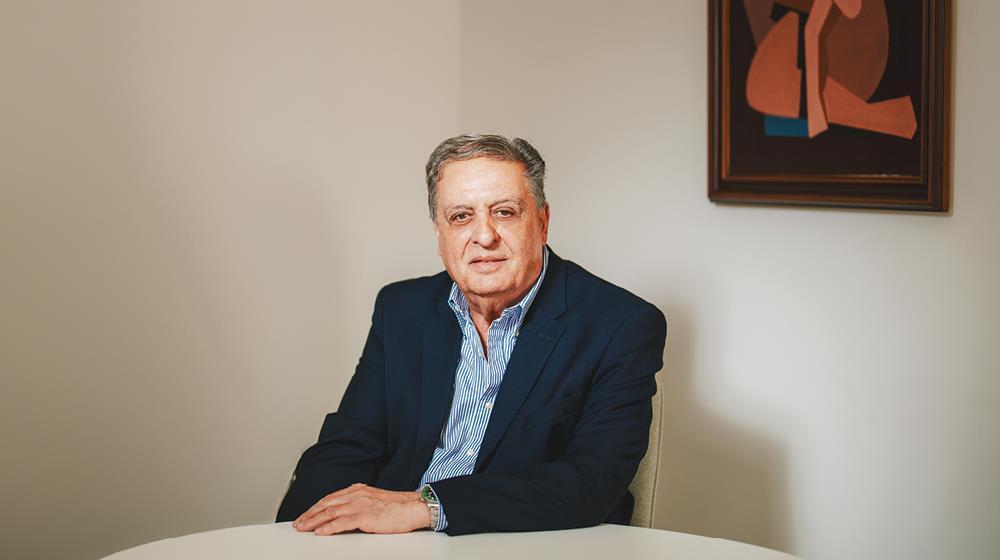
Expressing optimism about what the new day brings, executive chairman Minos Charalambous welcomes us to his office, treats us to Laiko coffee and, in a rare interview, talks to us about the great achievement, which he attributes to the people of the Group “who stood on the front line and kept it standing when this was not a given”.
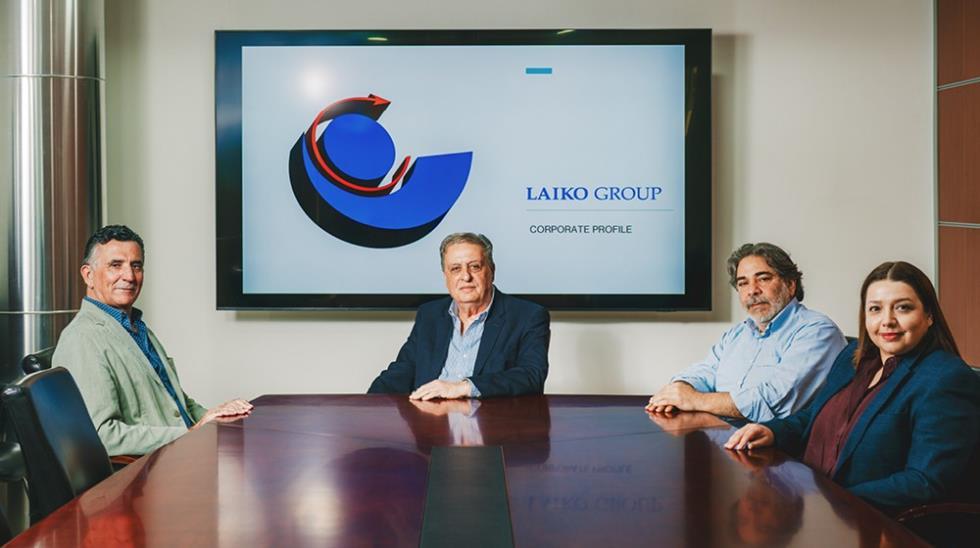
In April, a meeting was arranged with Minos Charalambous at the Group's headquarters, which are housed in its distribution centre in Dali. We had already spoken a few days before to arrange an interview after a photo shoot. The occasion was the reorganisation of the Laiko Group, which was ratified in March 2026, officially introducing the historic group into a new era of growth and profitability, following the difficult years.
Besides, Charalambous is considered in market circles as one of the most experienced executives in the reorganisation and redesign of businesses and organisations and the mastermind behind that of Laiko, although he will not accept the credit himself, attributing it to both the organisation's staff and its management team, which he introduced to us immediately upon our arrival there and before our conversation began. "In 2010, I took over as non-executive chairman of the Laiko Group with the aim of contributing to its return to profitability and to help restructure its banking obligations," he describes, to slowly reach 2016, the year in which the restructuring was completed and he himself took over as executive chairman, a position he holds to this day.
Mr. Charalambous, a general meeting was recently held to ratify the reorganisation plan of the Laiko Group. But when did the process begin and how did we get to where we are today?
To start from the beginning, in 2016, when the agreement was made to restructure the group's bank liabilities, there was a condition from the banks that the sustainable activities and loans that the group would undertake be transferred to a new clean group. Thus, Laiko Holdings Public was created. Some activities were transferred to the new group and some, due to practical difficulties, remained in the old group, Laiko Kafekopteio Public.
The two groups operated for ten years. Didn't that create problems?
The corporate structure was complex and operating costs were high. In addition, the existence of two separate groups made it complicated to implement our decision to start paying a dividend after 20 years.
The group, over the last ten years, has followed a dynamic growth path, achieving high levels of profitability, significantly strengthening its financial position, while at the same time proceeding with a substantial reduction in its borrowing.
Today, after complete financial consolidation, the reasons that led to the maintenance of two separate corporate structures, Laiko Holdings Public and Laiko Kafekopteio Public, no longer exist.
What does this mean on a practical level?
Through the reorganisation plan, all activities are reunited under the old group, as it was before 2016. This development, in addition to simplifying the corporate structure and reducing operating expenses, is anticipated to significantly facilitate the future distribution of dividends, as their payment will be made directly by a single parent company, Laikon Kafekopteion Public.
What were the changes for shareholders and staff?
The shareholders of Laiko Holdings Public will receive shares of equivalent value in Laikon Kafekopteion Public, which will now be the parent company after the completion of the reorganisation, while Laiko Holdings Public will be absorbed through a merger. Through the new, unified structure, the value of the shareholders' investment is ensured, while at the same time they gain a clearer and more comprehensive picture of the financial results and the course of the group. As for the personnel and commercial activities of the group, they are not affected in any way, since this is a purely administrative and corporate change.
Difficult and labourious designs
In 2016, Laiko Group agreed and implemented a restructuring with the banks. The financial consolidation you have achieved over the last ten years is described by many as a great achievement. How did you manage it?
This success did not come about by chance. It was the result of difficult and painstaking planning and decisions by the management, under the decisive leadership of our CEO Michael Parides, as well as disciplined execution by the management. Above all, however, it was an achievement of our people, who stood at the forefront of this effort and kept the Group afloat, when this was not a given.
It is important that management and employees worked together for the common goal. Their contribution was decisive and I personally recognise it with sincere appreciation and respect. You know, I could talk for hours about the way our obligations with eight different banks were restructured and how the negative course of the Group was reversed. I will limit myself, however, by saying that this achievement was the result of the quality, dedication and skills of the people I had by my side. That is why I am very optimistic about the future of the group.
How much importance does the Group place on technological upgrading and modernisation of its production units?
We attach great importance to the technological upgrade of our production units, as it is a key pillar for ensuring the quality of our products, for improving working conditions and productivity.
From 2018 to date, Laiko Group has made investments that exceed a total of €10 million, confirming its strategic commitment to growth and modernisation.
New possibilities in LOEL and Laiko Kafekopteio
Can you tell us about LOEL's new winery and the investments in technological and other upgrades?
The construction of a state-of-the-art winery for the needs of LOEL was recently completed, while the Zivania distillery and bottling facilities were fully upgraded. It is worth noting that the new winery cost approximately €5.5 million and is among the largest and most modern in Cyprus. It has advanced equipment with the capacity to receive up to six million kilos of grapes.
Significant investments were also made at the Laiko Kafekopteio Plant, specifically in the production of coffee and snacks. What did these include?
In coffee production, the production line was almost completely renewed with state-of-the-art machinery and with emphasis on the roaster, which is the heart of coffee production, as well as on the Laiko Gold packaging line. At the same time, a new capsule production machine of the innovative coffee system (Laiko-Raqwa) was installed, now allowing the production of Cypriot coffee in capsules from our factory. The total cost of these investments amounted to approximately €2 million. As for the snack and confectionery production factory, it was completely upgraded with investments exceeding €1 million in both production and packaging equipment and electromechanical installations.
Employees are essential stakeholders
In November 2025, Laiko Group was certified as a Great Place to Work. What practices did you follow to achieve this?
This certification did not come easily. It is the result of targeted actions taken in recent years, which strengthened communication, participation and the cohesion of the staff.
In terms of communication, regular meetings between the CEO and middle management and staff were established, as well as more frequent contact between managers and their teams. At the same time, the HR department strengthened its presence through briefings and on-site visits, while the adoption of complaint and suggestion boxes gave employees a meaningful voice.
How was active staff participation achieved?
Staff participation was further strengthened through their involvement in new product development teams and in the decision-making process for changes in production and improvement of the working environment. The cultivation of team spirit was strengthened through socialisation actions, such as corporate events, meetings and joint activities. In addition, initiatives such as the group newsletter contributed to transparency and the dissemination of information. Finally, the provision of bonuses based on the achievement of goals, the full reinstatement of the 14th salary as well as the practical support of staff in cases of serious illnesses and difficult family situations, have strengthened their loyalty and appreciation for the group.
What is your vision for the Group from now on?
The creation of a modern and diverse business organisation, which will not focus exclusively on profit and the interests of shareholders, but will place equal emphasis on employees.
I believe in a model where employees are not just executives, but essential participants in success. For this reason, my goal is to give them the opportunity to participate in the equity capital, so that they share part of the profit and value that they themselves help to create.
Do such strategies benefit the sustainability of businesses?
I firmly believe that businesses that operate with these principles are not only sustainable, but can be highly competitive and profitable. I want Laiko Group to be a living example for Cypriot business, that you can succeed, grow and create profit and value for shareholders, without losing sight of the human being.
The story behind the Group
What story has the Group followed towards the formation of its current profile and which companies are under its umbrella?
The Laiko Group has its roots in the middle of the last century, when the three companies that later formed the Laiko Group were founded, namely, LOEL, Laiko Kafekopteio and Printco Printing. In 2002, these companies merged, creating the Laiko Group, with the aim of reducing operating costs, mainly those of distribution. Since then, it has gone through various stages, leaving behind very difficult years and overcoming several difficulties, to today become an organisation that produces some of the best-selling Cypriot products, such as Laiko coffee and LOEL's zivania. It employs 325 people, has a total turnover of over €120 million and is made up of four main companies:
- Laiko Kafekopteio founded in 1948 and today the most recognised coffee producer in Cyprus, with the traditional Laiko coffee, the ready-to-drink El Café coffee and the Luno espresso-style coffees. It also produces the well-known Giants, Unicorns and Estella snacks and Jolly and Bye-Bye confectionery.
- LOEL, founded in 1943, with its main product being LOEL Zivania, which is undoubtedly a trademark of the Cypriot distillery. In addition to Zivania, LOEL is also known for its quality Commandaria, Alasia, as well as for a variety of wines, the most famous of which are the Evampelos Ghi and Morfes series, made mainly from local grape varieties.
- The third company is Masterstar, known in the Cypriot market for the marketing of Gree air conditioners, with a wide range of air conditioning products for domestic, commercial and industrial use. The company holds a significant share in its category.
- A defining moment for the entire Laiko Group structure was the creation of LaikoCosmos in 2012. This company is the result of the merger of the activities of Omilos Laikou Distributors and COSMOS TRADING, two of the oldest and most established companies distributing local and imported products. After the merger, LaikoCosmos, in which the Laiko Group holds a 50% share capital, followed a very impressive growth path. It has even managed to establish itself as one of the leading distribution companies in the country, with a rich portfolio of recognised food and beverage brands. These brands are supported by a dynamic and highly qualified team, led by our General Manager George Tsakistos, whose guidance has been crucial to the company's success.
Minos Charalambous
He is a graduate of the English School, studied economics at the University of Essex and then worked for four years in an audit firm in London, obtaining the title of chartered accountant. Returning to Cyprus, he served as a partner at the Audit Office of Grigoriou & Co. for 10 years and then at the Audit Office of Charalambous & Fotiadis for another six. From 2000 to 2020, he was the executive vice president of the public company Mallouppas & Papacostas (now Mallouppas Group), in which he continues to be a consultant and non-executive vice president of the board of directors. In 2010, he assumed the duties of non-executive chairman of the Laiko Group, with the aim of contributing to reversing its negative course. In 2016, after the completion of the restructuring of Laiko's banking liabilities, he assumed the position of executive chairman, a position he holds to this day. Furthermore, during his career, he participated as a non-executive member in various boards, such as the Commission for the Protection of Competition, Cyprus Airways and Cyprus Oil Refineries.
This interview first appeared, in Greek, in the May 2026 edition of IN Business magazine. Click here to view it.
